

‘A truly massive scale’: How Rock-It helped deliver the FIFA World Cup for the federation, broadcasters and beyond
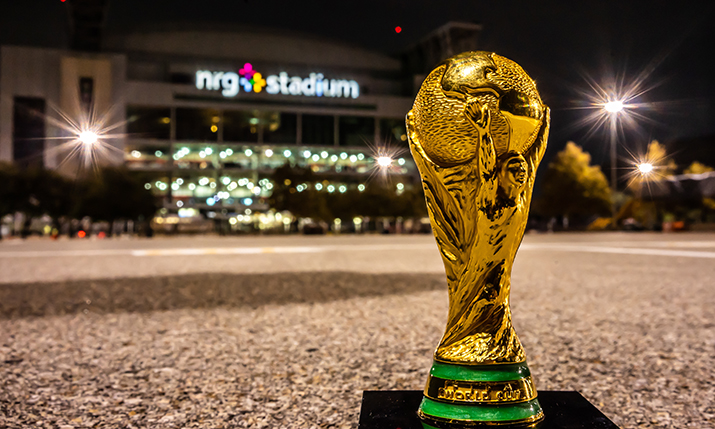
Given the numbers involved, we’ve almost become immune to being impressed by the sheer scale of this year’s FIFA World Cup. Forty-eight teams, three countries, 16 stadiums, 150 broadcasters, and record viewership and digital reach all help to support the organiser’s claim that it was the biggest sporting event in history.
But how did all of this actually come together? How did all the broadcast equipment, team kits, balls, uniforms, brand activations and so much more end up at the right venue at the right time? That’s where Rock-It Cargo, the Official Logistics Provider of the FIFA World Cup, comes in.
Angus Brown, SVP of marketing and partnerships at Rock-It, says: “I think what’s really unique about our partnership with FIFA and this tournament in particular, is just the sheer scale and size of the tournament. It’s a 63% increase in the number of matches, and it’s a 220% increase from 2022 in terms of the number of host cities. So this is a truly massive scale.”
For FIFA and HBS, a key part of Rock-It’s role was moving equipment across borders, often at short notice.
“We worked alongside HBS on a plan that basically required a lot of movements in between countries, really fast movements,” Brandon Boles, senior commercial director at Rock-It, explains. “Some of it was hand carries, a lot of ATA carnets. Everything was based out of nucleus Dallas IBC hub, but we brought everything in via ocean and air. We got it into Dallas, and then we started sending kits to every location, and then supplemental kits and last-minute things would pretty much be coordinated out of that IBC. We had a very strong team at our IBC.”
Rock-It’s role also evolved during the course of preparations, with its skills being in demand by everyone from event sponsors and teams to broadcasters and production companies.
“Our role as the logistic service provider primarily is to service FIFA. So our job is to make sure that FIFA’s tournament operations are handled properly. That could be uniforms for FIFA staff, it could be signage, it could be the actual infrastructure of the event, the goals, the balls, flags, anything that just happens to be in that arena. That goal in itself is truly massive, but what gets really interesting is that we had to bring out warehousing, trucking strategies, ocean and air freight strategies, on-site logistics teams. We had to bring all this whole massive team and strategy to facilitate FIFA’s needs. And it became evident that we could leverage that platform for all of the other participating members that are also involved with the tournament.”
This included working “for many, if not the majority” of broadcasters, he adds.
“We helped move all of their operations around, leveraging that same system and platform that we had in place for FIFA. We could go to the broadcasters and say, ‘Hey, we already have trucks going to that venue. We already have teams on the ground. We already have warehousing that’s in close proximity for last-mile deliveries. We can leverage all of that for the broadcast team’. So we helped a lot of the broadcasters.”
Boles adds: “Some of the broadcasters had their own partners, of course. A lot of them were coming in from other countries, but we tried to partner with their partners and make it streamlined. While we were on the ground, we were an integral part of the IBC. So anyone that needed anything, whether they’re a direct client of ours or not, they would come see us. We’d work out a plan for them, and we’d make it happen. We managed all the broadcast compounds in and out.”
While working across three countries was certainly a challenge, navigating so many different venues in the US also wasn’t without its difficulties.
Brown explains: “The cities are very different – think about Seattle versus Kansas City. The Seattle venue is in the core of the downtown, so there’s no parking outside the venue, there’s loading docks, but it’s tight and it’s in a busy street in the metropolitan area. Then Kansas City is about 45 minutes outside of town. It’s in the middle of nowhere with these massive parking lots. So each of the 16 venues has a very different structure, access points, security needs, parking needs, accreditation strategy, and so we really had to build out a plan for every single one of them. We had different leads for different countries too. We had a whole Canada team, a whole Mexico team. We were moving gear in and out of those borders, so there’s a whole carnet and customs strategy that goes with that to make sure that we’re tracking every single piece of equipment as it moves across the border and comes back.”
Insider knowledge and experience helped here too. “You can get goods into Canada very quickly if you’ve set up the right structures and have a proper importer, and all of this stuff is the hard work that we did on the front end, trying to get all of our clients set up in Canada to import goods on their behalf, because FIFA can’t just open the books and say everybody can import under us,” adds Boles. “So for all of our sub-vendors, basically, we did the hard work early. Mexico is completely different. From a customs standpoint, it’s very much like operating anywhere else in Latin America, where they have very strict trade rules and importation rules. And it takes time. It’s not like moving from Miami to New York. There’s a border and there’s customs regs. I think we did a pretty good job of managing that in Canada and Mexico, but it was absolutely challenging to say the least.”
Given that Rock-It had other projects on the go at the same time as the World Cup, staffing also had to be carefully considered.
“It takes a lot of coordination with a couple of really trusted and experienced staffing agencies that we had to rely on,” says Brown. “Rock-It has about 1,200 employees globally. But even if we dedicated every single Rock-It employee to this project, we still would not have had enough bodies, and so we relied on some third parties that are just great in the regions, that know the venues in Mexico really well, drivers that are experienced in those areas, on-site staff that either can speak the language, understand the culture, are experienced in their craft. It was really about getting the experts together regionally to support that 16-city network of staff needed.”
Boles is also keen to point out that the project proved useful in bringing in new team members too.
“We were able to bring in a lot of young talent to our organisation in preparation. We were able to scale up these new individuals, these young individuals, into our company, and it’s fantastic seeing that we’ve got some bench strength now for years to come.”
While sports and live events look set to continue to be key sectors for Rock-It, it’s clear that successfully delivering an event on the scale of the FIFA World Cup has created new opportunities too.
“With FIFA, there was also an element of new things that we got to learn how to do and we brought in some talented people from other industries. For instance, workforce at stadiums, that’s not something we typically would do, or material handling equipment – forklifts, golf carts, things like that – we really didn’t play in that space much. This has allowed us to actually take the blinders off. Historically we’ve done broadcast equipment in, broadcast equipment out. We’ve worked with teams, but all of the supporting stuff around a venue, the forklifts, the furniture, it’s opened our eyes that there’s a lot more for us to go out and attack, and that’s going to be our go forward.”
Crédito: Link de origem