A-Trophy of Faith: Brazil’s Catholics Despair Over the Changing Religion of Its Failing Soccer Team
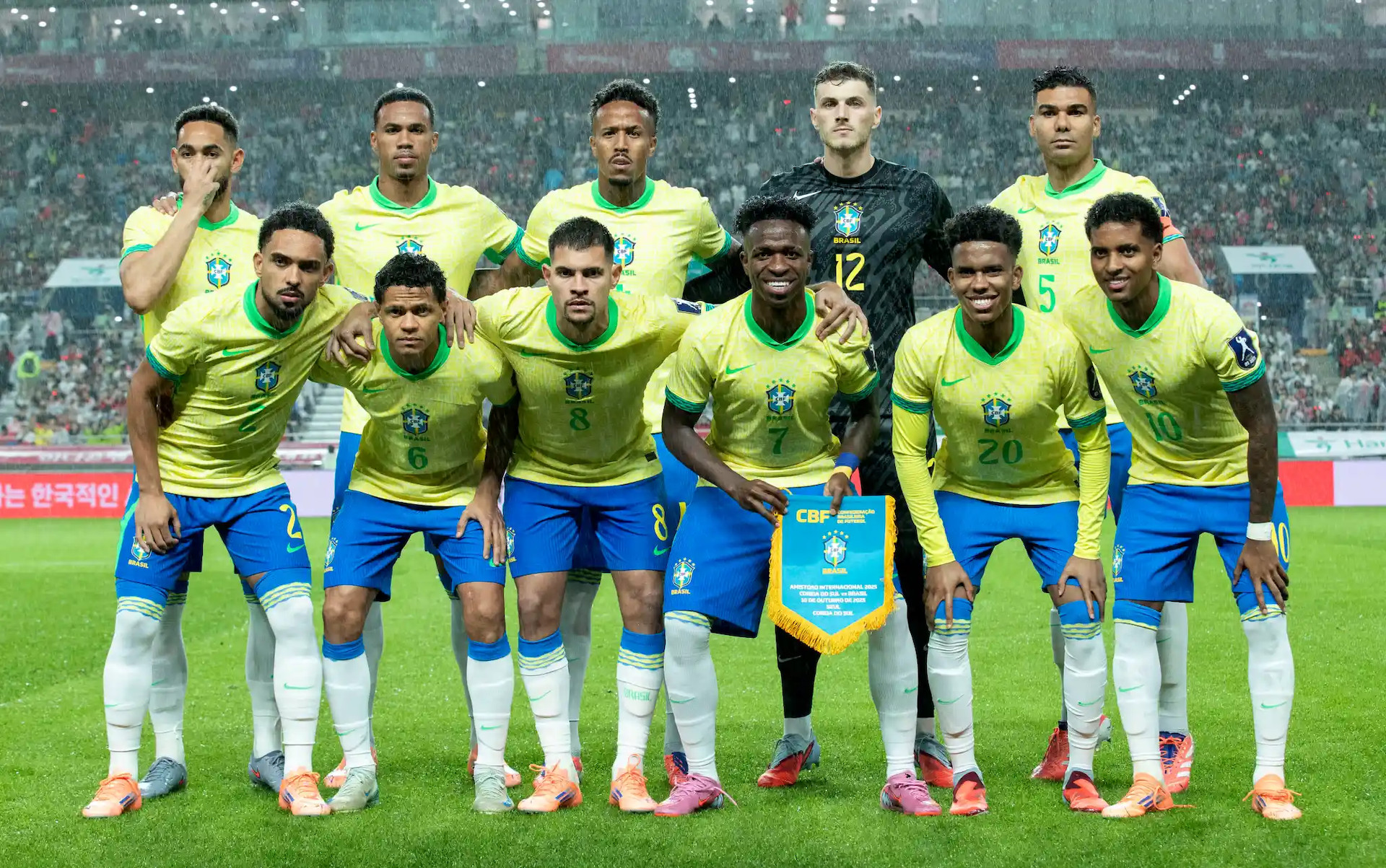
Does being a Catholic country give you a noticeable on-field advantage when it comes to winning the FIFA soccer World Cup? The data suggests this might be so.
Only eight nations have ever won the tournament, six of which are Catholic-majority: Brazil (five wins), Italy (four wins), Argentina (three wins), Uruguay (two wins), and France (two wins). By comparison, only two Protestant-majority nations have ever lifted the trophy, Germany (four wins) and England (one win)—although both of those will probably soon be Muslim countries anyway.
Brazil may be the most successful nation in World Cup history, but they certainly won’t be winning the Cup in the USA in 2026; they were knocked out by lowly Norway in their round-of-16 match on July 5, their earliest elimination from the contest since 1990.
How to explain this latest form of sporting ‘Brexit’? Back home in Brazil, sporting pundits have developed a strange theory: the decline in the dominance of the national team mirrors the decline in the domestic dominance of Catholicism.
The God Squad
Brazil is still a majority Catholic nation, though this status, something most people across the globe have blithely presumed to be eternal, may not last beyond the mid-point of our present century. Unlike what’s happening in France, England and Germany, at least the new religion pushing the old one out is not Islam, but a rival form of Christianity: various sects of Evangelical Protestantism like Pentecostalism.
The figures are stark. In the 1940s, 99% of Brazilians were Catholics, a legacy of the country’s colonization by the Catholic Portuguese in the sixteenth century. As of the 2022 Brazilian census of religion, only 56.7% of the population were Catholic, with 26.9% of citizens classed as evangelicals. This equates to 100.2 million Catholics, versus 47.4 million evangelicals. So, Catholics still outnumber evangelicals by a rough ratio of 2:1, but the trend is clear: the Roman religion is in severe decline, and the non-Roman one enjoys vast growth.
Optimists might point to the slowing down of Protestantism’s bloom since the previous Brazilian census in 2010, the religion’s growth rate having fallen to 5.2% from 6.5%. According to the census’s in-house demographer, José Eustáquio Diniz Alves, this represents only a temporary stay of execution, however: previously, Alves had forecast Brazilian Catholics would be replaced as the main religious majority by 2032. Now, thanks to the slight slowdown, this seems likely to happen in 2049 instead. Tellingly, Alves chose to illustrate this with a soccer metaphor, referring to Brazil’s worst ever World Cup defeat, 7-1 in a semi-final game against Germany in 2014. “According to my previous projection, the Catholic Church would lose 7-1, by a landslide. And it turned out that the Catholic Church [only] lost 1-0.”
But a narrow defeat is still a narrow defeat, as the Brazilians found out when crashing out 2-1 to Norway earlier this month, a sporting loss which some disappointed Brazilians tried to link to the loss of the nation’s traditional faith.
The greatest Brazilian teams of the past, from the 1950s to the 1970s, which featured such all-time great players as Pele, Garrincha, Jairzinho, and others, played with a joyously chaotic attacking style, which was a feast for the eyes, and their players and coaches were almost all Catholic.
Fast-forward to World Cup 2026 and, from a squad of 26 players, 20 were known to be evangelicals. You can’t necessarily assume the other six were Catholics. One previous Brazilian World Cup player was Alan Kardec, named after the founder of a bizarre religious offshoot of Spiritualism called Spiritism, which centers upon the cult’s priests contacting the spirits of the dead. Perhaps when Kardec wasn’t picked for the 2026 squad, he just put a curse on them?
From Te Deum To Tedium
Older Brazilians, who are more likely to be Catholic, sought to pin the blame for the defeat to Norway on the new, growing, replacement religion of Evangelicalism, which they see as an unassimilable artificial import from North America.
During the Cold War, the CIA and other similar bodies, alarmed by the growth of pseudo-Catholic far-Left Liberation Theology across Latin America, which Washington viewed as a mere front for Communism, fought the trend by seeding creeds like Pentecostalism throughout the region by funding evangelical US missionaries to begin proselytizing there. The program worked, and, long after the Cold War ended, the theological effects remained: well-funded, foreign, non-Catholic Churches continued winning new converts.
But the imported white American Protestant mentality, with its alleged emphasis on sociologist Max Weber’s fabled “Protestant work ethic,” was deemed by many skeptics to be inherently antithetical to the more relaxed non-white Catholic mentality of Old Brazil, a conflict which now finds itself embodied and reflected within sport.
The last time Brazil won the World Cup in 2002, the nation was still about 80% Catholic and some of its players were still notably free-spirited, even occasionally slightly overweight and out of shape. That team’s coach, Luis Felipe Scolari, was a devout Catholic who placed statues of Our Lady of Fatima in the dressing room before games to bless the team.
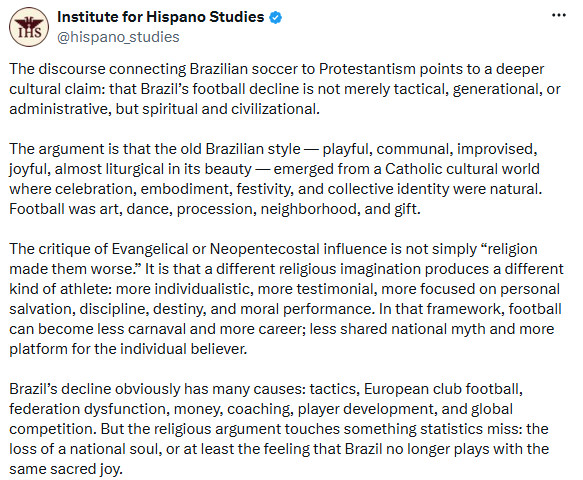
In the years since 2002, argued some critics after Brazil’s embarrassing 2026 exit to little Norway, the teams became too “professional” and stereotypically Anglo-Saxon Protestant, ruining their entire playing style according to one X account: “[E]vangelical Protestant sterilization has flattened their ball, ruined their samba and obliterated their swag[ger].”
Some contend that today’s Protestants are less happy for their children to “waste” their days playing street-soccer barefoot in shanty-towns, the very environment where poor Catholic players of the past honed their outrageous ball-skills, preferring to have their offspring stay away from ‘dirty’ lower-class Catholics, and work hard in self-improving spheres like education instead.
Although still of relatively high quality, Brazil’s national soccer team today is a boring, tedious shadow of its former self, adopting a more regimented, regulated and defensive style of play compared to the glory days of old, when most of its players were still Catholic. As such, pro-Catholic memes like the one below, showing Catholic past World Cup and Champions League winners like Pele, Ronaldo and Kaka meeting Popes or wearing vests blazoned with “I BELONG TO JESUS,” were contrasted with an image of the team’s present star striker Neymar, a well-known evangelical (whose former Muslim-owned club side once allegedly paid him 500,000 euros per month to “shut up about Jesus”) crying after again failing to win the trophy.
The slogan “Pray like a gringo, play like a gringo” has gone viral, with striker Endrick, who missed a particularly crucial chance of scoring a goal during the recent loss to Norway, being criticized for saying he thanked God for the spurned opportunity to have ever scored it in the first place, even in spite of his miss. This was interpreted by some critics, like soccer journalist Pedro Rosano, as being typical of the unacceptably passive mindset of some evangelicals. “The evangelical mindset is too conformist and permissive,” Rosano complained, “they outsource everything to God, and take responsibility for nothing.”
Academics are now studying such notions, with a conspiracy theory even arising that Protestant churches secretly pick the national team squads for the manager to stuff them with fellow co-religionists!
Game Theory
Overall, however, the hypothesis that Brazil left the World Cup earlier this year because of the low number of Catholics on the team is not particularly plausible.
The poor performance probably has more to do with most Brazilian players now being identified as talents very young, then transferred to Europe whilst still teenagers, where professional coaches train all the characteristic 1970s-style South American flair out of them in favor of making them fit into more inflexible and less creative European systems of play.
Anxieties about the national team becoming less Catholic, and therefore less traditionally Brazilian, are really just projections of anxieties about changes which are being imposed upon the wider soul of the nation off the pitch, the soccer team simply being a convenient, highly visible proxy for these. Brazil, like the rest of the planet, is being systematically homogenized and deracinated by globalists.
As national soccer teams tend to be full of young people—even Cristiano Ronaldo looks as if he’s going to have to bow out as an immobile near-cripple now he’s pushed past 40—they represent a likely sneak-preview snapshot of what the demographics of the nation will look like in 30 years. What’s happening to Catholics in Brazil mirrors very closely what’s happening to white people, and Christians in general, all across the West, in terms of the ongoing Great Replacement.
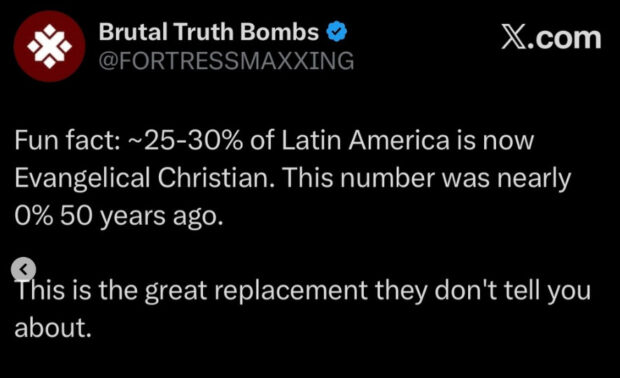
The parallels are very close. By mid-century, Catholics within the previously 99% Catholic Brazil will be reduced down to merely being the largest amongst a cacophonous group of other competing minority religions, none of whom will be able to claim over 50% of the population’s allegiance. That is precisely what is due to happen with the US’s whites in the formerly more than 90% white Christian nation, too, by the mid-point of this century, and it will be the same with whites all across Europe in the next few decades as well.
Sports like soccer allow viewers the chance to see a preview of such outcomes a generation or two early. Just look at the present French World Cup team, where nine or ten of the eleven players in the regular starting line-up tend to be black, a substantial number of them Muslims.
Any negative or nervous discussion of such facts is essentially deemed verboten, which is why, online, those concerned Brazilians criticizing the team for its insufficiently Catholic make-up are loudly condemned as morons, bigots or “corny-ass Catholics” by those anti-conservative political forces who welcome endless social change and the systematic dismantling of traditional ways of life, whether religious or ethnic in nature. Yet those who observe the radically altered demographics of contemporary soccer teams and rejoice in the Great Replacement they so clearly foreshadow are happily indulged by the gloating Left-wing media and political class.
Population Substitution
Another team still in the World Cup right now (at time of writing, anyway; they normally go out on penalty-kicks in the semi-final) is England, who have not won the tournament since as far back as 1966.
The squad back then was still 100% white Christian, but anyone making a tweet pointing this fact out would immediately be condemned as racist. Yet, when it comes to the present-day squad which, like France’s, is mainly of mixed-race or non-white immigrant stock, the Left-wing environmental campaign group Greenpeace UK can quite happily put out a tweet like this, without any fear of censure whatsoever:
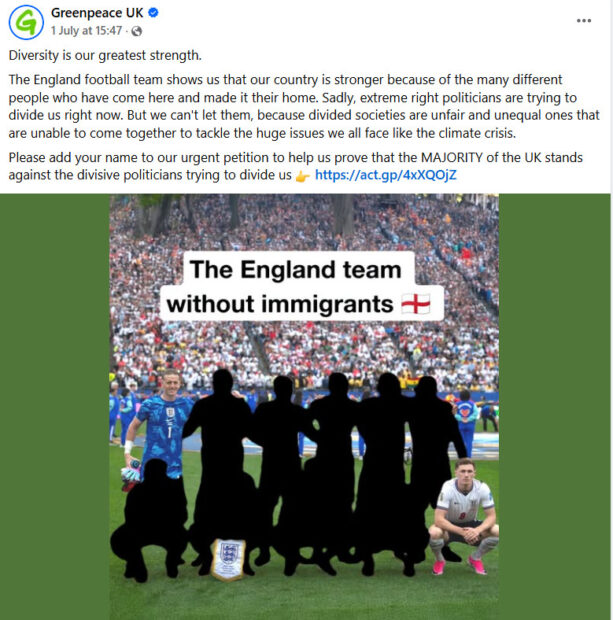
Shouldn’t Greenpeace be in favour of endangered species? Not if they’re white men. Not if they’re Christians, either. Prior to an earlier game in the tournament, against Ghana, Britain’s national broadcaster, the BBC, seemed to think the most noteworthy thing about the game was that one of the England players due to be picked was a Muslim:
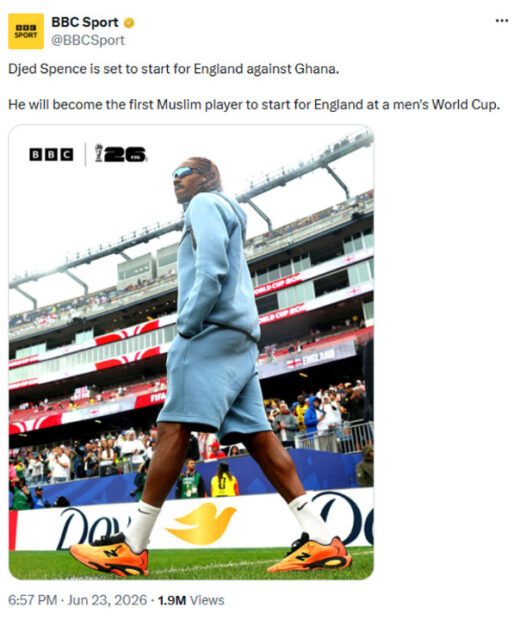
Anyone who wants more Catholics in the Brazil national team is an irredeemably evil bigot. Anyone who wants more Muslims in the England national team is a highly moral anti-racist.
An op-ed in Britain’s leading Left-wing broadsheet The Guardian, “Here’s the lesson to learn from England’s World Cup joy: shared purpose is key, not shared ancestry,” gave a taste of the kind of allegedly ‘improving’ propaganda lessons gullible World Cup viewers were intended to absorb.
A key question facing Britain today is: who is fully part of the country?…[The 2026 England] team embody and celebrate the very diverse England of today, with [white] Harry Kane wearing the captain’s armband, [mixed-race] Jude Bellingham dictating the midfield, and [black Nigerian] Bukayo Saka stretching defenses with fearless pace. During the match, nobody was asking where these footballers’ grandparents had been born. They were simply willing this English team to win…
The football team that qualified for the World Cup offered one compelling version of England’s contemporary story, drawing on talent from every corner of an England that has been shaped by decades of immigration…The strongest national identities are those that continually adapt who belongs within a national story…
At a time when politicians, pundits and some tech billionaires [i.e., Elon Musk] increasingly invite us to see Britain as irreparably divided, England’s football team offered a different vision: confident, ambitious and united by shared purpose rather than shared ancestry. That vision alone will not solve Britain’s economic problems or repair its frayed public services. But it can remind us that good government ultimately depends upon the stories citizens tell themselves about who “we” are. After Monday’s game, millions of people briefly inhabited the same story. Britain’s challenge now is to write one that lasts longer than 90 minutes.
Yes, because, once those 90 minutes of game-time are over and the final whistle blows, the population of England might begin to remember the existence of a few slightly more important things going on across the nation than some stupid soccer match, such as the ongoing Pakistani rape-gang scandal, or the horrendous, anti-white, race-based murder of Henry Nowak. It is all too easy to read too much of political and sociological significance into sporting occasions.
Perhaps Brazil’s Catholics are indeed guilty of doing this at times. But if so, can their globalist opponents on the internationalist Left please have the good grace to stop doing the same thing themselves here too? As with every political football, there are two sides to this particular game.