

A Look Inside Van Cleef & Arpels’ Fascinating Egypt Collection
By Renee Batchelor – published
The scene: the Louvre at the height of summer. The crowd: thousands of people from all over Europe and beyond. The department: the Egyptian antiquities section with over 50,000 artefacts including the Great Sphinx of Tanis, as well as countless pieces of jewellery, pottery and even gaming boards.
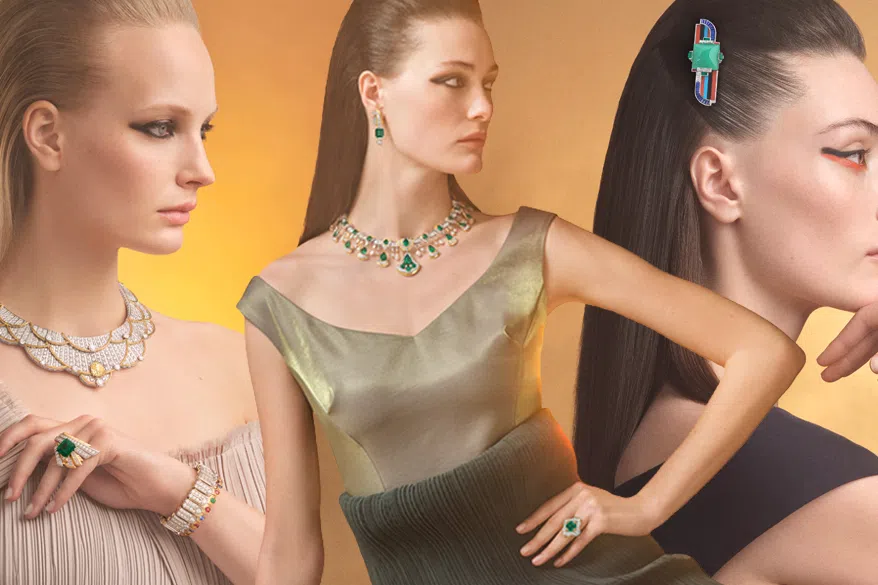
We were there to catch a glimpse of what life in ancient Egypt was like, and with good reason. The following day, we would be among the first in the world to witness the unveiling of Van Cleef & Arpels newest high jewellery collection, Fascinating Egypt, which pays tribute to the glorious spiritual and decorative symbols and motifs of Egypt in glittering, bejewelled detail.
Related article: Poetry In Motion: Van Cleef & Arpels’ Ballet Précieux Clips Are Inspired By Iconic Ballets
An illustration of Maat by Leon-Jean-Joseph Dubois from the Le Pantheon egyptien
Photo: Courtesy of Van Cleef & Arpels
To understand the Western world’s continuing fascination with Egypt, one has to appreciate the waves of Egyptomania that have hit the globe at various time periods in history—from Napoleon’s invasion of Egypt in 1798, to Jean-François Champollion’s cracking the code of hieroglyphics in 1822, to the more recent unearthing of King Tutankhamun’s tomb in 1922.
Along with each discovery came renewed interest and appreciation for its undeniable beauty. Says Catherine Rénier, CEO of Van Cleef & Arpels. “That’s the beauty of Egypt, and the reason why it has inspired artistic expression for so long. It’s a very rich, spiritual and colourful culture.”
Ancient Symbols
In jewellery, the Egyptian Revival has similarly seen its waves of popularity coinciding with these historical discoveries: with motifs like the scarabs, ankhs and lotus flowers featuring heavily in jewellery. For a historical maison like Van Cleef & Arpels, which boasts a 130-year history, this was a chance to revisit these symbols, designs and stones in a way that pays tribute to its rich source material, while still being relevant for 2026.
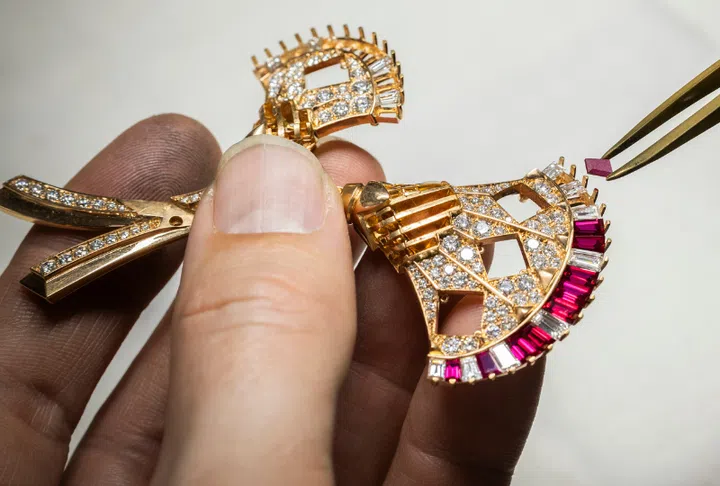
Gem setting of the Fleur de lotus Mystérieuse clip
Photo: Courtesy of Van Cleef & Arpels
After our viewing of the collection at the L’ÉCOLE, School of Jewelry Arts in Paris, Catherine Rénier sat down with us to share the inspiration and obstacles of crafting the collection. “The most challenging part is very often the craftsmanship of the pieces because you need a lot of technical expertise in some of these pieces with the gold work and the stone recutting that was required to follow the initial design. It was also about reinterpreting the vision of Van Cleef & Arpels on what Egyptomania has been and how Egypt has inspired the decorative arts over the last two centuries. We want to remain truthful and faithful to the Maison’s identity, while bringing an additional expression into this thematic,” she shares.
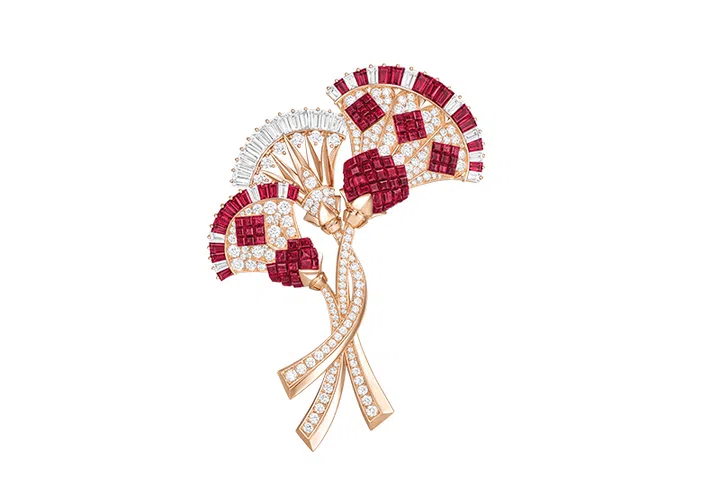
The Fleur de lotus Mystérieuse clip
Photo: Courtesy of Van Cleef & Arpels
Some of the pieces in the collection that directly referenced these Egyptian motifs and myths include Fleur de lotus Mystérieuse clip, which pays homage to the emblematic lotus flower in a rose and yellow gold creation that features the Maison’s Traditional Mystery Set rubies alongside round and baguette-cut diamonds to create a lush, velvety effect.
The inspiration can also be seen more directly in figurative interpretations like the Bénou Mystérieux, Griffon Mystérieux and Bastet Mystérieuse clips that pay tribute to key figures from Egyptian mythology. The Bénou Mystérieux clip, for example, depicts the mythical bennu bird, that represents the soul of Ra, the sun god.
This beautiful interpretation utilises stones for both embellishment and symbolism. Ra’s association with the sun is characterised by a 4.08 carat oval spessartite garnet and paired with a spinel with an intense red glow. Meanwhile, the bird’s plumage is achieved with iridescent mother-of-pearl, turquoise and lapis lazuli and the textured effect of mystery-set emeralds with a pear-shaped diamond as a centrepiece. This masterful play of stones and settings is where Van Cleef & Arpels excels, making these tiny treasures not just jewellery, but collectible works of art.
Related article: Van Cleef & Arpels’ Treasure Island Collection Is A Bibliophile’s Dream Come True
Romancing the Stones
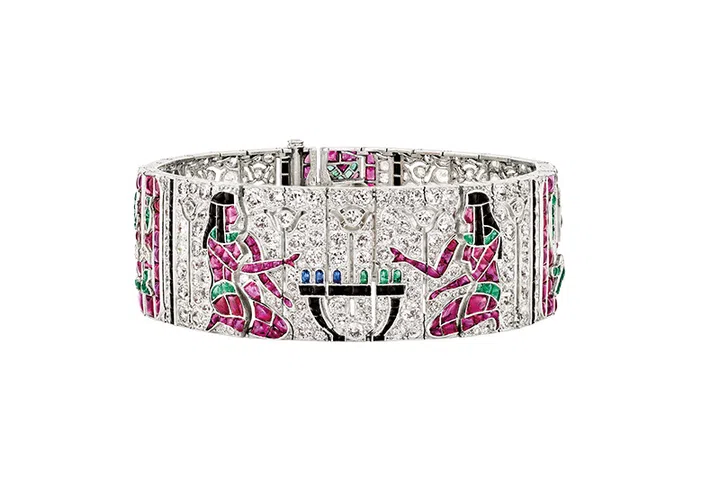
An archival landscape bracelet from 1924
Photo: Courtesy of Van Cleef & Arpels
The ancient Egyptians had a very strong relationship with stones, prizing colourful gems for their symbolism and using them in jewellery, amulets and religious artefacts. Among the stones that held great symbolism for them were lapis lazuli, which was used to represent the heavens; turquoise that represented the Nile; and reddish-orange carnelian, which was a symbol for vitality. Other stones that were prized included amethyst, emerald, malachite and peridot. Many of these gems can be found in the collection, used as both decorative elements and as centrepieces.
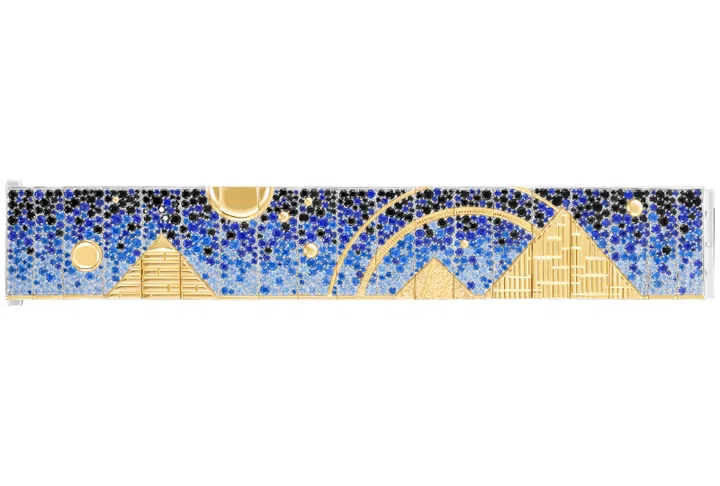
The Paysage merveilleux landscape bracelet
Photo: Courtesy of Van Cleef & Arpels
Says Rénier, “Stones had a very strong symbolism in Egyptian culture, and it was important for the Maison to to bring this creativity around stones and this symbolism into the collection.” One of the main sources of inspiration for the team was the 19th-century book Le Panthéon Égyptien written by Champollion and illustrated by Léon-Jean-Joseph Dubois.
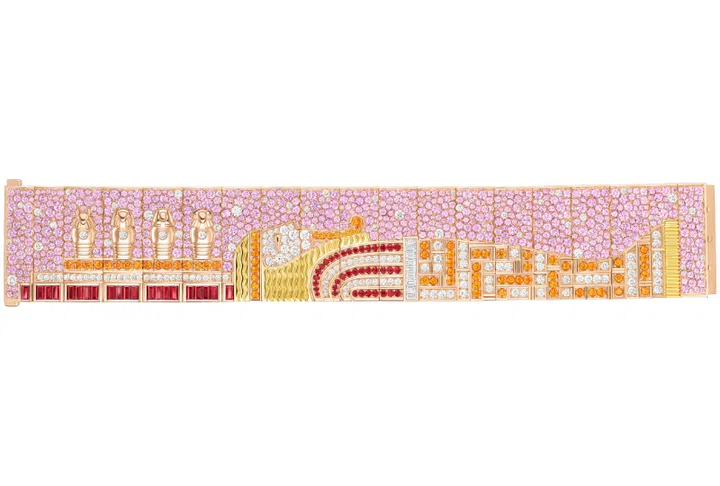
A bracelet with a pharaoh motif
Photo: Courtesy of Van Cleef & Arpels
“You can see the play with colours, and you can see sapphire, emerald and rubies, for instance, associated together. And we dared as a Maison to bring these three colours together for the first time in a mystery setting, in some of the pieces. It truly is a very deep work in playfulness with colour, not just through the stones but through the gold as well—yellow gold was used also to represent the shininess and the warmth of the sun in many of the designs,” shares Rénier.
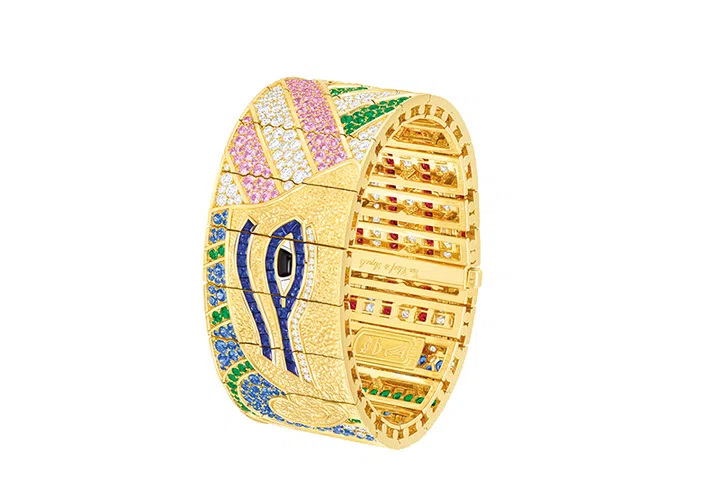
The Paysage royal bracelet
Photo: Courtesy of Van Cleef & Arpels
Among our favourite pieces from the collection were the landscape bracelets that play with the warmth of gold and the story-telling potential of coloured stones. The Paysage Royal bracelet uses diamonds, emeralds, onyx, rubies, blue and pink sapphires to depict the top half of a face, with details like the eye makeup—depicted in blue sapphires—and the stripes on his headdress—rendered in emeralds—showing off the beautiful interplay of stones.
The 180-piece collection also has its fair share of showstopping necklaces that are detained to hold their own place in jewellery history. One of the standout pieces for us was the Narration Précieuse necklace that was directly inspired by an illustration in Le Panthéon Égyptien. The mosaic of gold, diamonds, emeralds, rubies and sapphires has a fascinating geometric form crafted from three rows of gadroons that have been articulated to mould itself to the contours of the body necklace.
Related article: Van Cleef & Arpels Unveils New Flora Jewellery Collections: Flowerlace & Fleurs d’Hawaï
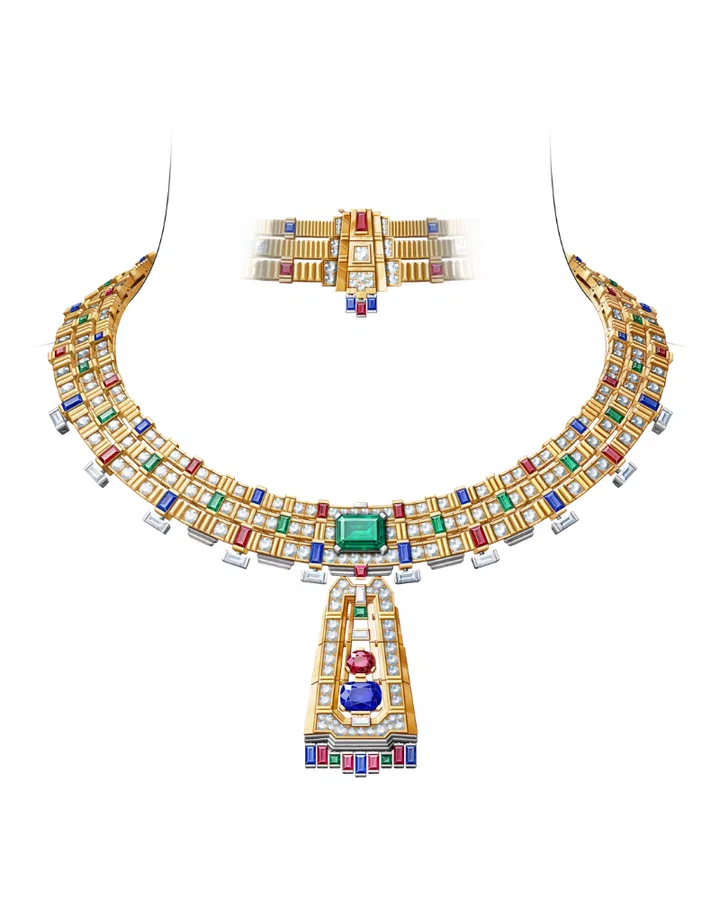
A drawing of the Van Cleef & Arpels Narration Précieuse necklace
Photo: Courtesy of Van Cleef & Arpels
Anchoring the necklace is an architectural detachable pendant with three standout stones: a 5.66-carat emerald from Colombia on the main necklace, and a cushion-cut Mozambique ruby weighing 2.16 carats, and 6.73-carat sapphire from Sri Lanka on the pendant. In this entire collection, and particularly in this piece, the precision, the craftsmanship, the stone selection and the inspiration all come together in a kind of poetic symmetry, transforming it from decorative necklace to a truly lavish spectacle.
Credit: Source link