

A Force Meant for Good | News
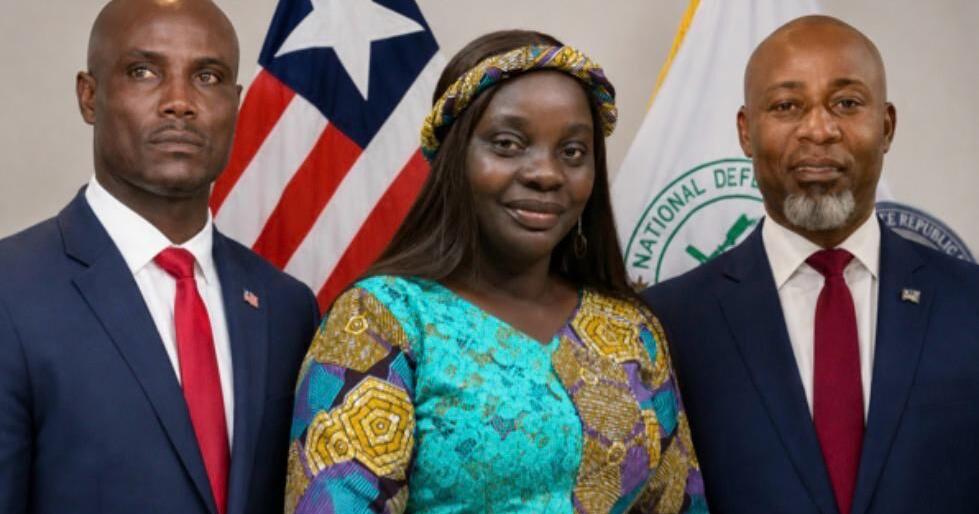
Nearly two decades after Liberia began rebuilding its Armed Forces following the civil war, officers produced by that reform now occupy some of the country’s most important national-security positions.
Retired Major General Daniel D. Ziankahn Jr. is President Joseph Nyuma Boakai’s latest appointee–selected to lead the Liberia Drug Enforcement Agency (LDEA). Prior to him was retired Major General Prince C. Johnson III who heads the National Security Agency (NSA) and retired Brigadier General Geraldine Janet George who serves as Minister of National Defense. Brigadier General Davidson Forleh, another product of the post-war military, remains Chief of Staff of the AFL.
The development is perhaps the clearest evidence that the U.S.- and UNMIL-supported restructuring of the military did more than create a new army. It produced a professional leadership pipeline from which successive governments can draw.
Of the six principal security institutions considered here, three — the Liberia National Police (LNP), Liberia Immigration Service (LIS) and Executive Protection Service (EPS)—are headed by personnel who did not rise through the AFL. Even so, the EPS reflects another dimension of international security-sector assistance: its director, Sam Gaye, is a retired U.S. Department of Justice/Drug Enforcement Administration supervisory special agent and graduate of the DEA/FBI Academy.
The emerging reality raises a broader question—has the success of military reform outpaced national development of comparable professional leadership pipelines in civilian security institutions?
The roots of today’s security architecture lie in the 2003 Comprehensive Peace Agreement, which ended more than 14 years of civil conflict.
The old military had become associated with political interference, factionalism, human-rights abuses and repression. Former President Ellen Johnson Sirleaf later described the security forces as having been “quite corrupt and largely dysfunctional,” saying they had lost public trust and intervened in political affairs without respect for law and due process.
Consequently, the peace process did not simply seek to retrain the old AFL. It sought to restructure it.
The old military was progressively deactivated and demobilized while a new force was recruited and vetted. The United States took the lead in rebuilding the army, while the United Nations Mission in Liberia (UNMIL) supported the broader security-sector transformation.
The United States contracted DynCorp International to undertake recruitment, vetting and basic training, while subsequent assistance supported advanced training and infrastructure.
The process accelerated after Sirleaf assumed office in 2006. Recruitment began on January 18, 2006, with applicants subjected to education, physical, medical and background screening. The first recruits began training at Barclay Training Center in Monrovia in July 2006, including women.
The objective went beyond teaching military skills. Liberia was attempting to create soldiers who understood constitutional government, human rights, civilian authority and professional military ethics.
In other words, the country was trying to build an army capable of protecting the state without becoming a threat to the state.
The reform was also designed with the eventual withdrawal of UNMIL in mind.
Sirleaf summarized the connection between security and development when she declared:
“Without peace and security there cannot be development or prosperity.”
She also emphasized the need for Liberia to prepare for the “gradual withdrawal of UNMIL troops.”
The objective was therefore to replace dependence on international peacekeepers with sustainable Liberian institutions.
Then-U.S. Ambassador John Blaney captured the long-term nature of the task:
“Training the military is a long-term process.”
The prediction proved correct. The reform evolved into a continuing system of professional military education, international exchanges, joint exercises and mentorship.
The most important legacy was arguably not equipment or infrastructure, but institutional culture.
The new AFL was expected to be politically neutral, subordinate to civilian authority, professional rather than factional, respectful of human rights and accountable under the Constitution.
In 2016, U.S. Ambassador Christine Elder said Washington was pleased to have helped develop an AFL capable of protecting Liberia and serving its people. Former U.S. Africa Command chief General William E. Ward likewise reminded Liberian soldiers that technical and tactical competence alone was insufficient.
That principle now has implications far beyond the military, and ex-officers are now leading the security state.
Daniel Ziankahn: From First Post-War Chief of Staff to LDEA
Few officers illustrate the AFL’s leadership pipeline better than Daniel Dee Ziankahn Jr.
Commissioned into the restructured AFL in 2006, Ziankahn progressed from platoon and company command through brigade command, operations leadership and ultimately chief of staff.
In 2014, he became the first Liberian post-war Chief of Staff of the AFL, succeeding Nigerian officers who had led the force during its formative period.
His professional education was strongly influenced by the United States. He attended Fort Benning and the U.S. Army Command and General Staff College at Fort Leavenworth, where he later earned a Master of Military Art and Science. He also undertook executive education at Harvard Kennedy School and served as chairman of the ECOWAS Committee of Chiefs of Defence Staff.
In 2018, he retired from the military and became President George Weah’s Minister of National Defense.
Now President Joseph Boakai is entrusting him with the LDEA at a time when narcotics trafficking has emerged as one of Liberia’s most serious security challenges.
His appointment does not necessarily suggest that military leadership is superior to civilian law enforcement. Rather, it demonstrates how the restructured AFL has become a reservoir of highly trained national-security managers.
His real test will be whether he can translate military leadership into intelligence-led investigations, inter-agency cooperation, evidence-based prosecutions and effective disruption of trafficking networks.
Prince Johnson: From Brigade Commander to National Intelligence
Retired Major General Prince C. Johnson III represents another generation of the post-war AFL.
Commissioned in 2007 after Officer Candidate School, Johnson served as platoon commander, company commander, battalion executive officer, operations and logistics officer, brigade commander and deputy chief of staff.
In 2014, he became commander of the 23rd Infantry Brigade, later rising to Chief of Staff in 2018.
His education reflects the international character of the restructured military. He attended the U.S. Army Command and General Staff College at Fort Leavenworth and undertook studies in Sierra Leone, Nigeria and China, as well as executive security education at Harvard Kennedy School and the African Center for Strategic Studies.
In 2022, Johnson and Ziankahn were inducted into the U.S. Army Command and General Staff College International Hall of Fame.
Reflecting on the importance of professional preparation, Johnson said:
“The future holds a lot for us all if we prepared and work diligently.”
His transition to the NSA places him at the center of Liberia’s intelligence architecture. The challenge is now different from military command: intelligence requires secrecy, analytical independence, legality and strong civilian oversight.
Geraldine George: From First-Class Recruit to Defense Minister
Brigadier General Geraldine Janet George may represent the most striking transformation produced by the new AFL.
She joined the restructured army in July 2006, becoming part of its first generation. Her career took her through military police, legal affairs, personnel, operations and command before becoming deputy chief of staff.
She also served with the UN mission in Mali and pursued professional military education in the United States, Rwanda and Sierra Leone, including at the U.S. Army Command and General Staff College.
In April 2024, she became Liberia’s first female Minister of National Defense.
Her journey—from the first generation of recruits to the civilian head of the Defense Ministry—demonstrates that the reform produced more than battlefield commanders. It created leaders capable of operating across military, diplomatic and civilian policy environments.
For the Boakai administration, George provides institutional continuity at a ministry requiring military expertise, civilian policymaking and international security cooperation.
The prominence of AFL-trained officers should not be mistaken for a military takeover of the national security sector.
The LNP and LIS have their own professional traditions, while the EPS provides another example of international security-sector influence.
EPS Director Sam Gaye is a retired U.S. Department of Justice/DEA supervisory special agent and DEA/FBI Academy graduate. His appointment demonstrates that Liberia’s security leadership pipeline is not exclusively military; it also draws from international law-enforcement experience.
The current architecture therefore represents a combination of military, police, intelligence and internationally trained professional expertise.
The significance of the AFL’s transformation is particularly evident as Liberia confronts organized crime, narcotics trafficking and other transnational threats.
Following a major cocaine seizure at Roberts International Airport in June 2026, President Boakai ordered a joint investigation involving the LDEA, LNP, NSA, EPS, Financial Intelligence Agency, Immigration, Customs, airport security and other institutions.
Such coordination requires precisely the type of inter-agency leadership and professional security culture that Liberia’s post-war reforms sought to establish.
The AFL itself has also expanded beyond its traditional military role, participating in peacekeeping, disaster response, engineering, medical and other national assignments.
In this sense, the United States and UNMIL did not simply help Liberia build an army. They helped build a human-capital institution.
The men and women recruited from 2006 onward were exposed to constitutional government, human rights, strategic planning, military professionalism and international cooperation.
Ziankahn summarized the American contribution at his 2022 Hall of Fame induction when he said U.S. mentorship had “rebranded the Liberian Military.”
Nearly two decades later, that rebranded military is helping shape Liberia’s wider security identity.
This is however, a success story that requires vigilance, and that the transformation should nevertheless not be romanticized.
Professional military education does not automatically guarantee good governance. The continuing challenge is to ensure that professionally trained officers strengthen institutions rather than personalities, and constitutional authority rather than political power.
President Sirleaf’s original vision remains relevant—national security forces must retain public trust and remain subordinate to civilian authority.
For President Boakai, however, the dependence is clear.
George leads Defense. Johnson leads national intelligence. Ziankahn is now being asked to lead the drug fight. Forleh remains at the helm of the AFL, while the LNP, LIS and EPS provide complementary civilian and law-enforcement leadership.
The irony is compelling.
An army deliberately rebuilt after the civil war so that the country would no longer depend on a politicized military has become one of the nation’s most important sources of professional national-security leadership.
That may ultimately be the greatest achievement of the reform.
But its final measure will be whether the officers produced by that process use their training to build institutions that are professional, accountable, constitutional and national in character.
Nearly twenty years after the first post-war recruits entered training, the AFL is proving to be more than a military force.
It has not just become “A Force for Good” but a professional leadership across the Liberian state.
Credit: Source link