

A democratic voice in the face of the Sahel’s challenges
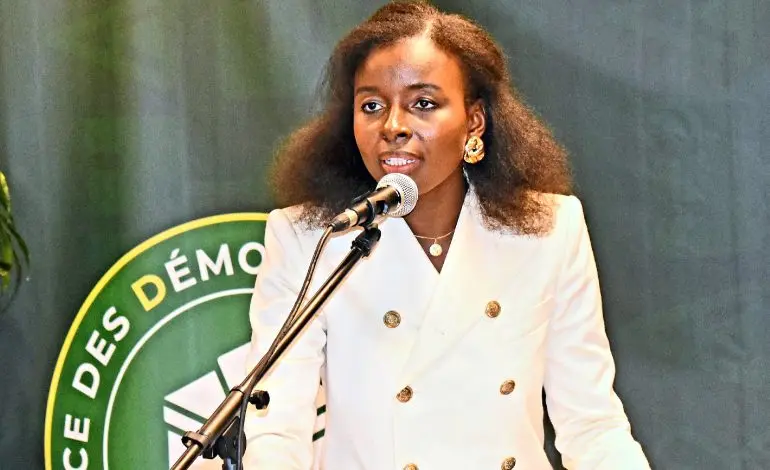
At a time when military regimes are consolidating their power in Mali, Burkina Faso and Niger, a new voice is seeking to put forward a different perspective on the Sahel crisis. At the helm of the Alliance of Sahel Democrats, Mayra Djibrine of Niger is calling for a return to the rule of law. An ambitious undertaking in a region where the most pressing concerns are security, the economy and humanitarian issues.
The official launch of the Alliance of Sahel Democrats (ADS) in Brussels marks a new political initiative spearheaded by civil society actors, academics and political leaders from Mali, Burkina Faso and Niger. At their helm, Mayra Djibrine embodies a generation of democrats who refuse to view coups d’état as inevitable or as the only response to the crises afflicting the region.
Still relatively unknown to the general public, the Nigerien woman first became involved in social work, supporting particularly vulnerable communities. This hands-on experience has profoundly shaped her understanding of the Sahel crisis. For her, the difficulties faced by local communities stem not only from insecurity or poverty, but also from the fragility of public institutions, the erosion of the rule of law and the lack of accountability mechanisms.
This background partly explains her political commitment. In taking over as president of the ADS, Mayra Djibrine does not merely wish to denounce military regimes; she intends to restore the very idea of democracy, which she believes has been gradually discredited in public debate in the Sahel.
“They have waged a massive propaganda campaign to claim that all our problems ultimately stem from democracy,” she recently told RFI. In her view, this narrative obscures the deeper causes: weak institutions, poor governance, persistent inequalities and the failure of states to meet their citizens’ expectations in a sustainable manner.
A democracy facing a crisis
Human rights organisations are protesting against the decision by the head of Niger’s junta, General Abdourahamane Tiani, to “provisionally” strip Mariama Djibrine of her Nigerien nationality on 11 June 2026.
Mariama Djibrine’s speech, however, comes against a particularly difficult backdrop.
The Sahel remains one of the most fragile regions in the world. According to the United Nations Office for the Coordination of Humanitarian Affairs (OCHA), more than 24 million people will require humanitarian assistance in 2026. In Burkina Faso, Mali and western Niger, 11.4 million people require emergency food aid, whilst nearly 2.8 million have been forced to flee their homes due to violence.
This humanitarian crisis is compounded by persistent poverty. The World Bank estimates that nearly one in two Nigeriens still lives in extreme poverty, whilst levels remain very high in Mali and Burkina Faso as well.
Under these circumstances, people’s immediate concerns are, first and foremost, to regain security, feed their families, access healthcare or send their children to school. Democratic debate naturally struggles to take hold when survival is the daily priority.

Mayra Djibrine is well aware of this. Her argument does not pit democracy against responding to emergencies. On the contrary, she defends the idea that legitimate, transparent and accountable institutions are an essential prerequisite for providing a sustainable response to the crises facing the region.
One of the strengths of the ADS president’s argument also lies in her reframing of the political issue.
Since the successive coups d’état, the military authorities have largely attributed the Sahel’s difficulties to the failures of previous democratically elected governments. This criticism has resonated with sections of the population, weary of years of insecurity, corruption and poor economic development.
Building a credible alternative
But three to five years after the first coups, Mayra Djibrine believes that the military regimes must also be judged on their results. They had promised a swift return to security, more effective governance and the restoration of national sovereignty.
Whilst this latter ambition has led to a profound diplomatic and strategic reorganisation – notably through the creation of the Alliance of Sahel States (AES) – the security challenges remain considerable. Violence persists in many areas, population displacement continues, and humanitarian needs keep rising. At the same time, political transitions initially presented as temporary have been extended and election dates postponed.
For Mayra Djibrine, therefore, it is not merely a question of defending democratic principles. It is also a matter of reminding people that no system of governance can escape the test of reality.
The future of the Alliance of Sahel Democrats depends on its ability to move beyond mere advocacy. In a region where citizens expect, above all, concrete responses to the challenges of security, employment, education and access to public services, a return to constitutional order will only be convincing if it is accompanied by a genuine governance plan.
The challenge facing Mayra Djibrine is immense: to restore faith in democracy amongst populations who, for several years, have seen military regimes as the promise of change.
It now remains to be seen whether this promise has delivered the expected results. For whilst democracies must be judged on their track records, those who suspended them cannot escape the same scrutiny. It is precisely on this ground that Mayra Djibrine now intends to shift the debate.
Crédito: Link de origem