

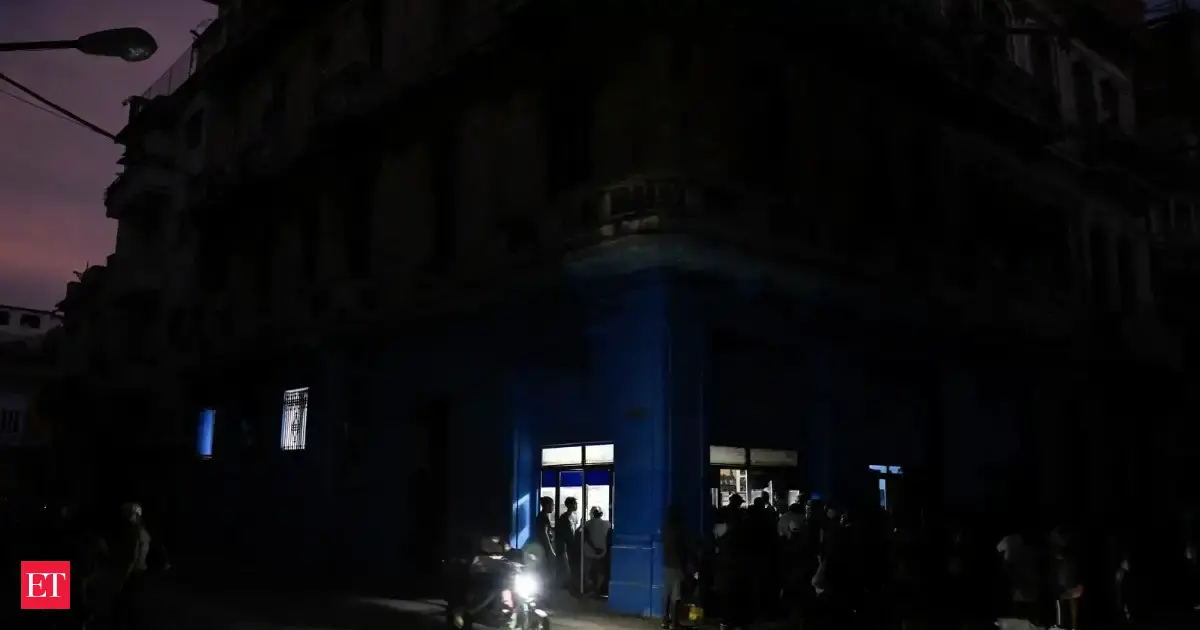
A country without evenings: Cuba’s blackouts pass 24 hours as Washington targets the firm that keeps its power plants running
The US Treasury’s Office of Foreign Assets Control designated six Cuban targets on September 3, the Associated Press reported. They include Abapet, the Oil Industry Supply Import Company, which brings in the specialised equipment and replacement parts needed to maintain Cuba’s thermal power plants. Also designated were Fidel Ernesto Castro, grandson of former president Raúl Castro, state lender Banco Exterior de Cuba, and enterprises in the oil and mining sectors.
Also read: US hits Cuba with new sanctions as island’s crises multiply
Brett Erickson, managing principal at the consultancy Obsidian Risk Advisors, told AP the measures are designed to force Cuba’s critical machinery offline and worsen the energy crisis. He said Cuban officials would find alternative routes to procure maintenance parts, but at higher cost, which would feed inflation and further damage the economy. “The goal in theory is to create so much civilian hardship and suffering that they have no option but to essentially rise up and topple their government,” he told AP.
The announcement came hours after Cuban officials briefed reporters on economic reforms approved in June. Speaking before the sanctions were made public, Deputy Prime Minister and Minister of Foreign Investment Oscar Pérez-Oliva Fraga said the past year had been complex and that the blockade amounted to genocide. Talks between Washington and Havana held earlier this year had already stalled.
Power for a third of the island
The state utility Unión Eléctrica reported on Tuesday that it had 1,150 megawatts available against a projected peak demand of 3,250 MW, leaving a generation deficit of 2,100 MW and an expected cut of 2,130 MW during evening hours. In Holguín province, scheduled outages ran past 22 hours. Multiple circuits across Havana, including Luyanó, Cojímar, Miramar, La Lisa and Santos Suárez, were disconnected.The national grid has failed outright at least seven times in 2026, in March, July and August. The utility warned in August that the September to December window could be the year’s most difficult, as scheduled maintenance on thermal units coincides with breakdowns.
Cuba produces about 40% of the oil it consumes, according to International Energy Agency figures for 2023. In late January, President Donald Trump signed an executive order authorising tariffs on countries that directly or indirectly supply oil to the island. Venezuela, Cuba’s long-standing supplier of subsidised crude, had already stopped shipments. Mexico halted its own deliveries under US pressure. In May, Energy and Mines Minister Vicente de la O Levy said Cuba had run out of fuel oil and diesel.
Cuban Foreign Minister Bruno Rodríguez has put the cost of what he called US economic strangulation at more than $8 billion between March 2025 and the end of February, which he described as a record.
Water, health and the human toll
The power cuts have taken the water supply with them, since most distribution depends on electric pumping. The US Embassy in Havana issued two public health alerts within a week. On August 28 it said Cuba’s water infrastructure was increasingly unstable, with residential neighbourhoods going long periods without municipal supply. On Friday it warned of a rise in gastrointestinal illness linked to the degradation of water and energy infrastructure, citing recent cases involving E. coli, norovirus and Shigella.
Transport and mobile phone service have also been disrupted.
Doctors say the strain is showing in ways that are harder to measure. Yomeidis Felicó Riverón, a primary care physician, told AP that patients now come to her to talk and to cry because they have no one else to turn to, and that she has ended up in the role of a psychologist. “Before there was hope,” she said. “Right now, what people have lost is exactly that.”
Yaqueline Bernal, 49, told AP last week that she had been without electricity since Sunday and was most worried about the effect on her eight young grandchildren.
Small protests have broken out across the island despite the risk of detention, with residents in Havana neighbourhoods banging pots and pans during evening cuts. In July, a crowd ransacked a local Communist Party building.
The one thing that has grown
Cuba’s solar capacity has expanded faster than almost anywhere in the developing world, with roughly 1,000 MW added over about two years using Chinese equipment, financing and technical support. The programme targets 92 parks by 2028 with combined capacity near 2,000 MW.
Also read: Cuba unveils historic package of free-market reforms
At midday the panels now supply a large share of national generation. They supply none of it after dark. Cuba has added generation without adding storage, and the utility’s daily reports show the deepest cuts falling in the evening, when solar output drops to zero and household demand peaks.