

He Came Back From Papua New Guinea. He Never Really Came Home. She Held the World Together.
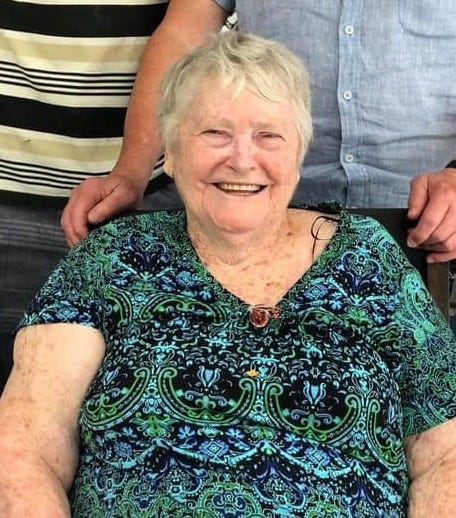
When I was a little girl growing up in the sun-drenched fields of North Queensland, I found refuge in my Nana Rita’s arms. Her modest cement flat with lime green walls, overstuffed with plastic roses, sunbaked photographs, and tattered romance novels, rested beside a giant storm drain on the edges of a small town. It smelled of floral perfume and passion fruit and crushed green leaves on hot bitumen. It smelled of comfort.
Born in 1930, Nana Rita is the kind of woman who drank Fosters beer straight from the can, played poker with ruthless precision, and piled my plate high with buttery spaghetti Bolognese, always with shredded chicken.
She let me watch Days of Our Lives in her lap and helped me peel lychees during the thick, sweltering summers when the afternoon downpours arrive like clockwork and the ground never fully dries.
With knees bruised from climbing trees and mango residue dripping down my sunburned cheeks, my cousins and I packed onto her cracked couch, and, if we begged enough, she let us spin across her waterbed until the whole room contorted.
In the dry season known to the rest of the world as winter, Nana and I sat together in the pleasant warmth of the speckled grass, the sweet-smelling air rising from the churning sugar mill downtown. These moments braided my childhood into something tender, fragrant, and eternal.
Nana Rita doesn’t just love me, she gets me. Where others saw my mud-scraped elbows and mangled, sun-licked hair as troublemaking, she considered me a perfectly wild, fueled-by-fire spirit who should not be dulled. Nana never arched an eyebrow when I ran from Sunday School in a frilly dress, only to return breathless with ripped seams from climbing trees. I lived for those hours of fantasy. I built kingdoms from sticks, wielded plastic swords, and narrated my own impromptu adventures aloud.
To me, Nana Rita was a real-life hero, equal parts steel and soft. She spoke to me not like a fidgety child, but like a small adult with thoughts worth hearing. Born Harriet to a large family of eight girls and one boy, this strong-willed soul renamed herself “Rita” as a little girl simply because she liked it much better. Nana dreamed of becoming a doctor or a writer. Life, of course, had other plans. At sixteen, she gave birth to her first child. In labor, still a child herself, she clutched the nurse’s hand and asked when the doctor would come to cut her open.
“But you aren’t having a C-section,” the nurse responded calmly, with a squeeze of the hand and a flicker of sorrow. “You poor thing.”
No one had told her how babies were born. Still, Nana brought seven children into the world by the age of thirty, three with a second husband after my father’s father, William McKay, left. Somewhere along the way, Nana lost a baby, too. I don’t know much about what happened and why, but she picked herself up and never spoke about it. What Nana lacked in formal education despite being incredibly well-read and intelligent, she made up for in instinct, tenacity, and the kind of wisdom that could only grow from hardship.
Nana was decades ahead of her time: progressive, unshakable, a force of nature. Even in an era drenched in racism and homophobia, she rose above the tumult with open arms and a fierce heart, embracing people for who they were and who they aspired to become.
Looking back, Nana embodied the women I would later meet in warzone survivors filled with love when hate could have stolen their hearts. Her battles were not fought with bullets and bombs, but with poverty, betrayal, and battles without medals.
On weekends, we roamed the local Gordonvale cemetery, brushing moss from old headstones and softly speaking the names of those she once danced with, drank alongside, or argued against.
“When you’re born,” Nana told me one day, “your name goes into a book in the sky next to the date you’ll die. And there’s nothing you can do to change it.”
I believed her. I sat beside graves and delivered stories. I talked to the dead, unafraid.
“I know. It’s just like going back to wherever I was before I was born,” I informed her with sudden clarity one afternoon, around the age of five, as if suddenly understanding an existence before the earth. “I don’t remember where that was, but wherever it was, it was okay.”
I do believe that she has made it this far, born the day before ANZAC Day, having just turned 96, because she is so richly loved by her many children, grandchildren, great grandchildren and even great great grandchildren.
Nana taught me about war not from textbooks, but from a shoebox of black-and-white photos and a silence that sometimes sat heavy behind her eyes as she peeled fresh paw paw and recollections. I was six years old. Curled beside her on the shag carpet, I learned about my grandfather, William (Bill) McKay, her first husband. The father of my father. A man my dad barely remembered.
It was April 25, 1992. ANZAC Day. I remembered the day in fragments: polished medals, solemn stares, the wailing of bagpipes and grief. I couldn’t name it yet, but I felt it scuttling beneath the surface of skin and sound.
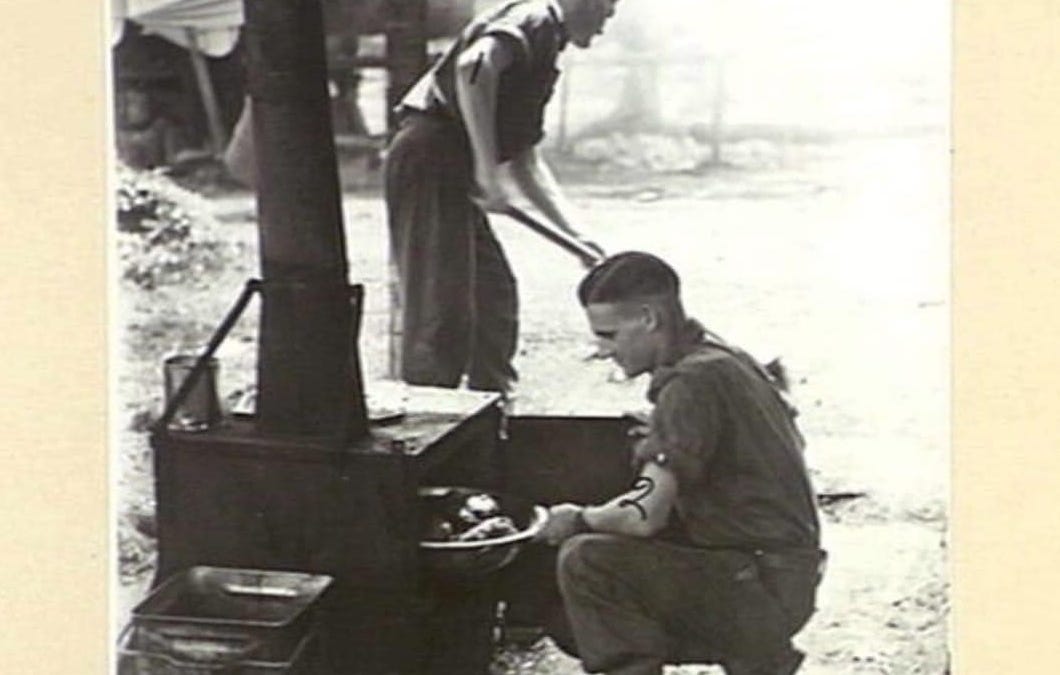
Granddad Bill was twenty when he was sent into the mud-slicked jungles of Papua New Guinea with the 47th Battalion, 5th Division of the Australian Army. He enlisted in January 1943 and returned in June 1946. Nana said he never really came back. The war stayed in him; in the tremor of his hands as they reached for the bottle, the stench of rot and gunpowder clinging to his spirit.
This is how I first understood war, not as maps or politics, but as a haunting that never really goes away. I understood war as something that ate through silence and implanted itself in the hearts and minds of those left behind, leaving mothers to collect the broken bits of memory.
Nana Rita met Bill when she was fifteen and working in a Far North Queensland pub to support her nine siblings after her father, a coal miner, who struggled with the “black lung,” where coal dust particles are inhaled and become trapped in the lungs, eventually leading to debilitating lung disease. Bill, just home from combat, worked next door in a grocery shop.
“I often used to sit outside the pub talking to him while waiting for my boyfriend to pick me up to go to the pictures,” Nana recalled. “My first impression was sympathy. I felt sorry for him. He looked so broken down.”
She paused, remembering.
“He couldn’t hold a glass without shaking. He had no friends and asked me to go to the movies one night. So, I went with him,” Nana continued. “He crept in between me and my then-boyfriend. I didn’t know he was drinking then, he hid that from me.”
The war followed them into marriage. Into the children. Into the loud and boisterous living rooms, and into the quiet.
Nana hoped fatherhood might change William. Only the demons would not leave him alone.
“He didn’t like to talk about the war but opened up at times when he had been drinking,” she said. “He recalled horror war atrocities but was mostly affected by the bodies of native women and children being brought into their army camp after being mutilated by Japanese soldiers.”
Nana’s voice softened and grew tired.
“He started drinking more and working less. I had a drink from his (water) bottle one day, and that’s when I discovered he was drinking metho—methylated spirits—when he couldn’t afford the grog. There were good parts to him when he was away from the drinking. He loved his kids.”
Australia’s involvement in World War II began voluntarily, but by 1942, the conflict was roaring closer to home. Japanese forces landed in New Guinea, and the Pacific ignited. Operation Cartwheel launched in mid-1943, a coordinated Allied offensive that halted the Japanese advance but exacted a brutal toll. Disease and death came in equal measure. So did trauma.
My father was just four when Bill walked out for good. Nana survived and raised her then-four babies alone while still barely an adult herself. It is just what you did. She met another man, too, and had three more. In all, Nana had seven children by the age of twenty-seven, and one baby that “did not make it.” Back then, that was all that the doctors could tell her.
Bill disappeared into another life, started another family, and died alone of alcohol poisoning at the too tender age of forty-one. A tough bloke to the outside world, inside, he remained trapped somewhere in that jungle, unable to explain what had happened or how it kept happening.
Even as a child, I knew that April 25 was sacred. At dawn, my father pinned his father’s medals onto his chest, gold, silver, ribbons undulating in the early wind, and we joined the crowd of families for ANZAC Day. I didn’t yet have the language for what sat in my father’s eyes, but I knew it was the only time I saw him break.
Later, he said war had stolen his father.
You, the mothers,
Who sent their sons from faraway countries
Wipe away your tears,
Your sons are now lying in our bosom
And are in peace
After having lost their lives on this land,
They have become our sons as well.
PLEASE CONSIDER A PAID SUBSCRIPTION TO SUPPORT INDEPENDENT WRITING AND JOURNALISM. THANK YOU FOR JOINING ME ON THIS JOURNEY. IG: Hollie McKay
Credit: Source link
Comments are closed.