

The 20-metre walk that explains Juan Seco’s vision for Mukuru

Why does a 20-metre walk in Harare explain the future of African fintech? When Juan Seco left Wall Street private equity for African tech, he realised the biggest gap wasn’t complex financial software—it was what happens after a remittance arrives. From auditing American Express in New York to building JumiaPay and scaling Mukuru’s neobank infrastructure across Southern Africa, Seco joins PATHISANI MOYO in our latest edition of Coffee With…
A few days before speaking with Juan Seco, Chief Growth Officer and Managing Director for East Africa at Mukuru, a digital financial services company, I found myself reflecting on a conversation with my 76-year-old mother.
She lives in Harare; I live in Johannesburg. Having transferred funds to her via Mukuru, I called to check if the money had arrived safely. Her response was characteristically direct: “Mntanami (my son), don’t ever send me money through your friends again.”
The funds had landed directly on her mobile phone, allowing her to collect the cash in person after a brief 20-metre walk. That modest 20-metre stroll captures the core philosophy behind Mukuru’s expansion far better than any corporate presentation.
The 20-metre lesson
For the Spanish-born executive, who spent years advising tier-one financial institutions in New York before relocating to Nairobi, the future of African fintech is not about crafting hyper-complex financial instruments. It is about eliminating the friction that hinders how people receive, store, move, and spend their money.
That principle underpins Seco’s definition of South Africa-headquartered Mukuru as a “remittance-led neobank.”
It helps explain why a company best known for helping migrants send money home is fast moving into everyday digital financial services, from wallets and cards to payments and banking infrastructure.
Today, Mukuru operates across more than 60 countries, serving 17.6 million customers through a vast physical and digital payout network across Southern and East Africa.
Seco’s path to African financial infrastructure was anything but linear. Born in Madrid, he spent his childhood between France and Luxembourg before studying finance and international business at McGill University in Canada.
He began his career at PwC in Spain, auditing financial institutions such as American Express and Prudential, before transferring to New York to work in private-equity mergers and acquisitions. On paper, it was a textbook corporate career; in practice, it was an exhausting routine.
The turning point arrived when Seco and his wife—a Colombian corporate lawyer who grew up in Kenya—welcomed a daughter, followed quickly by twins. Managing three children under three alongside two high-powered corporate careers proved unsustainable.
“We found ourselves working crazy hours with three kids under three,” Seco recalls. His wife posed a decisive question: “You’ve been unhappy for years doing work you aren’t passionate about. Why not make a change?”
The answer was Nairobi, the Kenya capital city, where Seco took what he describes as a huge pay cut to join Jumia, Africa’s e-commerce trailblazer. It was a dramatic move from the world of New York finance into one of Africa’s most ambitious technology companies at the time.
He would spend roughly a decade in the Jumia ecosystem, working across technology, commerce, and financial services. It was there that Seco began to see African financial infrastructure differently.
The problem that changed how he saw African fintech
As Jumia’s chief financial officer (CFO), he encountered a problem that looked mundane but had enormous implications. The company operated across multiple African markets, and customers often paid in cash. Cash-on-delivery was expensive and operationally painful. Digital payments, by contrast, could make the business more efficient.
But building those payment connections was not simple. The same technology team operating across numerous countries and business lines was repeatedly building integrations with different mobile-money systems, including M-Pesa, Kenya’s pioneering mobile money service.
Seco realised Jumia’s problem was bigger than adding more payment integrations. It needed a layer in the middle to connect them. “This is broken. We need something in the middle,” was essentially the conclusion he reached.
That thinking helped lead to Jumia Pay, the e-commerce company’s fintech payments platform, and, later, a deeper focus on financial technology.
He saw similar problems on the banking side. Corporate financial services that should have been digital still involved cumbersome processes. A corporate card could effectively behave like a prepaid instrument. Transactions could require physical interaction with bank branches.
For someone who had spent years exposed to digital banking in North America, the contrast was striking. The opportunity was not to copy the banking systems he had known elsewhere but to build around the realities of African consumers.
At Jumia Pay, that thinking expanded into lending, including working-capital products for sellers, buy-now-pay-later integrations, consumer credit in Egypt, microloans in Nigeria, and other financial products designed around transactions already taking place on the platform.
From remittances to a “remittance-led neobank”
That lesson followed him to Mukuru, where Seco joined in 2023 and found something many fintechs spend years trying to build: trust.
Mukuru had spent two decades moving money across borders, earning the trust of millions of customers who relied on it to send money home. But Seco saw that the person receiving the money was just as important as the person sending it.
Seco noticed that people in countries such as Zimbabwe, Malawi, and Botswana were not necessarily asking for a complicated new financial product. They wanted the thing they already understood to work better.
That became the foundation of his idea for a remittance-led neobank, with Mukuru using the trust it has built through moving money across borders as the starting point for a broader financial relationship with its customers.
“Remittance is the tip of the spear,” Seco said. “It is the first transaction and, in many cases, the first time we have that relationship with the customer. The opportunity is to take that trust and make the customer’s everyday financial life easier.”
According to Seco, remittance is the entry point that gives customers a reason to trust the platform and creates the opportunity for Mukuru to serve more of their everyday financial needs.
Instead of the money arriving and immediately disappearing into cash, it can remain in a wallet. The customer can pay a bill, make a purchase, receive a salary, send money elsewhere, or eventually access other financial services.
Seco is careful not to frame Mukuru’s expansion as simply selling more products to existing customers. Instead, he wants each new service to fit naturally into how customers already manage their money and solve a financial need they already have. “They should be an extension or adjacent to what the customer already does,” he said.
Making the money usable after it arrives
That thinking is becoming increasingly visible in Mukuru’s products.
In Botswana, for example, Mukuru recently launched a physical Visa debit card linked to its wallet, allowing customers to spend from their wallet balance at retailers and withdraw cash from automated teller machines (ATMs). The idea is deceptively simple: money sent by a relative overseas can become immediately usable money rather than something that requires another step before it can be spent.
Seco sees this as the practical expression of Mukuru’s philosophy of meeting customers where they are. “At Mukuru, we always talk about meeting our customers where they are,” he stated.
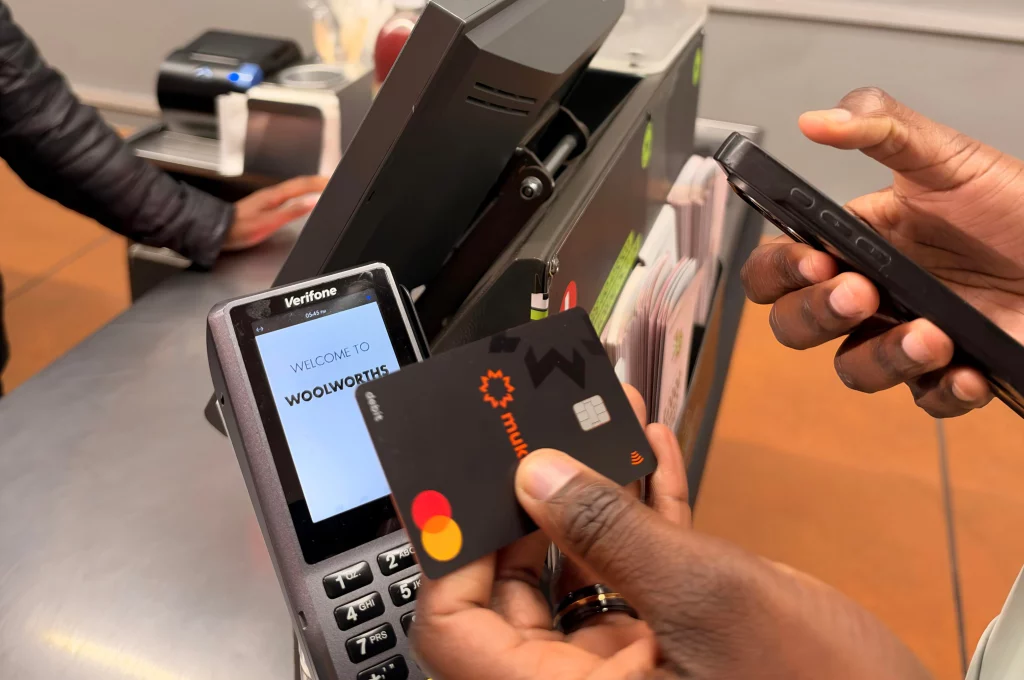
That means meeting customers wherever they are, whether through Mukuru’s agent network, USSD, WhatsApp or increasingly through digital accounts. This is where the Bank Zero partnership in South Africa becomes important.
Mukuru has partnered with Bank Zero to provide banking infrastructure behind its new account and card offering. Customers can receive salaries and other payments, make electronic payments and use their cards for everyday transactions, while Mukuru continues to own the customer relationship and experience.
It is a model that makes sense for Seco because Mukuru does not have to become a traditional bank in order to offer more banking functionality.
Bank Zero provides the underlying banking infrastructure, while Mukuru brings the customers, distribution, technology and financial-services experience.
The partnership is already significant in scale. About 500,000 Mukuru customers are being migrated onto Bank Zero’s infrastructure, contributing to a combined Bank Zero customer base of more than 700,000 end customers.
The 20-metre philosophy
Seco believes the significance of those numbers lies less in their scale than in what they enable: customers can move from cash to digital financial services without having to start their financial journey all over again, an important shift in markets where cash and digital money still coexist.
“Just because someone transacts in cash should not mean they have access to fewer financial services,” Seco explained to TechCabal.
For Seco, success is not measured in app downloads or digital card issuances alone, but in making the transition between cash and digital value completely frictionless.
“Just because someone transacts in cash does not mean they should be excluded from formal financial services,” Seco emphasizes. Whether interacting via USSD, WhatsApp bots, agent networks, or debit cards, Mukuru’s mandate is to meet consumers within their existing habits.
Which brings the narrative back to a 76-year-old mother in Harare.
For fintech analysts, financial inclusion is often discussed in abstract metrics: regulatory licences, transaction throughput, and API integrations. For a mother collecting her monthly support, it boils down to something far more practical: the money arrives safely, predictably, and without unnecessary travel.
Her journey was 20 metres. In an industry often obsessed with technological novelty, Juan Seco’s vision for Mukuru proves that the most profound financial innovations shorten the distance between receiving money and using it.
True scale demands moving beyond surface-level integrations to robust execution. We’ve filtered the noise out of Moonshot 2026, optimising the conference strictly for high-calibre connections between startup founders, global financial operators, enterprise leaders and individuals rewiring Africa’s technical frameworks. Get 20% off Early Bird tickets for a limited time.

Crédito: Link de origem