

LWSC, AUC Strengthen Gov’t’s Capacity to Finance Water Projects | News
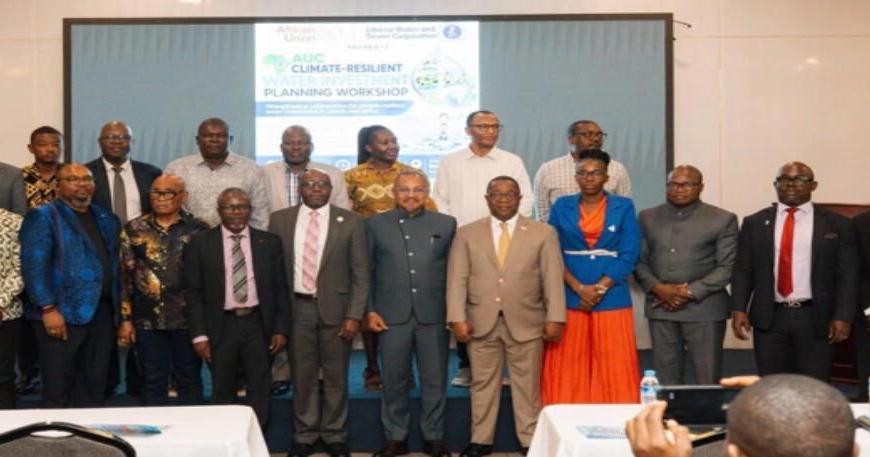
The Liberia Water and Sewer Corporation (LWSC) and the African Union Commission (AUC) have launched a five-day training initiative aimed at strengthening Liberia’s capacity to develop bankable water projects and mobilize financing for climate-resilient water infrastructure.
The Climate-Resilient Water Investment Planning Training Workshop, which opened in Monrovia Monday, brings together government institutions, development partners, civil society organizations and continental experts to improve the country’s ability to plan, prioritize and finance investments in water and sanitation.
The workshop runs from September 14–18 and is being led by the LWSC in collaboration with the AUC’s Sustainable Environment and Blue Economy (SEBE) division.
LWSC Managing Director Mohamed Ali said the training represents the culmination of nearly a year of engagement with the African Union after he first requested technical capacity-building support during the AU Water Investment Conference in Cape Town, South Africa, in October 2025.
He said he renewed the request during the African Union Summit in Addis Ababa in February 2026.
“My request was based on a simple but important concern,” Ali said. “Liberia has significant water infrastructure needs, but identifying those needs alone is not enough. We must strengthen our institutional capacity to properly plan and prioritize water investment, develop bankable and climate-resilient projects, and mobilize the financing required to implement them.”
Ali said Liberia’s water sector faces mounting pressures from flooding, changing rainfall patterns, coastal vulnerability and other climate-related challenges affecting water sources, treatment facilities and sanitation systems.
He emphasized that the country must move beyond identifying infrastructure gaps and develop projects that can attract sustainable financing.
“We must move beyond simply identifying infrastructure needs,” Ali said. “We must be able to translate those needs into technically sound, climate-resilient, financially viable and investment-ready projects.”
According to the LWSC Managing Director, the ultimate success of the workshop will be determined by Liberia’s ability to convert the knowledge gained into bankable projects capable of attracting actual investment and delivering improved services to communities.
Representing the AUC delegation, Director of Sustainable Environment and Blue Economy Nyambe Harsen Nyambe said the training forms part of broader African efforts to address the continent’s water and sanitation financing challenges under Agenda 2063 and the Sustainable Development Goals.
Nyambe said more than 400 million Africans currently lack access to clean water, while about 700 million lack access to safe sanitation.
He said the African Union has responded through frameworks including the Africa Water Vision 2063 and the Africa Water Investment Program (AIP), while 2026 has been designated as the African Union’s year of focus on water and sanitation.
Nyambe cited estimates indicating that Africa needs between US$30 billion and US$50 billion annually to meet its water and sanitation investment requirements.
He stressed that the Monrovia training should be viewed as the beginning of a longer-term investment process.
“This training will not be an end by itself, but a means to an end,” Nyambe said.
He said the AUC and Global Water Partnership would continue supporting Liberia in developing its water investment roadmap and packaging bankable projects capable of attracting financing.
“That is what we are going to measure as the success of this training when we have those bankable project proposals that will go to partners and that will be funded. Until then, we have not yet achieved our goal,” he added.
WaterAid Liberia Country Director Chuchu Selma underscored the economic consequences of inadequate investment in water, sanitation and hygiene.
Citing a recent WaterAid study, Selma said Liberia loses an estimated US$231 million annually because of inadequate action on water, sanitation and hygiene—equivalent to about US$44 per person and 5.3 percent of GDP.
She said the estimated annual cost of adequate investment is about US$119 million, highlighting the economic case for closing Liberia’s WASH financing gap.
Selma said Liberia must pursue multiple financing sources, including increased domestic resources, continued official development assistance, private and commercial financing, blended and results-based financing, and climate finance.
She also emphasized the need for greater transparency, affordability, equity and sustainability in how WASH financing is deployed.
“WaterAid reassures the Government and people of Liberia of its fullest and unwavering commitment,” Selma said, pledging continued technical and coordination support.
The AUC delegation includes experts in transboundary water management, climate change and investment planning who are providing technical guidance and knowledge-sharing support throughout the workshop.
Participants include representatives from the Environmental Protection Agency, National Water, Sanitation and Hygiene Commission, Ministry of Public Works, Ministry of Finance and Development Planning, National Legislature, WaterAid Liberia, WASH civil society organizations and UNDP, among others.
Credit: Source link