

EU Refuses Sahara Probe Demand, Reaffirms Morocco Partnership Over Polisario
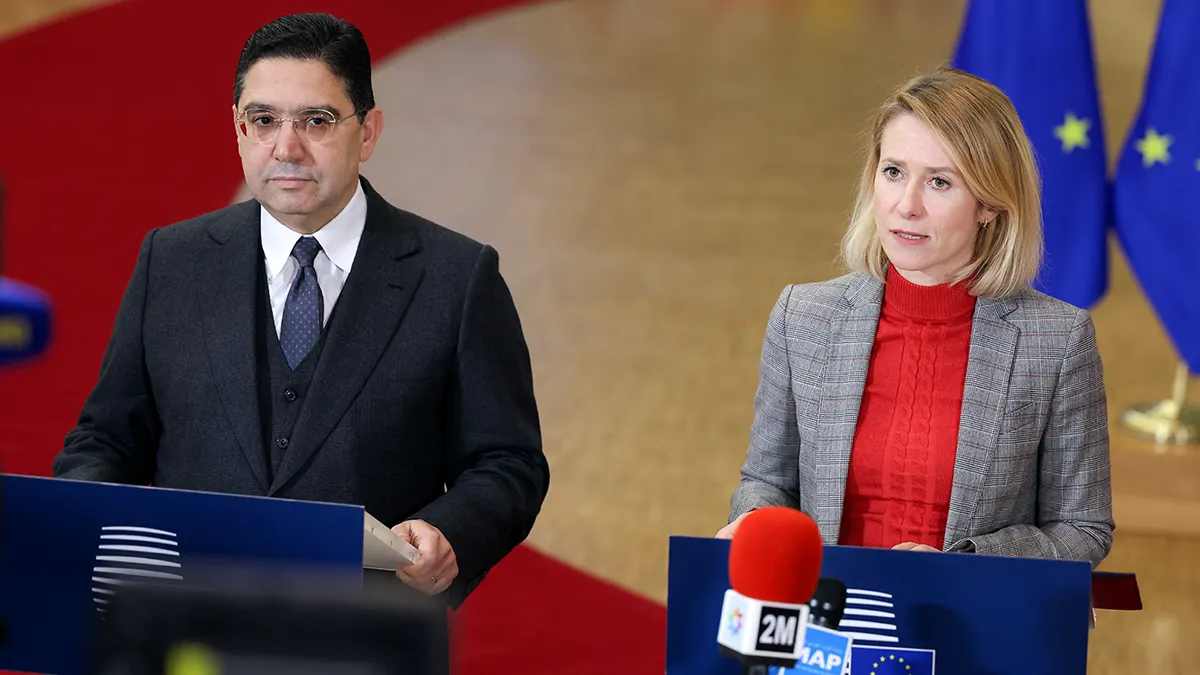
Marrakech – Brussels has brushed aside a coordinated push by a bloc of far-left and green lawmakers who tried to drag the European Union into a campaign against Morocco over the Western Sahara.
The rebuff came in an August 14 answer from High Representative Kaja Kallas to written question E-002880/26, filed on July 13 by ten members of the European Parliament, most of them from The Left.
The lawmakers leaned on figures they attributed to the Sahrawi Mine Action Coordination Office, a body in the Polisario orbit. They claimed the Moroccan Royal Armed Forces (FAR) had carried out 129 drone attacks, causing more than 310 victims east of the Berm between 2021 and 2025, and asserted that 63% of those hit were killed.
On that unverified basis, they pressed Kallas to open “an international, independent and impartial investigation,” to question the EU’s trade agreements with Rabat, and to choke off any European “technology, components, funding or military cooperation.”
Kallas gave them nothing. She refused to endorse a single one of their demands.
In place of a probe, the High Representative recalled that “now is not the time for escalation, but for negotiations on Western Sahara,” and called on “all parties to respect international law.” She threw the EU’s full weight behind the UN-led process, “in line with UN Security Council Resolution 2797 (2025),” and behind the drive for “a just, lasting and mutually acceptable political solution.”
That resolution, adopted on October 31, 2025, had already gutted the lawmakers’ premise before they filed. The Security Council took Morocco’s Autonomy Proposal as its basis and affirmed that “genuine autonomy under Moroccan sovereignty could constitute a most feasible solution.” The MEPs were fighting a position the world body had already discarded.
On trade, Kallas closed the door again. She pointed to the European Council conclusions of October 17, 2024, and to the aim to “preserve and continue strengthening close relations with Morocco in all areas of the EU-Morocco Partnership.” The Union, she added, “continuously attaches high value to its long-standing partnership with Morocco across all key areas of our bilateral relationship, including trade.” No suspension. No review. No concession.
On the arms demand, Kallas handed the lawmakers a jurisdictional dead end. Export licenses, she wrote, fall under national law, the Council Common Position and the Arms Trade Treaty.
“The decision whether to authorise a specific export or not lies with the individual EU Member State concerned,” with each capital “solely responsible” for weighing licenses against eight criteria. Brussels would not police what the treaties leave to member states.
In a May 8 post on X, the EU’s own ambassador in Rabat, Dimiter Tzantchev, had already set the tone. He demanded that the attack on Es-Smara by the Polisario “should be condemned” and slapped down the appetite for confrontation, insisting that “now is not the time for escalation, but for negotiation.”
He anchored that stance in Resolution 2797 and Morocco’s Autonomy Plan – the same framework Polisario and its sympathizers keep trying to torch. The message was unmistakable: it is the separatist camp, not Rabat, that reaches for violence to force its way onto a stage the UN has already denied it.
The lawmakers wanted Brussels to indict Morocco, but the EU instead reaffirmed the partnership and pointed them back to the negotiating table Rabat has long defended.
Read also: Western Sahara: Algeria, Pro-Polisario Lobbying Fails to Deter EU-Morocco Alliance
Credit: Source link