

Russia’s Fuel Crisis Raises Stagflation Fears as Growth Stalls and Inflation Accelerates
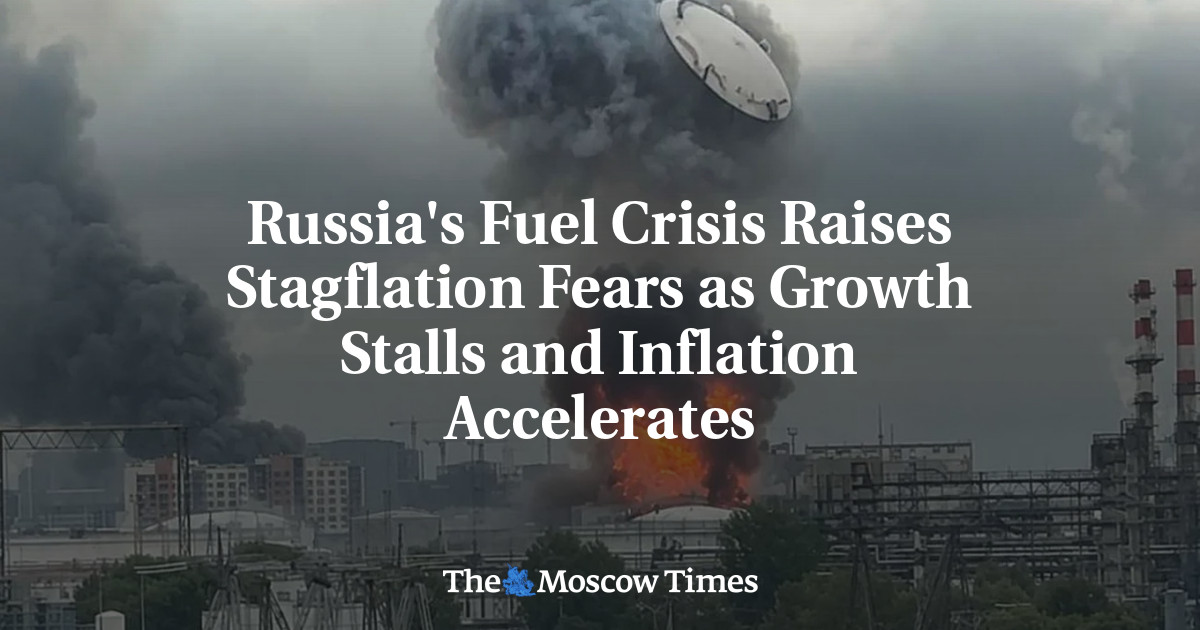
Russia’s fuel crisis is fueling concerns that the country’s economy is slipping into stagflation, as accelerating inflation coincides with slowing growth and policymakers face increasingly difficult tradeoffs over interest rates and fiscal policy.
The disruption, triggered by the loss of a significant share of Russia’s refining capacity, has pushed up business costs, weakened industrial output and raised the risk that the economy could enter a prolonged recession, according to economists, analysts and recent business surveys.
The latest signs of deterioration emerged in June, when the Central Bank’s monthly survey of thousands of businesses showed a sharp drop in business activity.
The survey’s business climate indicator fell deep into negative territory, a level that investment banker Yevgeny Kogan said has historically coincided with economic crises.
“It appears the fuel crisis has pushed the economy into recession,” analysts at the Moscow-based MMI research group wrote in a commentary.
The slowdown comes after Russia’s economy had already lost momentum. The Economic Development Ministry estimates gross domestic product grew just 0.2% year-on-year in January-May, suggesting June may have marked the start of an outright contraction.
At the same time, inflation has accelerated. Consumer prices rose 0.87% in June and a further 0.43% in the first two weeks of July.
Kogan said the Central Bank’s business survey pointed to a surge in companies’ costs and inflation expectations, increasing the risk of stagflation — a combination of weak economic growth and persistent inflation.
That leaves policymakers facing a difficult choice. Raising interest rates to curb inflation could further weaken an already slowing economy, while cutting rates to support growth could allow inflation to accelerate further.
The prolonged war in Ukraine has made those policy choices even more difficult, the Bank of Finland said in a recent analysis.
It said the government has again been forced to increase spending and widen the budget deficit, adding inflationary pressure and limiting the scope for interest-rate cuts. High borrowing costs, in turn, continue to weigh on investment, particularly for companies without access to subsidized state lending.
The Washington-based Center for Strategic and International Studies (CSIS) said in a recent report that the costs of the war were rising rapidly and that military spending could become increasingly unsustainable for Russia.
Participants in a discussion organized by the Centre for Economic Policy Research (CEPR) similarly argued that Russia’s economic growth had stalled, reserves were being depleted and dependence on China was increasing.
Meanwhile, the pro-government Center for Macroeconomic Analysis and Short-Term Forecasting (CMAKP) concluded earlier this year that Russia was already experiencing stagflation.
Its leading indicators pointed to a high probability that the economy would enter recession — defined as GDP over the previous 12 months falling below the corresponding period a year earlier — no later than July, with the downturn likely to last more than a year.
Analysts at Promsvyazbank have abandoned their previous forecast for 0.6% GDP growth this year and now expect the economy to stagnate. They also cut their 2027 growth forecast to 0.5% from 2%, citing growing risks that Russia could become trapped in a prolonged period of stagnation.
They warned that economists may still be underestimating the inflationary impact of the fuel crisis, while shortages could worsen further.
The disruption has already hit industrial production.
According to state statistics agency Rosstat, refined petroleum output fell 13.5% year-on-year in May, while overall industrial production declined 0.7%. Over the first five months of the year, refined petroleum production was down 4.9% and industrial output grew just 0.4%.
The Central Bank has previously said refinery outages had also reduced crude oil production, as exporters struggled to redirect supplies overseas, while weighing on wholesale trade and freight transportation.
June industrial data have not yet been published, but the fuel crisis intensified further in July.
The Central Bank expects the government to bring the situation under control and views the resulting stagflationary pressures as temporary.
Kogan questioned that assumption, asking whether the slowdown would prove temporary if fuel shortages persist.
Even if Ukraine does not launch further attacks on Russian refineries, it is unlikely Russia can restore the roughly 40% of refining capacity that has been knocked offline within two months, Reuters reported Wednesday, citing a source familiar with the industry’s recovery efforts.
Economists also warn that inflationary pressures could intensify again later this year. The government is due to unveil the main parameters of the 2027 federal budget at the end of September, while regulated household utility tariffs will increase from October.
Average utility bills are set to rise by 11.9% this year, adding another source of upward pressure on consumer prices.
Read this article in Russian at The Moscow Times’ Russian service.