

Little Haiti rally calls on Senate to protect Haitian TPS holders from deportation | Local News & Updates | The Miami Times

By the time last week’s rally in Little Haiti began, Myriame Pierre had already seen one version of what immigration-related fear can do: empty seats in an English classroom.
Pierre, an ESOL teacher originally from Haiti, said some of her adult education students stopped coming to class after the Trump administration moved to end Temporary Protected Status for Haitians. They had come to school to learn English, she said, to build confidence, find work and navigate life in South Florida.
Then the fear of deportation became stronger than the promise of the classroom.
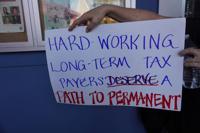
A rally attendee holds a sign calling for a pathway to permanent residency for long-term immigrant workers and taxpayers during a Little Haiti rally supporting Haitian Temporary Protected Status.
“They were very happy to learn English, to come to school,” Pierre said. But after the fear set in, “they decided they can’t come to school anymore.”
That fear brought Pierre to Little Haiti, where Haitian immigrants, community organizers, educators and elected officials gathered on Thursday to demand that the U.S. Senate protect Haitian TPS holders from losing their work permits, driver’s licenses and legal status.
The rally was part of a national day of action organized after last month’s U.S. Supreme Court decision cleared the way for the Trump administration to terminate TPS protections for Haitians and Syrians. The Haitian Bridge Alliance described rallies in Florida, New York, Boston, Georgia, Illinois, Washington, D.C., and other states as a coordinated response to a ruling that, for many families, turned a long-running immigration fight into an immediate crisis.


The Little Haiti Cultural Center was the site of a rally supporting Haitian Temporary Protected Status.
On Friday, the U.S. Citizenship and Immigration Services announced that Haitian TPS holders will keep their status and employment authorization until July 24.
In Miami, the fight over TPS lands in a community that has long carried Haiti’s crises and hopes at the same time. Little Haiti remains the symbolic heart of that story — a neighborhood shaped by Haitian churches, restaurants, radio stations, markets, cultural spaces and families who built a home here while staying closely tied to the country they left behind.


An American Community Survey analysis published by Social Explorer counted more than 106,000 residents of Haitian ancestry in Miami-Dade County, many of whom are concentrated in Little Haiti.
But Haitian Miami extends beyond one neighborhood. It reaches through North Miami, North Miami Beach, Miami Gardens and across the wider region, where Haitian families have helped shape schools, small businesses, churches, health care, hospitality and local politics. An American Community Survey analysis published by Social Explorer counted more than 106,000 residents of Haitian ancestry in Miami-Dade County, with South Florida as a whole hosting the nation’s largest Haitian population.
Temporary Protected Status allows nationals of countries facing armed conflict, natural disasters or other extraordinary conditions to live and work legally in the United States. Haiti first received TPS after the 2010 earthquake, and the designation has been extended or redesignated repeatedly as the country faced deepening political instability, gang violence, poverty and humanitarian crises.

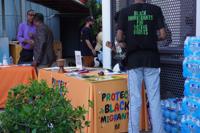
The Black Alliance for Just Immigration shares information with attendees at a Little Haiti rally supporting Haitians Temporary Protected Status.
The Supreme Court’s June 25 ruling in Mullin v. Doe did not determine whether Haiti is safe for residents to return. Instead, the court held that the TPS statute bars judicial review of most nonconstitutional challenges to the secretary of homeland security’s decision to terminate or extend a country’s designation. The court also concluded that the equal protection claim brought by Haitian TPS holders was unlikely to succeed.
The practical effect was immediate: Haitian TPS holders were again left looking to Congress, the administration and the courts for any lasting protection.
Paul Christian Namphy, lead organizer with the Family Action Network Movement, or FANM, said Thursday’s rally was meant to turn that uncertainty into pressure on lawmakers. He said organizers and allied groups wanted to show that TPS holders are not only legal cases or political symbols, but people whose lives are embedded in the communities around them.
“Our sisters and brothers,” Namphy said, face “great danger” if TPS ends, including losing work authorization, driving privileges and protection from deportation.
The immediate legislative demand is for the Senate to take up the companion to H.R. 1689, a bill that passed the House in April by a bipartisan 224-204 vote. The measure would extend TPS protections for Haitians for three years. The Senate companion legislation was introduced by Sens. Lisa Blunt Rochester of Delaware and Ed Markey of Massachusetts, along with Senate Democratic Leader Chuck Schumer and 16 other Senate colleagues.


A speaker leads attendees in a chant at a Little Haiti rally supporting Haitian TPS. “It is our duty to fight for our freedom. It is our duty to win. We must love and support each other. We have nothing to lose but our chains.”
The urgency is sharpened by conditions in Haiti. The U.S. State Department currently advises Americans not to travel to Haiti because of crime, kidnapping, terrorism, unrest and limited health care. The advisory says Haiti has been under a national state of emergency since March 2024. The International Organization for Migration reported that displacement in Haiti reached a record 1.47 million people in May.
Namphy said those conditions make forced return impossible to defend. He said Haitians abroad should be able to help build a stronger future for Haiti, but not by being deported into dangerous conditions.
“We believe in a strong future, prosperous Haiti,” he said. But for those facing removal now, “they have zero good choices in Haiti. They have zero good choices here if they’re forcibly deported.”


A Venezuelan Alliance speaker addresses attendees at a Little Haiti rally supporting TPS protections for Haitian and other immigrant communities.
That uncertainty has already changed behavior in South Florida, including in Pierre’s ESOL students.
“It makes me feel that they stripped something from them,” she said.
The possible end of TPS also raises economic concerns for a region that depends heavily on immigrant labor. FWD.us, an immigration advocacy organization, estimates that 330,000 Haitian TPS holders live in the United States, including 158,000 in Florida. The group estimates 93,000 Haitian TPS holders are in Florida’s workforce, including cooks and servers, agricultural workers, stockers and packers, security guards and nursing assistants. It estimates Haitian TPS holders contribute $2.6 billion annually to Florida’s economy and $1.5 billion to the Miami metro economy.


Two people stand behind speakers at a Little Haiti rally supporting Haitian TPS, holding a banner that reads, “Rigged courts are not due process.” The sign refers to advocates’ criticism of the Supreme Court ruling that allowed the Trump administration to move forward with ending TPS protections for Haitians.
“They are a major part of our economy, our hospitals, our hotels, the airport, the seaport,” said Dale Holness, former Broward County mayor and a candidate for Florida’s 20th Congressional District. “Every aspect of our lives are touched by these immigrants.”
Holness said many TPS holders were among the essential workers South Floridians relied on during the COVID-19 pandemic.
“They were the ones out on the front line when others would not go out to help keep our economy alive,” he said. “They were the ones in the hospital saving lives.”
Other speakers at the rally described Haitian immigrants as parents, neighbors, students, taxpayers, business owners, caregivers and church members — people who have spent years building lives in a place that now depends on them in ways both visible and invisible.
For many TPS holders, however, the legal foundation under those lives remains temporary. TPS does not automatically provide a pathway to citizenship. Recipients can work legally while the designation is in effect, but their futures remain tied to federal deadlines, court rulings and political decisions.
Namphy said Florida’s senators, Rick Scott and Ashley Moody, should support the Senate bill and recognize the stakes for the state they represent.
“We are asking the senators [to] side with the American economy, side with families remaining together,” he said. “Side with our hardest-working members of our community to remain safe and to continue to support the American economy.”
For Pierre, the issue returns to the students who stopped coming to class. She said she hopes TPS protections are extended because recipients “really need to be here in the country so they can build a better life.”