

Growth Dragons Weekly: China Courts Foreign Investors, Bank of China Evades Tax, Two Apple Suppliers Eye Hong Kong IPOs
What happened in China this week:
-
China’s 15-Point Plan to Attract Foreign Capital
-
Bank of China Evaded Tax and the Rest of China’s Banks Have Questions to Answer Too
-
Trip.com Tumbled More Than 10% After Q1 2026 Results on Soft Guidance
-
Two Apple Suppliers Are Lining Up for Hong Kong IPOs
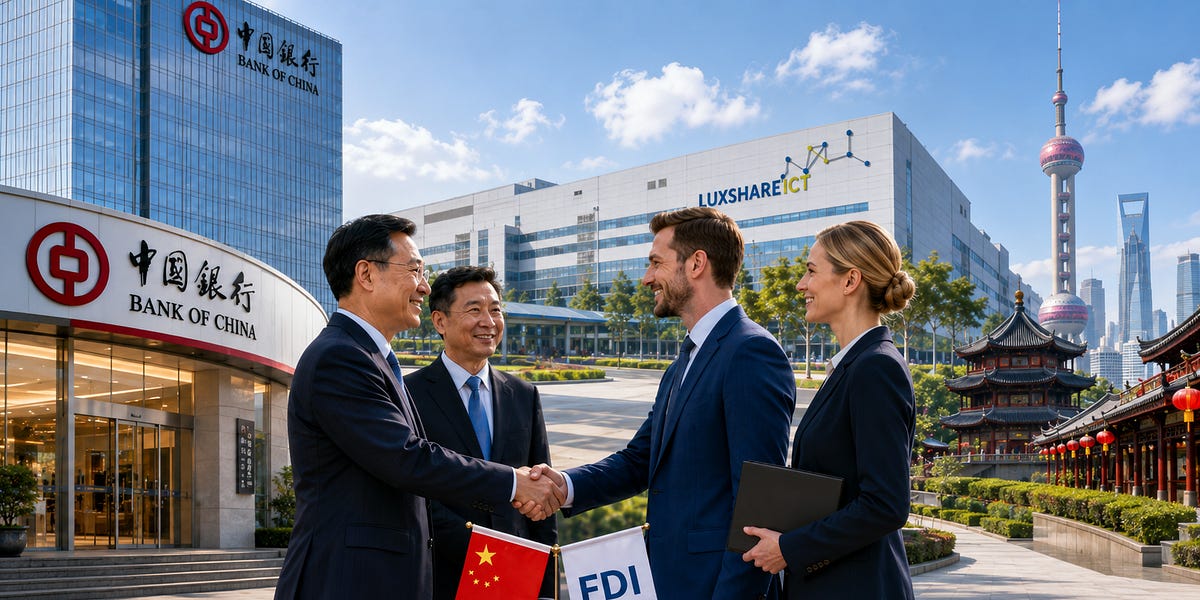
China just dropped a fresh 15-point action plan to court foreign investors. Released on June 22, 2026 and jointly issued by three of the most powerful economic ministries (Commerce, the NDRC, and Finance) it’s the clearest signal yet that Beijing is serious about reversing a troubling trend where Foreign Direct Investments (FDI) into China fell 8.6% in the first five months of 2026.
So let’s go through what’s actually in the plan, and what it means.
The first three points all deal with opening doors that have historically been hard to crack.
On services, Beijing is expanding pilot programs for foreign participation in vocational training institutions, universities, and higher education, specifically science, engineering, agriculture, and medicine. Hong Kong and Macau investors get priority early access. Beijing’s own national services demonstration zone gets a push to pilot new openings in digital economy and healthcare first.
On finance, foreign institutions can now use a wider range of risk management tools including treasury bond futures. They can also conduct fund investment advisory business, something previously off-limits. For large foreign firms, cross-border financing is getting easier, and those that qualify can now pursue domestic listings in China.
On pharmaceuticals, the plan addresses something foreign drug companies have long complained about, the inability to do cross-border segmented production. That’s now being unlocked, meaning an overseas drug license holder can split the manufacturing process across borders. Pilot regions for wholly foreign-owned hospitals and biotech firms are being expanded, and commercial insurers are being pushed to cover more innovative drugs and medical devices.
Points four through seven deal with the mechanics of actually getting money in and working.
The foreign M&A rules are getting a long-overdue overhaul. The current rules date back to 2006. The revised version promises cleaner procedures and clearer payment terms. Qualified foreign private equity firms can also now participate as strategic investors in listed companies, a notable shift.
On data, this is the point that will matter most to tech companies. Free trade zones and pilot cities can now draft their own sector-specific negative lists for outbound data transfers, essentially creating clearer rules for what data can and cannot leave China. National standards for identifying important data will be developed across industries including automobiles, medicine, civil aviation, and telecoms. For foreign companies that have been paralysed by data localisation uncertainty, this is meaningful progress.
On reinvestment, the tax incentive for foreign companies reinvesting their China profits rather than repatriating them will be fully enforced. More reinvestment projects will also qualify for the major and key foreign investment project list, unlocking additional government support.
On R&D centres, Beijing is doubling down on its push to attract foreign innovation capacity. Support policies are being improved for hiring senior foreign talent, setting up open innovation platforms, and commercialising research results. Imported research equipment also gets tax relief.
Points eight and nine are about making China easier to navigate and harder to ignore.
The “Invest in China” brand is getting a digital makeover. A new integrated portal is being built to combine information, consultation, professional support, and feedback in one place. Promotional campaigns will run both domestically and overseas, with a deliberate narrative push around China opportunity and global cooperation. Make of the messaging what you will. The infrastructure behind it is real.
On project recruitment, local governments are getting clearer rules on what they can and cannot offer foreign investors. A list of encouraged and prohibited practices is being published. Critically, the plan says governments must honour policy commitments made in accordance with law. This is a direct response to a long-standing complaint. Foreign companies were promised incentives by local officials that were later quietly withdrawn.
Points ten through thirteen address the day-to-day frustrations of operating in China.
National treatment, the principle that foreign firms should be treated the same as domestic ones, is being more aggressively enforced. Except where restricted by law or national security, all enterprise support policies must apply equally to foreign companies. Government procurement and bidding processes will be subject to stricter fair competition review.
Foreign brands will also be able to participate fully in China’s consumer stimulus campaigns, trade-in programs, green consumption initiatives, and international consumer city schemes. Local governments cannot exclude foreign products from these just because they are foreign-made. That sounds obvious. It apparently needed to be spelled out.
On the online environment, there’s a new complaint mechanism for foreign enterprises facing intellectual property infringement or other online rights violations. Whether this has teeth remains to be seen.
For major foreign investment projects, the government is promising end-to-end case management from complaint collection through resolution and feedback, with periodic public reporting of how cases were handled.
The final two points are about plumbing. Less glamorous, but important.
On regional coordination, eastern provinces and border areas are being encouraged to pair up and cooperate on attracting investment, sharing industrial transfers, and splitting revenue. Border economic cooperation zones get support to co-develop industrial parks with domestic partners and neighbouring countries. The aim is to spread foreign investment beyond the coastal cities where it has traditionally concentrated.
On information systems, the foreign investment reporting framework is being upgraded. A direct reporting channel is being set up to ensure investment data flows cleanly to the relevant agencies covering foreign exchange registration, administrative approvals, and fixed asset investment management. Unglamorous? Yes. But bad data plumbing has been a real headache for foreign firms navigating China’s regulatory maze.
Even as China opens one door to foreign capital, it’s directing significant state investment through another. The National Integrated Circuit Industry Investment Fund, the so-called Big Fund, has been consolidating positions in domestic semiconductor companies, tightening its grip on SMIC, and redirecting capital toward AI chips, advanced packaging, and next-generation manufacturing. The message is clear. In sectors where geopolitical risk is highest, Beijing isn’t relying on foreign investment. It’s deploying state capital.
China wants foreign investment, just in the sectors it chooses, on terms it controls, while simultaneously making sure the industries that matter most don’t depend on anyone else.
Whether it works depends on execution and willingness of foreign firms to trust China. The impact will depend on effective implementation at both national and local levels.