

China Takes Lead In Supercomputer Race
By Mark LaPedus
For some time, the United States and China have been vying for the leadership position in several technical areas.
Those segments include AI, computing, communications, defense, robotics, self-driving cars, space exploration and others. The U.S. is leading in many areas, but China is gaining ground in others.
This should set off some alarm bells in the West: China is suddenly leading the supercomputer race.
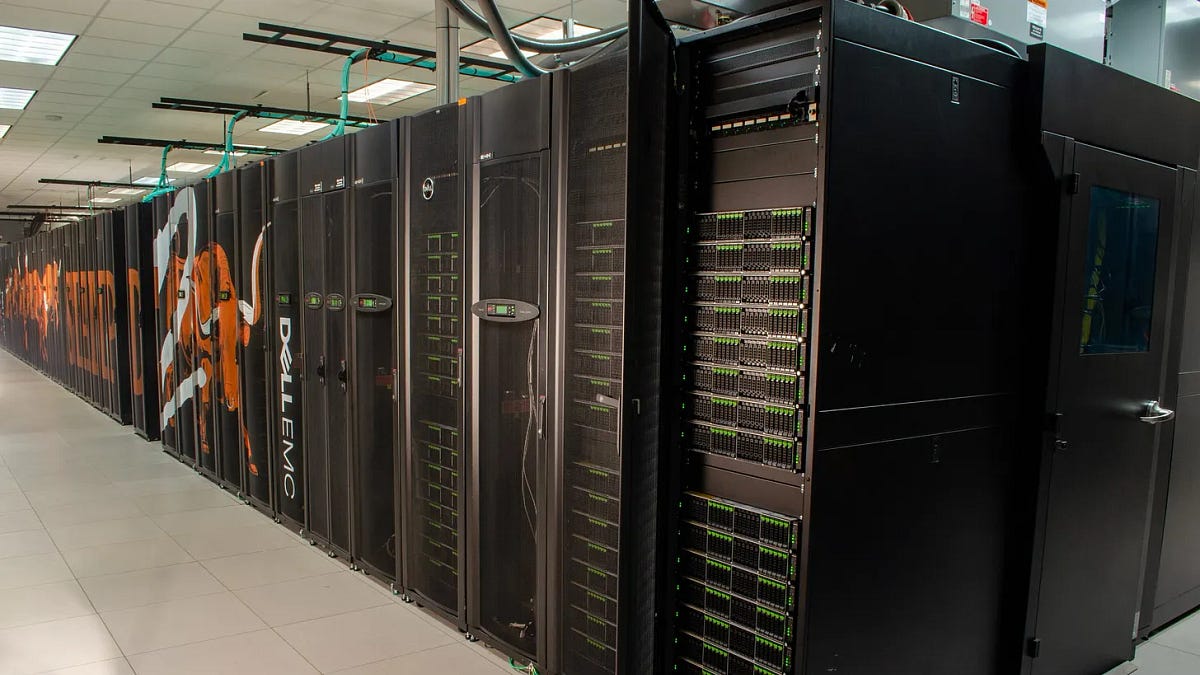
Supercomputers are large and powerful general-purpose systems. They are the mainstream computing systems for today’s high-end applications. Supercomputers are used for various complex, number-crunching applications, such as defense/aerospace, math, physics, medical research, weather forecasting and others.
Nonetheless, the new LineShine supercomputer from China is ranked as the world’s most powerful supercomputer, displacing a U.S.-based system for the top spot, according to the new rankings from the TOP500 project. This marks the first time since 2017 that a Chinese supercomputer has led the TOP500 rankings.
LineShine, a previously unlisted system in the rankings, has displaced El Capitan as the world’s most powerful supercomputer as measured by the High Performance Linpack (HPL) benchmark, according to the rankings. The U.S.-based El Capitan supercomputer is located at the Lawrence Livermore National Laboratory in California.
LineShine achieved 2.198 Exaflop/s on HPL — about 80% of its 2.736 Exaflop/s theoretical peak — making it the first system on the TOP500 to exceed two exaflops of sustained double-precision performance using CPUs only. “An exaflop is a measure of performance for a supercomputer that can calculate at least one quintillion floating-point operations per second,” according to Nvidia.
Installed at the National Supercomputing Center in Shenzhen (NSCS) and built by the Shenzhen Cloud Computing Center, LineShine is based on a custom Chinese processor and the “LingKun” platform.
The system consists of 13.79 million cores across 304-core LX2 processors running at 1.55GHz, linked by the proprietary LingQi interconnect and running Kylin OS, according to the TOP500 project. LineShine draws 42.2 megawatts of power for an efficiency of 52.07 Gigaflops/Watt.
Meanwhile, the El Capitan supercomputer fell from first to second place in the rankings. As before, this supercomputer achieved 1.809 Exaflop/s of performance with 11.34 million cores. This system is based on HPE’s Cray EX255a architecture with AMD’s 4th Gen EPYC CPUs and Instinct MI300A accelerators.
Located at Oak Ridge National Laboratory in Tennessee, the U.S.-based Frontier supercomputer fell from second to third place. As before, Frontier achieved 1.353 Exaflop/s of performance. This system is based on HPE’s Cray EX235a system with AMD’s CPUs and Instinct MI250X accelerators.
Then, the U.S.-based Aurora supercomputer at Argonne National Laboratory holds the No. 4 spot at 1.012 Exaflop/s. Aurora is built by Intel. The system is based on the HPE Cray EX – Intel Exascale Compute Blade, which uses Intel’s Xeon CPU Max Series processors and Intel’s GPU Max Series accelerators communicating through Cray’s Slingshot-11 interconnect.
JUPITER Booster, operated by the Jülich Supercomputing Center under the EuroHPC Joint Undertaking, moves to No. 5 at exactly 1.000 Exaflop/s, remaining Europe’s only system above the exascale threshold on HPL.
Meanwhile, in the TOP500 rankings, U.S.-based HPE is the dominant system integrator, supplying six of the world’s most powerful systems. Supercomputers from Europe, the United States and elsewhere tend to incorporate merchant processors (AMD, Arm, Intel) and/or GPUs (AMD, Nvidia).
In contrast, supercomputers from China tend to incorporate proprietary processors. These systems tend to incorporate as many processors as possible, thereby driving up the performance levels.
Supercomputers vs quantum computers
Supercomputers are not new. These systems have been in the market for decades. Generally, supercomputers incorporate traditional processors, memory and other components. In simple terms, these systems process and store data using the traditional binary language (1 or 0) approach.
In contrast, quantum computers use an internal device called a qubit to encode and process data. A qubit can represent a “0” or “1” or a superposition of both states simultaneously. Thus, in theory, quantum computers can outperform a classical computer. But quantum computers are still in the development stages.
Today’s quantum computer companies are based in China, the European Union (EU), Japan, the U.S. and other nations. It’s imperative for each country to gain a leadership position in quantum computing. In fact, the governments in China, EU, India, Japan and the U.S. are separately funding various quantum computing programs.
In a major boost for the quantum computing industry in the United States, the U.S. Department of Commerce recently announced the signing of nine letters of intent to provide $2.013 billion in federal incentives under the CHIPS and Science Act.
Still, for the foreseeable future, traditional supercomputers will remain the mainstream computing systems for high-end computing tasks.