

Libya’s Gas Awakening: Europe’s Pipeline Alternative to Volatile Global LNG & Future Hormuz Impact
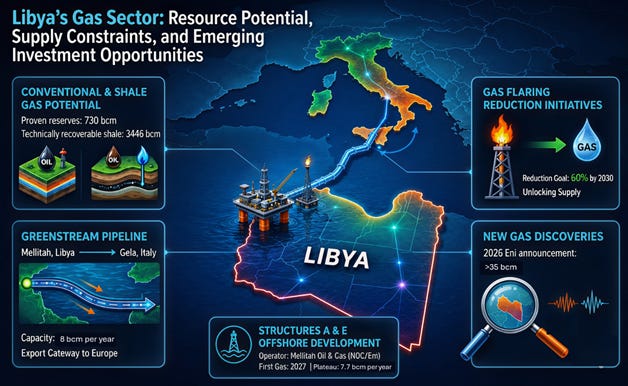
Source: EOA, 2026
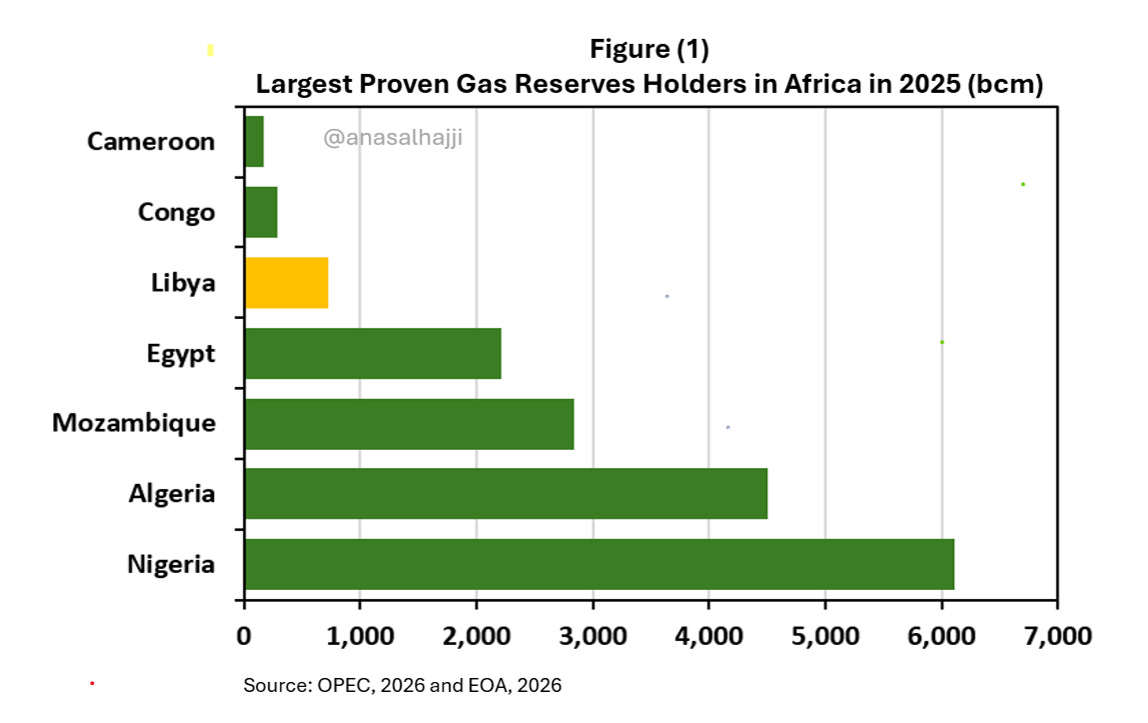
Libya is a major African hydrocarbon producer with a long record of exploration and development. Recent OPEC data show that its proven natural gas reserves reached 730 billion cubic meters (bcm) in 2025, ranking Libya fifth in Africa after Nigeria, Algeria, Egypt, and Mozambique, and ahead of Congo and Cameroon, as shown in Figure 1.
Libya’s unconventional gas potential is even more striking. The U.S. Energy Information Administration (EIA) estimates the country’s technically recoverable shale gas resources at 3,446 bcm, more than four times the size of its proven conventional reserves.
For context, Libya’s technically recoverable shale gas resources are broadly in line with the estimated gas resources of the Levant Basin, which the U.S. Geological Survey (USGS) places at around 3,455 bcm. Discoveries in the Levant Basin have helped turn the Eastern Mediterranean into one of the world’s most attractive hydrocarbon provinces for international oil companies.
Despite this large resource base, Libya remains one of the “least explored and least developed” gas frontiers in the Mediterranean region. Political instability, security challenges, and prolonged underinvestment since the 2011 conflict have held back exploration and development, leaving much of the country’s gas potential undeveloped.
Successfully developing Libya’s conventional and unconventional gas resources could have transformative economic and energy-sector effects. Additional gas production could help satisfy rapidly growing domestic demand, ease chronic power shortages, revive upstream investment, and potentially re-establish Libya as a more important gas supplier to Europe. Realizing this potential, however, will require a stable investment climate, clear energy policies, substantial capital spending, advanced technologies, and a regulatory framework that balances economic development with environmental and social considerations.
Credit: Source link