

5 Powerful Signs Argentina Cuba solidarity Is Defying the U.S. Blockade
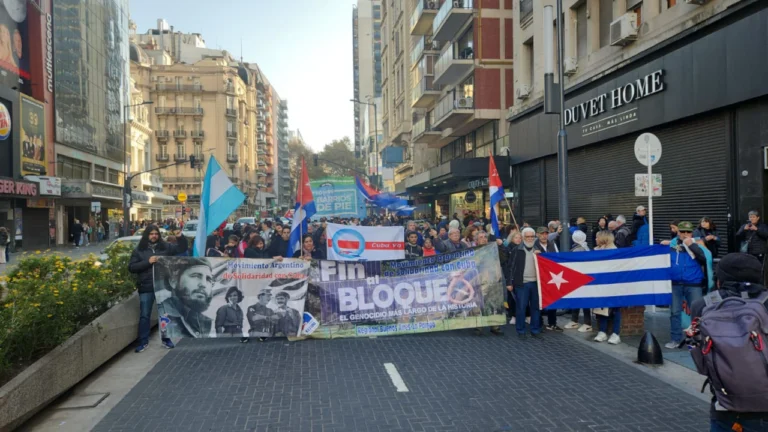
Activists in Buenos Aires march in support of Cuba and call for an end to the U.S. blockade.
May 31, 2026 Hour: 9:48 am
-
-
-
-
-
-
PDF
🔗 Comparte este artículo
Argentina Cuba solidarity fills Buenos Aires as activists demand an end to the U.S. blockade, fuel delivery to Cuba, and removal from terror list.
Related: Argentina Launches Digital Sticker Album Honoring Human Rights Movement Struggle
Argentina Cuba solidarity took center stage in Buenos Aires as activists from more than 100 social organizations marched in support of Cuba and demanded that the United States end its long-standing blockade. The demonstration linked political solidarity with humanitarian demands, including immediate fuel access for the island.
Argentina Cuba solidarity in the streets of Buenos Aires
Activists, union members, human rights groups, and political organizations marched through central Buenos Aires on Saturday under the banner “We Are With Cuba.” The mobilization began at Callao and Corrientes and ended at the Obelisk, one of the city’s best-known landmarks. The march sought to turn public solidarity into pressure on Washington.
The central demand was clear: the end of the economic, commercial, and financial blockade against Cuba. Protesters also called for the immediate entry of oil into the country, arguing that the island continues to face severe shortages of fuel, electricity, transport, and basic goods. Organizers said the blockade has produced a humanitarian crisis that can no longer be ignored.
In a public statement issued during the march, the organizations said the demand was not a plea but a direct insistence on U.S. responsibility. “It is not a request, it is a demand we make to the United States: end the economic, commercial, and financial blockade against Cuba,” the statement said. The groups added that Cuba is not isolated, because “Cuba is not alone.”
The message also condemned what the organizers described as one of the longest and most inhumane policies of the modern era. They said the blockade has lasted 66 years and has been intensified through repeated restrictions, political pressure, and media attacks.
Campaign goals and humanitarian pressure
The march was part of the campaign “We Are With Cuba,” which seeks to strengthen international solidarity with the island and draw attention to the impact of the blockade on ordinary people. Since March, the campaign has also organized fundraising efforts to send solar panels to Cuba, joining similar initiatives in other countries.
The organizers argued that Cuba continues to contribute to the world despite the pressure it faces. They cited Cuban doctors, teachers, medical research, and international solidarity missions as proof that the island gives more than it receives. Among the examples mentioned were Cuba’s vaccine research during the COVID-19 pandemic and its medical brigades in Africa during the Ebola outbreak.
The statement also praised the Henry Reeve International Contingent of Specialized Doctors in Disaster Situations and Serious Epidemics, saying it has saved lives around the world. For the organizations, that international record contradicts the image promoted by the blockade and its defenders.
The communiqué also called on major powers and regional governments to act. It urged China, Russia, and oil-producing countries such as Mexico, Brazil, Colombia, and Venezuela to prevent unilateral U.S. decisions from turning the blockade into what the organizers described as genocide. The wording reflected the sharp political tone of the campaign and its view that Cuba’s hardship is being prolonged by external policy.
Broader meaning for Latin America
Argentina Cuba solidarity has broader implications for Latin America’s political landscape. The march showed that Cuba remains a symbol in regional debates over sovereignty, sanctions, and social justice. For many movements in the region, Cuba represents resistance to external pressure and a call for independent development models.
The protest also revived criticism of U.S. policy toward the island, including Cuba’s designation as a state sponsor of terrorism. Organizers demanded the removal of Cuba from that list and called Donald Trump’s executive order branding Cuba an “unusual and extraordinary threat” irrational and dangerous. They also rejected the recent accusation against Raúl Castro as malicious and unfounded.
The groups said the U.S. designation should never have existed because, in their view, Cuba has been the true victim of organized terrorism originating from U.S. territory, especially Miami. They cited figures claiming 3,478 deaths and 2,099 people disabled or mutilated as a result of that violence. Those numbers were included in the communiqué as part of a broader historical indictment of U.S.-Cuba relations.
From a geopolitical perspective, the mobilization in Buenos Aires reflects how Cuba continues to resonate across the Global South. Solidarity with Cuba often becomes a proxy for broader opposition to unilateral sanctions, foreign intervention, and economic coercion. That makes the march more than a domestic event; it is also a political signal about the future of Latin American diplomacy and resistance movements.
Author: JMVR
Source: telesurtv