

Without a car and faced with accumulated trash on the streets, a 24-year-old university student builds the first handcrafted solar-powered car in Sierra Leone using scrap and recycled materials. It takes three years to assemble the vehicle, which runs at 15 km/h.

Emmanuel Alie Mansaray, a young innovator from Sierra Leone, transformed trash, scrap, and recycled materials into a solar-powered car. The project took three years of work, was born out of concern about pollution in Freetown, and was recognized by the UNDP as the first locally manufactured solar car in the country from waste and repurposed materials.
In Freetown, the capital of Sierra Leone, a young university student decided to tackle two problems at once: the lack of clean transportation alternatives and the accumulation of waste on the streets. Without resorting to a car manufacturer, he began collecting scrap and discarded parts. The person responsible for the project is Emmanuel Alie Mansaray, described by the United Nations Development Programme, UNDP, as a young innovator and self-taught engineer from Sierra Leone. The organization reports that he developed the first locally manufactured solar car in the country using trash and recycled materials.
According to Euronews, Mansaray was 24 years old when he turned the idea into reality. The vehicle, called Imagination Car, took three years of work to be completed and began circulating in the city.
Student transformed scrap into solar car
The story draws attention because it did not start in a large factory or a multimillion-dollar automotive lab. The project was born from the search for a local solution, created from waste, repurposed parts, and materials available in the urban environment itself.
According to Euronews, Emmanuel Alie Mansaray built a solar-powered car using trash and scrap collected along the way. The vehicle was developed in Freetown and started functioning after three years of work.
The UNDP also notes that the creation was made with waste and recycled materials, classifying the project as the first locally manufactured solar car in Sierra Leone.
Project born amidst pollution in Freetown
The student’s motivation was linked to the growing problem of pollution. Euronews reports that Mansaray was seeking a response to the increasing pollution in Freetown, a city where transportation, waste disposal, and fuel use still put pressure on the urban environment.
The Euronews text itself highlights the need for renewable transportation to ensure cleaner air for residents. The publication also points out that part of urban pollution was linked to the use of coal and wood as domestic energy sources.
In this scenario, the handcrafted solar car gained strength as a symbol. Even without industrial scale, the project showed that waste could be repurposed to create a clean mobility solution.
Vehicle took three years to be ready
The construction of the Imagination Car did not happen quickly. According to Euronews, Mansaray spent three years working until he managed to get the vehicle running.
This period reveals the complexity of a project made outside the traditional automotive industry. A car needs to bring together structure, steering, wheels, electrical system, energy storage, and integration between components.
The UNDP states that Mansaray had been working since 2018 on developing prototypes aimed at local challenges, including a solar tricycle for people with disabilities and a silent 600 W fuel-free generator.
Car became known as Imagination Car
The vehicle was named Imagination Car, an expression that reinforces the experimental nature of the project. Euronews reports that Mansaray began driving the car around the city after the creation started working.
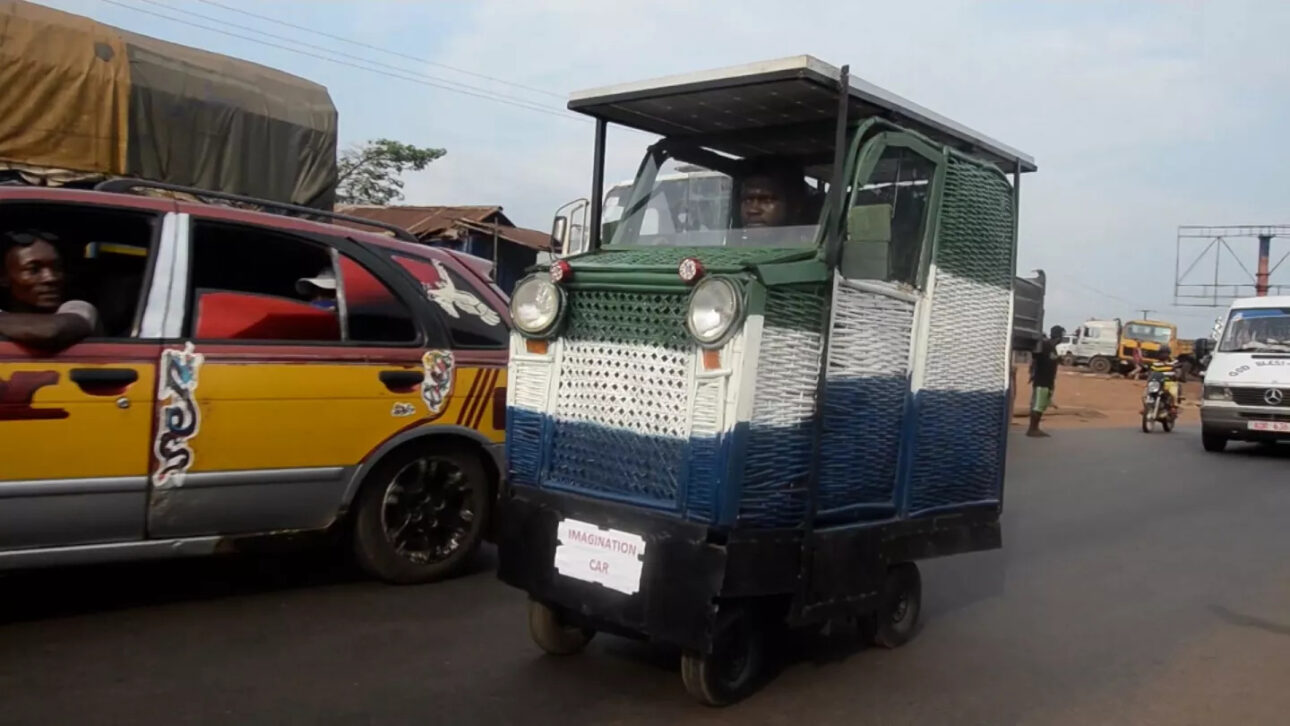
The appearance of the vehicle also carries national symbolism. According to the publication, the car was designed with the colors green, white, and blue, associated with the flag of Sierra Leone.
Local residents described the project as surprising, according to Euronews. The public reaction helps explain why the invention gained attention outside the country.
Speed reaches 15 km/h
The Imagination Car was not presented as a high-performance vehicle. Euronews reports that the car can reach 15 km/h, a speed compatible with a handcrafted prototype created with repurposed materials.
This number does not place the vehicle on the same level as a commercial car. The technical value lies precisely in demonstrating functionality, electric traction, and the use of solar energy in a structure built with limited resources.
The reduced speed also indicates that the project should be seen as a prototype of social and environmental innovation. It shows a possibility of local engineering, not a ready product to replace conventional automobiles on a large scale.
Innovation was recognized by the UNDP
Emmanuel Alie Mansaray’s project gained international recognition by being highlighted by the UNDP in Sierra Leone. The organization presented him as a young innovator and self-taught engineer capable of transforming local challenges into practical solutions.
The UNDP reported that Mansaray’s journey was included in the global documentary For Tomorrow, an initiative linked to community-based innovations. The world premiere was scheduled for September 15, 2022, in New York.
The inclusion in the documentary increased the project’s visibility. The case went from being just a local curiosity to representing the potential of young inventors in countries with less technological infrastructure.
First solar invention came before the car
The solar car was not Mansaray’s first experience with clean energy. The UNDP states that he had already built a locally made solar tricycle for people with disabilities.
The organization also mentions a 600 W silent fuel-free generator, developed in 2018. These projects show that the young man was not working on just one isolated invention, but on a sequence of prototypes.
In 2021, according to the UNDP, Mansaray also developed a prototype of an affordable prosthetic limb for amputees and came second in an assistive technology category during an event linked to the Social Goods Summit.
Solar car aims for accessible energy
Euronews states that Mansaray’s goal was to engage with the UN Sustainable Development Goal 7, focused on access to clean and affordable energy.
This detail helps to understand the project beyond the vehicle. The Imagination Car is not just a handmade car, but an attempt to show that solar energy can be applied in local transportation solutions.
The choice of recycled materials reinforces another point: clean technology does not need to rely solely on imported and expensive equipment. Under certain conditions, scrap can become a platform for experimentation.
Scrap became a symbol of popular engineering
The case of Mansaray shows a form of engineering different from that practiced by automakers. Instead of starting from standardized parts, he gathered available materials, adapted components, and built a functional prototype.
The UNDP calls this type of solution grassroots innovation because it arises from everyday problems faced by local communities. In the case of Sierra Leone, the combination of pollution, waste, and lack of accessible energy created the environment for the invention.
The result is not just technical, but social. The solar car serves as a public demonstration that young inventors can transform material limitations into visible and useful projects.
Despite the repercussion, there is no confirmation from the consulted sources of mass production, commercial approval, or sale of the Imagination Car to the public. The project appears in the sources as a handmade prototype and local innovation.
The speed of 15 km/h, the use of scrap, and the individual construction indicate that the vehicle is closer to a proof of concept than a market-ready automobile.
This does not diminish the project’s relevance. On the contrary, it reinforces its importance as a demonstration of creativity, waste reuse, and solar energy application in a country with significant infrastructure challenges.
Invention puts Sierra Leone on the clean innovation map
The Imagination Car gained attention because it combines three strong elements: youth, technical improvisation, and renewable energy. A 24-year-old student transformed discarded materials into a solar vehicle capable of driving on the streets.
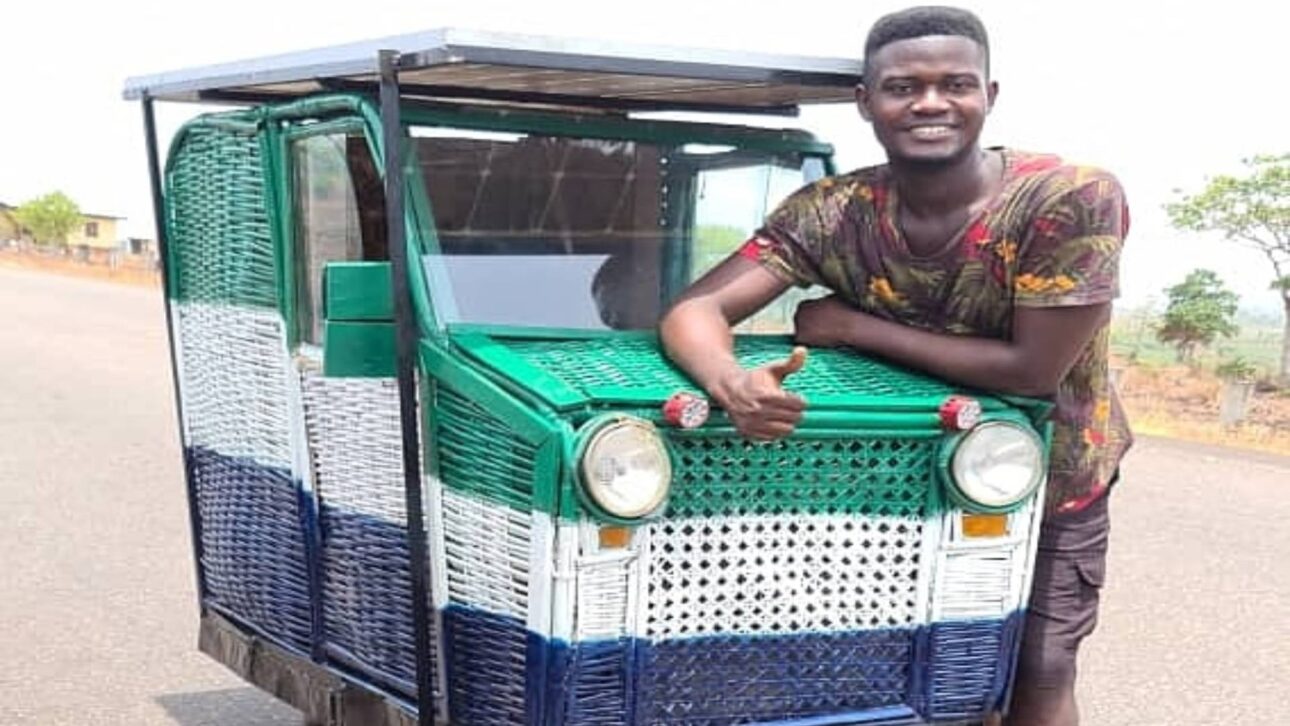
Euronews reported the case as the first solar car made from waste in Sierra Leone. The UNDP reinforced the recognition by describing the project as the first solar car locally manufactured in the country with waste and recycled materials.
The strength of the story lies in the contrast. Where many saw only waste and lack of resources, Mansaray saw parts to assemble a car, test solar energy, and prove that innovation can also be born far from major industrial centers.
Credit: Source link
Comments are closed.