

UN chief says world owes Gaza, Sudan and Lebanon victims a mea culpa
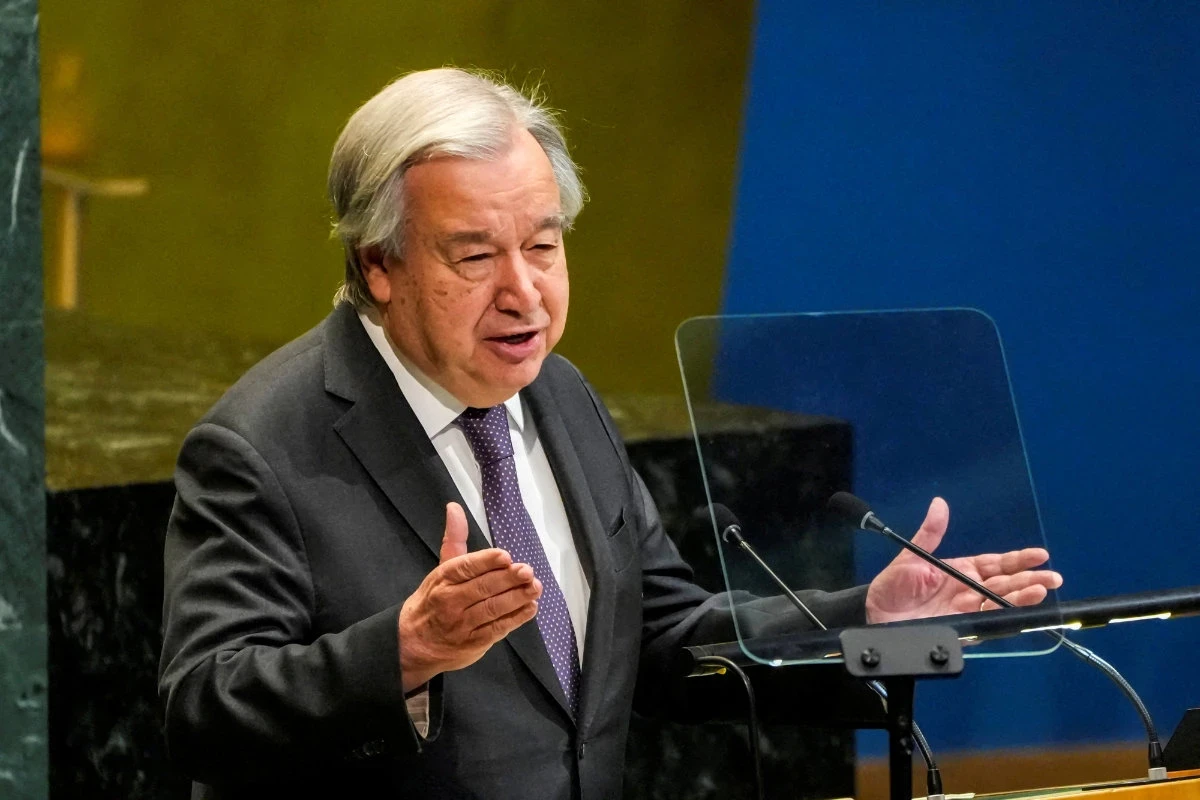
NEW YORK: NEW YORK: UN Secretary-General Antonio Guterres on Wednesday told Arab News that the international community — though not he personally — owes a “mea culpa” to the people of Gaza, the West Bank, Lebanon and Sudan, whose suffering he said the world has too often chosen to ignore.
At his final press conference before the opening of the 81st UN General Assembly, Arab News asked Guterres what he would say to people in Gaza, Lebanon, Sudan and elsewhere who had pinned their hopes on the UN and whose tragedies it failed to stop, and whether he personally owed them an apology.
“‘Culpa’ means that I am responsible for what’s happening to them,” Guterres said, pushing back on the premise. “I’ve been consistently fighting for the rights of those people.”
But he said “on behalf of the international community, there is a mea culpa that needs to be expressed, because the international community has been many times indifferent to the suffering of those people, and this is absolutely intolerable.”
He pointed to the current crisis in the Gulf as an example, saying attention had repeatedly drifted from Gaza and the West Bank whenever a new flashpoint emerged elsewhere.
(Photo caption) Israeli settlers celebrate the inauguration of a newly built synagogue at the occupied West Bank illegal outpost of Homesh on Sept. 16, 2026. (AP Photo/Ohad Zwigenberg)
“There will be no peace in the Middle East without solution of the Palestinian-Israeli crisis, and there will be no peace in the Horn of Africa if the Sudan crisis is not solved,” he told Arab News.
Wednesday’s press conference was the last of Guterres’ tenure before world leaders converge on New York for high-level week.
His second term expires on Dec. 31, with a successor due to take office on Jan. 1, 2027, after the Security Council forwards a recommendation to the General Assembly, a process that began in November 2025 and currently involves eight declared candidates.
In Gaza and the West Bank, Guterres said Israel “is not accepting the implementation of the peace plan as it is conceived now,” even as strikes continue and civilians in Gaza face serious threats.
In the West Bank, he said, “creeping annexation” is underway “with violence by the settlers, sometimes with the support of security forces that are absolutely intolerable,” and warned that new settlements, if completed, could split the territory in two — a move he called “entirely against international law.”
He called for an immediate halt to actions that could lead to “ethnic cleansing” and said conditions must be created “for the two-state solution to be again put seriously on the table.”
He said the US-backed Board of Peace, led by Nickolay Mladenov, “is not replacing the UN” and has run into the same obstruction the UN itself has faced, saying a recent push to advance “phases one and two” of the plan was again blocked by Israel.
The goal, he said, remains “the progressive disarmament of Hamas and progressive withdrawal of Israel from Gaza, full humanitarian access,” and a link between Gaza and the West Bank so a two-state outcome is not lost.
The Gulf crisis drew a similar call for negotiation.
Guterres said “there is no solution for the (Iran) crisis without dialogue,” between the US and Iran and between Iran and Gulf states, citing Pakistan, Turkiye, Egypt and Saudi Arabia as potential mediators — noting Riyadh “is at the present moment becoming one of the victims of this conflict.”
He said he had “clearly condemned” Houthi attacks on civilian infrastructure in Saudi Arabia and on shipping in the Bab Al-Mandab strait, while urging dialogue between the warring sides.
He added that in Yemen military action “will not solve the problem by itself.”
Asked whether states arming the warring parties in Sudan bear responsibility for prolonging a conflict he called “absolutely horrible,” Guterres said the Sudanese parties bear responsibility for fighting each other, but that outside states are fueling the war — a conclusion, he said, reached by the Security Council’s Panel of Experts.
“There should be accountability,” he said, for countries supplying weapons later used to attack civilians in the war, one of the world’s largest humanitarian crises.
In the Syrian Arabic Republic, Guterres said President Ahmad Al-Sharaa “has said all the right things” on development.
He singled out the government’s agreement with Kurdish leadership as “moving in the right direction,” while acknowledging Syria “has enormous problems” after years of war and dictatorship and said the country’s education system needs further attention.
Guterres also warned that artificial-intelligence development is “racing ahead of our understanding of the risks” and that voluntary, unverifiable pauses would not suffice, calling for binding international guardrails rather than good intentions alone, with AI safety expected to feature prominently in his talks with leaders next week.
On climate, citing recent flooding in Nepal and warning of approaching tipping points in coral reefs, forests and polar ice sheets, Guterres said the world will overshoot 1.5 degrees Celsius of warming and must keep that overshoot “as short and as low as possible,” while arguing that falling renewable energy costs and fossil-fuel price volatility tied to conflict make a faster transition both economically and strategically rational.
Credit: Source link