

Thousands of doses of Ebola vaccine arrive in DR Congo
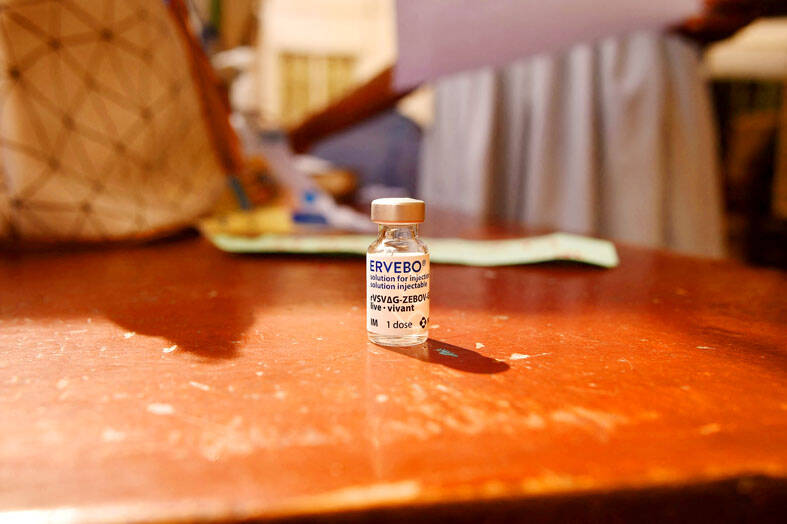
PROMISING:
It is unknown whether Ervebo protects against the Bundibugyo strain, but animal trial data suggest it could offer some protection, the WHO said
More than 16,000 doses of the Ervebo vaccine arrived in the Democratic Republic of the Congo (DR Congo) late on Friday, as the country faces the deadliest Ebola outbreak in its history.
The DR Congo’s 17th Ebola outbreak, which has killed thousands of people, was declared on May 15, but is thought to have been spreading for several weeks prior. It has hit regions in the north and east where the presence of the state is weak, health infrastructure is largely lacking and myriad armed groups have roamed for decades.
The WHO on Thursday announced that DR Congo would receive a total of 70,000 doses of the Ervebo vaccine, produced in Germany.
Photo: AFP
The vaccine, developed by the pharmaceutical company Merck, is approved against the Zaire strain of the virus, but not against the Bundibugyo strain circulating in the country.
WHO experts still do not know whether Ervebo protects humans against the Bundibugyo strain, but early data, notably from animal trials, suggest it could offer some protection.
The Ervebo vaccine “has already been used several times, and in particular on a very large scale during the 2018-2020 outbreak,” Congolese Minister of Public Health Samuel Roger Kamba said.
He was speaking on the tarmac of Kinshasa airport, where a batch of 16,250 doses was delivered by plane.
Of the 70,000 doses made available to the DR Congo, 20,000 are intended for a clinical trial, and 50,000 for “frontline and health workers,” the WHO said.
The Ebola outbreak in the country has already caused 2,516 deaths among 5,290 confirmed cases, the latest data published by the Congolese authorities showed.
“[It] is growing exponentially,” UN Senior Ebola Coordinator Julien Harneis said.
This month, WHO vaccine experts recommended a full-scale human trial of Ervebo, the only existing approved Ebola vaccine, to see if it offered cross-protection against the Bundibugyo strain.
Two vaccines specifically targeting the Bundibugyo strain are in clinical trial phases: one is being developed by the US-based group Moderna, which uses mRNA technology, and the other by the UK’s University of Oxford.
An “rVSV Bundibugyo” vaccine, described by the WHO as “the most promising,” is to be developed by Singapore-based Hilleman Laboratories.
Credit: Source link