

‘The Answers Are There’ by Libby Hoffman
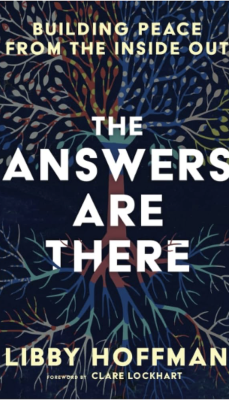
‘The Answers Are There’ by Libby Hoffman, Publisher: Blue Chair Press.
This could have been written for a divided Britain in the 21st century. But it is the story of how people in Sierra Leone repaired their communities following the civil war (1991-2002, 50,000 dead) and Ebola (4,000 dead). The success rests in the belief that local inhabitants, and not national politicians, academics, NGO experts or officials, know what is best. It is grounded in people’s capacity to re-establish trust in each other when they have the agency to determine their future. It is also rooted in the moral authority of Christianity
Whether in post-Brexit Britain or post-war Sierra Leone, it would be optimistic to think one can easily rebuild trust in institutions. Yet the prevailing think-tank-dogma persists, cutting communities and faith out of the picture, assuming some top-down solution can be imposed. In the developing world, this arrogance endures, with international initiatives filtering through corrupt or disinterested national officials, arriving as meaningless jargon at district level.
The well-intentioned ICC and ad hoc tribunals, and the Truth, Justice and Reconciliation Commissions in Cambodia and elsewhere have been expensive, yet often resulting in few convictions, and performative “closure”. Too often, national political interests determine how people tell the truth about what happened during conflict, with survivors feeling enormous pressure to forgive perpetrators. At its worst, it is theatre to appease the international community – and it is bankrolled by the same countries which failed to fulfil their international obligations under the Genocide Convention (1948) and the Responsibility to protect Doctrine (2005). As with Eleanor Rigby, “No one was saved,” and far too few participating in these national spectacles feel they have achieved a kind of justice that resonates within their culture and their religion.
Confession and forgiveness are at the heart of Christianity, and so it is with a community torn apart in a civil war. The approach used by Sierra Leone’s People’s Planning Process and Peace Mothers starts with using traditional settings to try to re-establish trust between people. Decisions are devolved to the lowest possible level, literally sitting around bonfires and speaking openly about issues that have divided people. These centuries-old ceremonies are adapted to include people traditionally silenced (women, youth, the disabled).
In a less individualistic, more communal society like Sierra Leone, many perpetrators embrace the chance to be re-admitted to their community, having confessed and apologized to their victims. Every village contains men who joined with one war lord or other, committing atrocities such as amputations and rape. In poor countries, where thousands took up arms, often only the masterminds were sent to prison.
Having gone through communal healing ceremonies, the informal structures created then become the vehicles for planning how to develop the village economy. Reparations can take the form of joining in a communal farming project or soap-making, earning and saving money together in village loans schemes. Activities like football matches and dances cement these connections. The People’s Planning Processes then send delegates to the district level, advocating for improvements and investment in their area. This is especially empowering for women who have traditionally been excluded by the “big man” culture.
Once the trust is established, the process can be used to prevent election violence and to mediate in future disputes beneath designated Peace Trees. Consultation is an ongoing process, and it requires months of work to get to the point when cleansing processes such as traditional ceremonies can be considered.
These are not quick fixes of the type favoured by the international community. They have also required outside investment by Libby Hoffman’s US NGO Catalyst for Peace, hiring three or four respected local people in each district to make it happen. What they have created has enough credibility in the eyes of survivors and perpetrators that the same process has rolled out across 2,500 villages at a total cost of $2m. Meanwhile the Special Court for Sierra Leone cost $500, with nine people found guilty.
Rebecca Tinsley’s NGO Network for Africa provides trauma counselling for survivors in Sierra Leone.
Credit: Source link