

Sadr, the Militias, and Iraq’s Struggle for Sovereignty
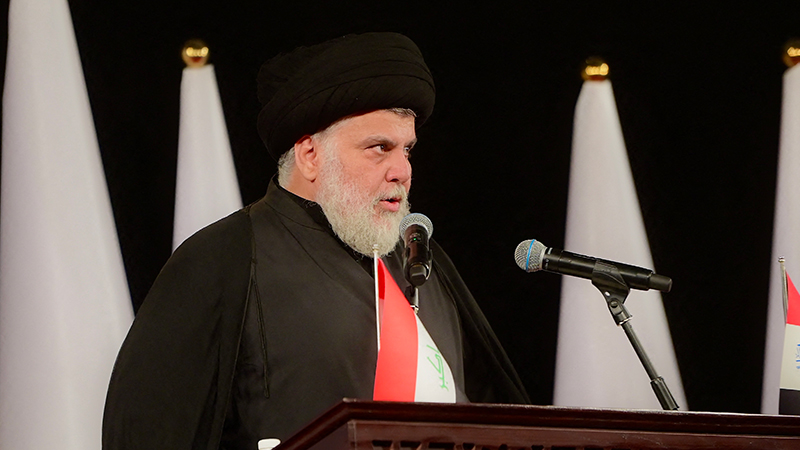
Iraq could be at a turning point following Shia cleric Muqtada al-Sadr’s May 27, 2026, decision to place his armed faction, Saraya al-Salam (the Peace Brigades), under the state’s authority. He also called on the Popular Mobilization Forces (PMF)—an umbrella organization that includes between 50 and 70 Iraqi Shia militias—to surrender their arms to the state. Sadr’s decision came as Washington is putting Baghdad under increasing pressure to disarm Iraq’s militias and to assert its control over armed groups in the country.
Sadr’s move may help the new government led by Prime Minister Ali al-Zaidi in reestablishing state sovereignty. Yet skeptics question whether Sadr is genuinely committed to disarmament or is simply attempting to ensure his relevance in a rapidly changing political environment. Some commentators have interpreted Sadr’s major announcement and actions as a ploy to undermine and embarrass the pro-Tehran armed factions that he has long criticized for weakening Iraq’s sovereignty, not as a serious effort to strengthen the Iraqi state. On previous occasions, such as in 2017 and 2019, there were also reports that Saraya al-Salam’s activities would be frozen. But the group relinquished neither its arms nor its firm political loyalty to Sadr’s leadership.
Disarming Iraq’s militias depends not on declarations from influential figures—however promising they may be—but on whether the Iraqi state can successfully establish a national framework for integrating all armed factions—Shia and non-Shia—from across the political spectrum. The central question is whether Sadr’s move is a genuine advance toward Iraqi sovereignty, or just the next step in the evolution of militia power within the state.
Previous Attempts at Disarmament
Formed in the aftermath of the 2003 US-British invasion and occupation of Iraq and the overthrow of Saddam Hussein’s regime, the Mahdi Army led by Sadr quickly emerged as a powerful actor. After waging an armed resistance against the foreign military presence and setting down roots in Iraqi society, the Mahdi Army soon grew into a major military and social force. In August 2007, during wide-ranging armed clashes, Sadr announced a ceasefire under significant political pressure. In August 2008, Sadr decided to suspend the Mahdi Army’s activities indefinitely—not as a sign of defeat, but as a way to salvage his political project following intense years of armed resistance and exhausting political challenges.
In June 2014, Sadr launched Saraya al-Salam in response to Ayatollah Ali al-Sistani’s fatwa calling on Iraqi citizens to volunteer in the fight against the rapidly expanding so-called Islamic State in Iraq and Syria (IS). The official justification for Saraya al-Salam was to defend Shia shrines and to combat the IS “Caliphate” that had usurped control of large swathes of Iraq. This new force, in fact, was essentially a rebranding of the old Mahdi Army. Sadr’s proven ability to resurrect an armed wing years after its supposed disbanding has raised suspicions regarding his recent promise to lay down arms. Sadr has been shrewd in the past about using the language of demobilization to adapt to Iraq’s evolving political dynamics.
Sadr’s proven ability to resurrect an armed wing years after its supposed disbanding has raised suspicions regarding his recent promise to lay down arms.
The Sadrist movement’s popularity among large segments of Iraq’s population stems from several factors, including nationalism, social services, Islamic legitimacy, and anti-elite politics. Sadr’s resistance to the US-British occupation and his independence from Iran have helped cultivate his image as an Iraqi nationalist. From the movement’s support base in impoverished Shia neighborhoods in Baghdad and southern Iraq, Sadr has been a voice for lower-middle class citizens, for communities underserved by the state, for unemployed youth, and for the urban poor. Perhaps most important, his anti-corruption messages emphasizing the need for accountability and reform have resonated with many ordinary Iraqis.
Understanding the Timing of Sadr’s Announcement
Sadr’s recent announcement about putting Saraya al-Salam under state control arguably reflects his response to evolving political dynamics more than a fundamental shift in ideology. Newly installed Prime Minister al-Zaidi has emphasized the need for state authority amid continuing public frustration with actions taken by armed factions outside the state’s control. The administration of US President Donald Trump has intensified pressure on Baghdad over the role of Iraq’s Tehran-aligned armed factions, some of which have joined Iran’s conflict with the United States and Israel by attacking US military infrastructure along with civilian targets in Iraq, Jordan, and Gulf Cooperation Council states. Washington has been seeking to weaken these armed factions through imposing sanctions on militia leaders such as Harakat al-Nujaba’s Akram al-Kaabi. On May 9, 2026, it was reported that a committee composed of then-prime-minister-designate al-Zaidi, Prime Minister Mohammed Shia al-Sudani, and Secretary-General of the Badr Organization Hadi al-Amiri was working on an “executive project” aimed at disarming Iraq’s armed groups. This project was to be presented in response to mounting pressure from the Trump administration.
Sadr has now tasked a joint committee with facilitating the implementation of this major reform, and the committee has started its work. These steps suggest that Sadr may be attempting to foster an image of a responsible Iraqi statesman who is above factional politics, to replace his old public image of a militia leader. His genuine intentions, of course, may be more complex.
Divisions Among Iraq’s Shia Actors
Soon after Sadr’s May 27, 2026, announcement, Asa’ib Ahl al-Haq and the Imam Ali Brigades also vowed to transfer their arms to state authorities. However, there are yet no signs that other pro-Tehran armed factions in Iraq, including Kataib Hezbollah, Harakat al-Nujaba, and Kata’ib Sayyid al-Shuhada, will take meaningful steps toward disarmament. The political clout of these Shia factions, which are closely aligned with the Islamic Republic of Iran, is deeply rooted in their military muscle. In contrast, the Sadrist movement has sufficient social, political, and religious influence to mobilize support without depending on an overt armed wing. The more hardline Iraqi Shia groups that are part of the Iran-led Axis of Resistance are less bound by Iraq’s domestic considerations, and are more responsive to the wider geopolitical context, including the US-Israeli war on Iran and the December 2024 fall of Syria’s pro-Iran Assad regime. Tehran’s interests and agenda heavily influence their actions. Even if Saraya al-Salam’s integration into the Iraqi state proceeds, other influential Shia groups are unlikely to follow its path.
Even if Saraya al-Salam’s integration into the Iraqi state proceeds, other influential Shia groups are unlikely to follow its path.
Iraq’s Shia political landscape now stands to become increasingly divided between Sadr’s project, which—at least for now—appears to be supporting Prime Minister al-Zaidi’s agenda of asserting state sovereignty, and factions close to the Iranian government, which consider their weapons, autonomy, and regional networks essential to maintaining their position.
This is not to say that Sadr or his movement are inherently opposed to the Islamic Republic. The Iraqi landscape is too complicated to categorize actors by the simple binary of being pro- or anti-Iran. In certain instances, Sadr’s interests have aligned with those of Tehran, such as his opposition to the US military presence on Iraqi soil. In others, his interests have clashed with Iran’s, particularly regarding the role of Tehran-sponsored armed factions under the PMF umbrella. Sadr has gone to pains to stress that he is not subservient to Iran, but his relationship with Tehran can veer from cooperative to, at times, somewhat adversarial.
Defining “State Control” in Iraq’s Contemporary Context
To be sure, the incorporation of armed factions into the Iraqi state is a complicated matter. Defining “state control” requires addressing the fact that many of these Shia militias are, from a legal standpoint, already part of the state. But formal integration does not necessarily mean operational control. Funded by Iraq’s national budget in the amount of $3.5 billion annually, the PMF technically is a state institution, despite the fact that some of the factions under its umbrella have maintained high levels of autonomy and loyalty to their own leaders, not to the Iraqi armed forces’ top commanders. If history is any guide, the formal integration of armed factions into the state will not guarantee that these organizations will cut ties with their original commanders.
There are several scenarios under which armed factions could be integrated into the state. First, militias could genuinely incorporate themselves into the state and adhere to a unified chain of command, significantly reducing their autonomy. Second, they could partially integrate, meaning that their leaders would essentially become political actors in Baghdad while retaining their militia influence. Third, the most minimal form of integration would entail militias surrendering their heavy weapons while keeping their other armed capabilities intact. Ultimately, weaponry itself is not the key issue: reforming the political power structures that determine how these arms are used is more consequential and equally urgent. For now, it is unclear which path is being discussed by government officials in Baghdad and by the armed factions that have agreed to disarm.
A Model for Iraq’s Future?
Sadr has created political momentum that some optimists might credit with pressuring Iraq’s Tehran-aligned armed factions to incorporate into the state. From this perspective, Iraq now has an impetus for reform that can help the state to assert its sovereignty. Yet Sadr’s two decades of reversals and Iranian patronage, coupled with Iraq’s weak national institutions, may dim the prospect of successful disarmament.
Tehran undoubtedly has its own interests in pressuring pro-Iran forces in Iraq to resist such reforms.
Indeed, Iran’s high level of influence in Iraq cannot be ignored. Tehran undoubtedly has its own interests in pressuring pro-Iran forces in Iraq to resist such reforms while it continues to argue that disarmament is part of an American-Israeli plot to weaken Iraq. After the fall of Bashar al-Assad’s government in Syria, the blows that Lebanese Hezbollah suffered in its 2024 war with Israel, and the damage inflicted by Israel and the United States in their 2025 and 2026 wars on Iran, the Islamic Republic’s leadership increasingly considers the Tehran-aligned Iraqi militias important to the Islamic Republic’s regional influence—particularly as long as it remains in conflict with the United States and Israel.
The success of disarmament is less about the influence of Sadr himself and more about the capacity of Iraq’s national institutions to implement security sector reforms in the face of daunting challenges.
Conclusion
Sadr’s declaration highlights a major test for Iraq. Implementing the reforms necessary for the Iraqi state to fully assert its sovereignty is likely to deepen Iraq’s political divisions, particularly among the various Shia groups. Iraqis also must decide what disarmament means in practical terms and assess whether securing the state’s monopoly on force is even possible in the current regional context.
It may be unrealistic to expect Iraq’s hardline armed Shia groups, so deeply tied to Iran’s Supreme Leader and its Islamic Revolutionary Guard Corps, to agree to disarm. Other factions will likely take steps to integrate into the national armed forces without fully relinquishing their independence from the state or giving up their arms. For these groups, these moves mainly would serve to end Washington’s characterization of them as Iran-linked rogue actors. Yet without addressing whether the militias surrender political power to the state along with their arms, disarmament risks being largely an exercise on paper. Ultimately, Iran’s entrenched patronage networks—and the Iraqi state’s lack of capacity or willingness to confront them—will limit the al-Zaidi government’s success in reining in the pro-Tehran factions.
The Trump administration arguably sees Iraq mainly through the prism of countering Iranian influence. Trump’s heavy pressure on Baghdad to take significant action against pro-Iran armed factions has been the main factor driving Washington’s disarmament policy. Baghdad’s taking up this agenda has been motivated by fear of US sanctions that would halt the foreign investments that Iraq so desperately needs. Sadr’s May 27, 2026, announcement seems to have been positively received by the Trump administration: the newly appointed US envoy to Iraq, Trump’s ambassador to Turkey Thomas Barrack, hailed the cleric’s initiative as a positive contribution to Iraq’s “architecture of order.”
Nevertheless, the Trump administration may not be satisfied with the Iraqi government’s efforts given the ongoing US war against Iran, into which Iraq increasingly may be drawn. Under these circumstances, Sadr’s Shia rivals—who are deeply loyal to Iran’s Supreme Leader Ayatollah Mojtaba Khamenei—are likely to consider even discussing disarmament to be dangerous. For Iraq, the challenge is not just whether militias can be integrated into the state, but whether the state can genuinely assert itself.
The views expressed in this publication are the author’s own and do not necessarily reflect the position of Arab Center Washington DC, its staff, or its Board of Directors.
Featured image credit: Photo by MUNTAZER UDAY SAHIB / NURPHOTO / NURPHOTO VIA AFP
Comments are closed.