

Pitso Mosimane’s Bafana return: redemption, pressure and unfinished business
Myron Naicker|Published

Comment
The footsteps which echoed through SAFA House on Tuesday belonged to a man walking past his own ghost.
Pitso Mosimane has stepped inside the administrative headquarters in Nasrec many times before. He knows the quiet hum of the executive offices and the heavy atmosphere that pervades the home of the national body that once pulled the trigger on his coaching ambitions.
Fourteen years ago, the debacle in Mbombela against Sierra Leone and a subsequent draw with Ethiopia, eight months later brought his first spell to a painful halt. Across 23 matches in charge between 2010 and 2012, his record stood at nine wins, 10 draws, and four losses, leaving him with a modest 39.1 per cent win rate when his tenure was cut short and his public standing left in tatters.
Does football ever truly grant second chances, or does it merely delay its next heartbreak? Do people ever genuinely forgive, or do they simply store past mistakes away, waiting for the first sign of vulnerability to bring them back to the surface?
In a game governed by short memories and ruthless judgment, redemption is the hardest currency to earn. Yet, as the Lebanese-American poet Kahlil Gibran wrote, “To be able to look back upon one’s life in satisfaction is to live twice”.
Unfinished Bafana business
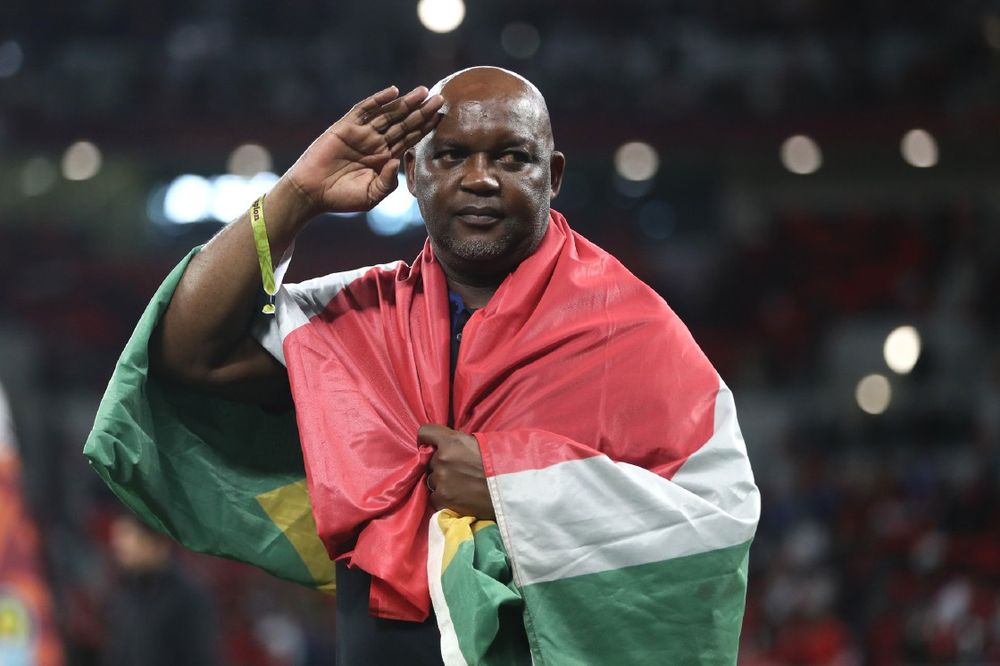
When the 62-year-old tactician stepped up to the podium on Tuesday to be officially unveiled as Bafana Bafana head coach, he entered the auditorium to complete unfinished national business.
With a resume glittering with trophies and FIFA Club World Cup accolades, Mosimane remains a hot commodity. He could easily have chosen lucrative offers in North Africa, the Gulf, or Asia, where massive contracts and state-backed budgets were readily available. He did not need this role for money, security, or validation. He chose Bafana Bafana because he carries an intrinsic, unquenchable drive to succeed where the stakes are highest.
For all his club dominance, Mosimane understands that conquering domestic and regional leagues was merely prologue, elevating his own country to a sustainable international power will be his true magnum opus.
The road ahead is defined by a massive strategic vision. First comes the high-wire act of the 2027 Africa Cup of Nations qualifiers in East Africa, where a single slip-up in a treacherous three-team group could spell disaster. Beyond that lies the big fish, navigating the expanded qualification cycle for the centenary 2030 FIFA World Cup across Morocco, Portugal, Spain, and South America.
Where others might have been broken by that departure in 2012, Mosimane built an empire out of the fallout. Back then, as he stood on the brink of dismissal, he issued a prophetic warning to a resistant federation.
“We don’t want to accept that the world is catching up with us… We need to accept reality.”
Rather than staying behind, he went out and conquered that reality. He spent the next decade and a half traversing the continent and the globe, studying elite structures and collecting silverware under intense scrutiny.
He transformed Mamelodi Sundowns into an unstoppable domestic force before capturing the continental crown in 2016. He stepped into the furnace of Cairo with Al Ahly, winning back-to-back CAF Champions League titles in 2020 and 2021, reaching three consecutive continental finals, and claiming two FIFA Club World Cup bronze medals. Later stints in Saudi Arabia, the UAE, and Iran broadened his horizon even further.
Standing before the press, Mosimane measured the vast gulf between the man dismissed in 2012 and the decorated leader at the microphone by pointing directly to the sheer weight of his accrued achievements.
Reminding those in attendance that during his first spell he had yet to win even a domestic cup competition, he noted that 21 major medals now separate his past from his present, including participation across four FIFA World Cups at both club and international levels. For Mosimane, the personal and tactical architecture required to succeed at this level is now fully loaded.
Son of the soil
There is an undeniable truth in appointing a native son to lead a national side; across every FIFA World Cup tournament played since 1930, every single winning boss has been a domestic coach.
In nearly a century of global football, only two foreign tacticians have ever even reached a World Cup final. International football, at its zenith, demands a soul-level understanding of a nation’s identity, culture, and psyche that no hired mercenary can replicate.
Now, this is not to suggest that South Africa is ready to challenge for a World Cup title, perspective remains essential.
Yet, trusting the man affectionately known as “Jingles” is not an act of sentimental charity, it aligns with football’s most enduring law.
Navigating SAFA’s adminstrative turbulences
While the playing squad itself is far from broken, Mosimane walks back into an administrative space plagued by familiar, lingering inertia. SAFA House remains a turbulent landscape, currently shadowed by public standoffs over government-ringfenced development grants, unspent VAR funding, and structural delays that continue to draw intense ministerial scrutiny.
It is the very landscape Mosimane warned the country about fourteen years ago, a global game moving at hyper-speed while local administration stumbles along behind. To succeed, the new head coach must build a modern, high-performance sanctuary on the pitch that operates entirely above the administrative noise and friction. I know right, easier said than done.
That depth of experience is vital because the incoming coach is inheriting a squad rich with quality. Hugo Broos departed after five strong years, having led Bafana Bafana to an AFCON 2023 bronze medal in Côte d’Ivoire and pushing them into the Round of 32 at the 2026 World Cup in North America.
Broos restored international credibility; the mandate now is to convert that foundation into silverware and guaranteed World Cup qualification.
Crucially, Mosimane is not dismantling what works. He made it clear that he is not carrying a broom to sweep the house clean, recognizing that the current squad boasts elite individual pillars like Ronwen Williams and Teboho Mokoena alongside stars like Relebohile Mofokeng, Sphephelo Sithole, Mbekezeli Mbokazi and many others.
Instead, he is bringing in his trusted technical team to raise daily standards. Addressing chatter around assembling his own backroom staff rather than retaining interim assistants, Mosimane grounded his decision in elite international precedent, noting that top-tier leaders naturally bring their own trusted personnel, citing Carlo Ancelotti’s success alongside his son, because the global game judges only the ultimate output, not the composition of the bench.
He embraces that pressure, openly admitting that public criticism serves as his primary fuel.
Yet long-term dreams mean nothing without immediate execution.
His primary objective begins on the pitch, navigating the treacherous waters of the 2027 AFCON qualification campaign against Guinea, Eritrea, and co-hosts Kenya.
With Kenya automatically qualified, Mosimane faces an unforgiving environment where only one team advances from the group. It is an immediate task that demands ruthless focus before 2030 World Cup ambitions can be spoken aloud.
Understanding national setup
This is a coach who understands the national setup from the inside out, having earned four caps and scored on his international debut against Gabon in 1993. Having represented his country as a player and led teams at the highest levels of global football, he returns home with perspective and an established tactical blueprint.
Following the announcement, social media predictably ignited pockets of skepticism, as cynical fans revisited old scars and questioned whether retreading familiar ground is ever the answer.
Yet internet commentary cannot overwrite a resume forged in gold across Africa. Mosimane has earned this opportunity through a decade and a half of relentless, proven work.
Weekly results will dictate his immediate survival, but legacy will define his career.
In this second stint, Mosimane stands on the precipice of his defining act, to transform Bafana Bafana into a sustainable global force, ensuring that the native son who once fell at Mbombela, leaves South African football fundamentally transformed for generations to come.
Crédito: Link de origem
Comments are closed.