

No to the FIFA World Cup, yes to cycling – How the UCI Road World Championships returned to Montreal for 2026
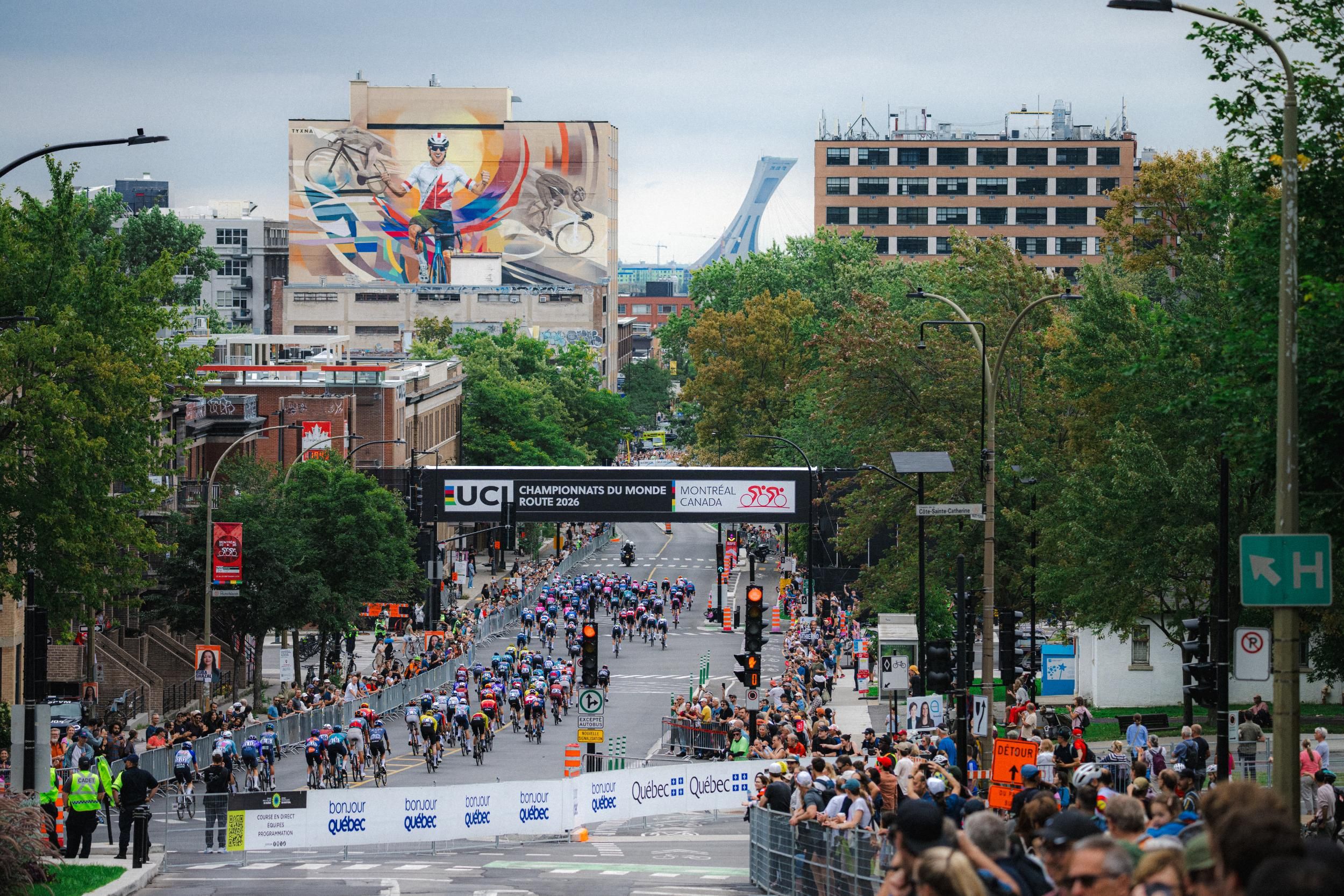
One hour. That’s how long it took for a bid for the 2026 UCI Road World Championships to arrive on the mayor of Montreal’s desk after city officials confirmed they wouldn’t be bidding to be a host city for the 2026 FIFA World Cup.
That was back in 2021. The bid was ready – it had been for years – and all the organisers needed was the green light to get the ball rolling for the first North American World Championships in 11 years.
Fast forward to now, and the long-anticipated Montreal World Championships are very nearly here, but it’s an event that’s been in the works for much, much longer than the five years since the bid. In fact, the organisers have been dreaming about this since the very start of the Grands Prix Cyclistes de Québec and Montréal.
Latest Videos FromCyclingnews
“The idea about the Worlds started maybe two or three years after [the first editions], at the third edition of the Grands Prix Cyclistes,” explained the GPCQM and Worlds general manager, Joseph Limare, tracing this event’s roots all the way back to 2012.
“It was a big challenge to have WorldTour races outside of Europe. The first year was, for all the cycling community – the WorldTour, UCI – a test. At the first edition, the teams went for maybe a kind of holiday in Canada, but after the first edition, they saw how we take care of the organisation, how we take care of the teams, about the quality of the race, and they also discovered at that time how hard the two Grands Prix Cyclistes of Québec and Montréal were. So after the first or second edition, the mindset changed.
“The feedback that we had after two editions was ‘OK, you are in the top 10 of organisations’. And with the originality to be on a circuit, it’s like the World Championships, the direction where the UCI wants to have the World Championships always finish on a circuit. So the idea came.”
From the seed of an idea, the planning slowly began. An early decision to make was which city might host. The World Championships had come to Montreal before in 1974, and then Hamilton in Ontario in 2003, though Montréal quite quickly became the obvious choice and they started to work out the details.
The latest race content, interviews, features, reviews and expert buying guides, direct to your inbox!
“It’s not the same thing [as the Grands Prix]. It’s 10 times bigger than a WorldTour [race] to organise the World Championships. So after that, it was a long work about which year, where in Quebec or in Canada. We had the last edition in 2003 in Hamilton, so we needed to focus on where and when,” Limare explained.
“The work began at that time, and when the city of Montreal took the decision not to go with FIFA in 2021, the bid was ready on our side … So maybe one hour after the decision of the city of Montreal not to go with FIFA, the bid was on the desk of the mayor. And after that [it was], ‘OK, go’, so we decided to put the bid in for 2026.”
Designing a distinct route
Already WorldTour hosts for a decade, the GPCQM organisers had the confidence and backing of the UCI from very early on, who knew they could deliver a good race in Montreal. But from the start, Limare knew they didn’t want to just run the Grand Prix de Montréal version 2.0 for the World Championships.
Both organisationally and in terms of the sporting challenge, it needed to be different.
“When we jumped into the first discussion with operational people in Montreal four years ago, the first discussion was, ‘OK, it’s like the Grand Prix Cyclistes.’ No, no, no, no, no. We had to convince them that it’s not like the Grand Prix Cyclistes. It’s eight days; it’s 13 events.”
They also had certain requests from the UCI, who wanted the 2026 courses to fit into the variation of Worlds courses over the years: “The UCI asked us to have a race less difficult than last year in Kigali and less difficult than next year in Sallanches.”
So what they came up with was a revamped course, finishing in the iconic natural stadium that is the hilly Mount Royal park in the centre of Montreal, but with tweaked laps, and a loop out of the city that will show off parts of Montreal that the Grand Prix has never visited.
“We did not want 100% on the circuit, because we want to show Montréal, not just on the circuit, and involve the population,” Limare said. “Cycling is a sport that is going to the population. For us, it’s already easy to have people coming downtown with subways or buses and everything to come to the event, but we wanted to have more people involved because it’s cycling.”
There’s a sporting benefit to expanding outside of the circuit, too, with Limare hoping that the 12 laps, compared to the Grand Prix’s 16, will change the shape of the racing.
“They have 16 laps for the Grand Prix Cyclistes, [which is] easier for Pogačar, for example, or that kind of rider,” he said, speaking before the news that Pogačar would miss the World Championships. “But we ‘only’ have 12 laps for the Worlds, so it won’t be as easy as it could be for Pogačar to win, because with less laps, it will open the race.”
New challenges
Of course, as well as designing a route that was distinctive and different from the Grand Prix, Limare and his team have faced brand new challenges in organising an event as big as the World Championships.
Even the matter of going beyond the main centre of Montréal is a prime example of how the challenge quickly multiplied.
The main city of Montreal is an island, so to take the race off it, they obviously need to use bridges. And in Canada, bridges are under the domain of not the local government, but the federal government, so they had to work with the Canadian government from day one. Whilst some questions were an easy yes, Limare explains, other people – like the police forces outside the city who would help with security – took longer to convince.
What’s more, in Montreal they will host not just two road races like for the Grands Prix, but six, plus six time trials, and the mixed relay, as well as the UCI Congress. Hundreds more riders, hundreds more dignitaries, and hopefully thousands more fans. Roads need to be closed for over a week – in fact, the main finish area will be closed for more than a fortnight, straight through from the Grand Prix to the end of the Championships.
In total, 36km of roads will be closed for the duration of the event – excluding the trip outside of the city – which Limare underlines as an achievement to ‘only’ close that many kilometres, minimising what will be a lot of disruption in the city.
It’s a logistical challenge ramped up to the max, and Limare points to the addition of time trials as a particular puzzle to solve, and something his organising team had never done before.
“We had the mountain, we had the finish, but for us, the new thing is the time trials, because with the Grand Prix Cyclistes, we don’t have that kind of event,” he explained. “For us, it was natural to have the time trial around the river, so we will have the time trials there, to have less elevation.
“Also, we have no European culture of cycling here, and we never had a time trial, for example. So for people here, it will be a new event, a time trial, they don’t know, so we need to explain.”
Five years of official planning done – and almost 10 before that – Limare and his team have done the outreach and promotion in Europe, they’ve done the work in the local community, they’ve done the work with the city, and now all that’s left is the actual event. Given how long this has been in the works, the organisers seem more than ready.
“So far, so good,” as Limare put it.
A Canadian team so good it feels planned
The cherry on top of all of the organisers’ planning is that this year will mark the first time ever that a Canadian rider comes into the World Championships as the defending champion in the road race.
Magdeleine Vallieres Mill won the country’s first elite road race title this time last year, putting Canadian cycling on the map in a big way and kicking off a year of hype for her home World Championships.

For a plan over a decade in the making, the timing couldn’t be much better.
“You think it was the plan?” Limare joked. “It’s really good timing, the best marketing plan that we could have with Magdeleine’s victory last year. The girl power is awesome, and not only in the elite team, but for under-23 too, we know Isabella [Holmgren] will perform in under-23 too – our best chance of medals is maybe in the under-23, not elite.
“Magdeleine is focused on the 26th of September; she will be at home, she will have all the support and recognition from the Montréal citizens, and all who come for the Worlds. So the timing is perfect for us.”
Whilst Canadian road cycling is looking the healthiest it has in a long time right now, Limare also hopes that the Worlds can contribute to that growth, as well as shining a light on what has already been achieved.
“We have more and more young riders, men and women, involved in cycling, more and more riders who are going to Europe for training camp or races, and this is part of what we want to celebrate with the Worlds,” he said.
“We managed to be able to fund Cycling Canada and the Fédération Québécoise with a donation after the Worlds to be able to have more and more training camps and programmes for juniors to be able to bring them to Europe and to let them perform and understand cycling more than they can here, with more races and being more and more involved in the highest level.”
Considering Canada’s men’s football team exited the FIFA World Cup in the round of 16 earlier this summer, but their cycling stars are genuine medal contenders in multiple races next week, it certainly feels like the city of Montreal made the right call on that all-important day five years ago.
Subscribe to Cyclingnews for comprehensive race coverage of both the UCI Road and Gravel World Championships, alongside the final monument of the season, Il Lombardia. Subscribers get unlimited access to exclusive analysis from our expert columnists, in-depth features and industry-leading tech insight. Plus, the Cyclingnews app lets you follow the action wherever you go! Join today.
Crédito: Link de origem