

Meet The Marshes Boy, the teenager introducing the world to Iraq’s ancient wetlands
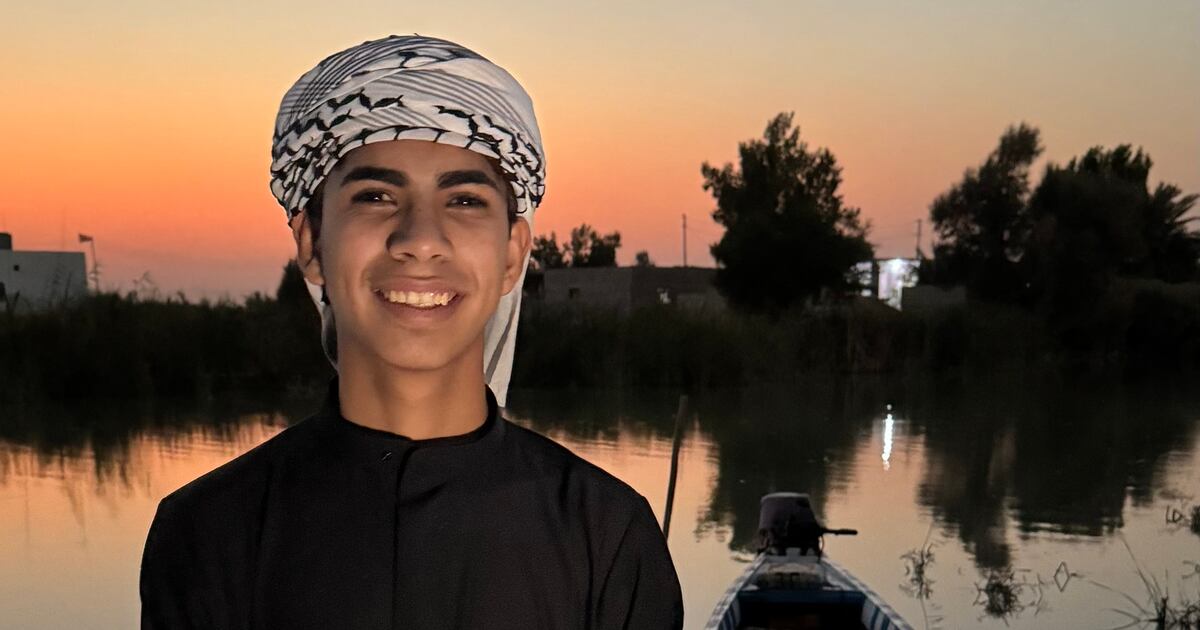
As the sun begins to dip over Iraq’s southern Chibayish marshes, 16-year-old Sajjad Hassan steers his narrow wooden boat through a maze of reeds, pointing out buffalo cooling in the water, birds circling overhead and reed houses that have stood here for generations.
“I know every channel and every branch in the marsh waters, just as a driver knows his way inside the city,” he says.
Known locally as Fata Al Ahwar or The Marshes Boy, Sajjad is one of the youngest tour guides in Al Chibayish, a town on the Euphrates River. He introduces visitors from around the world to one of humanity’s oldest inhabited landscapes while trying to ensure it has a future.
“I like talking about the nature here. The nature is very beautiful, so many animals here,” he says.
Sajjad started guiding visitors when he was just 10 years old, after watching local and international tourists arrive in his village. While most children his age were still in primary school, he was already learning how to introduce strangers to the wetlands he calls home.
Today, his tours are about much more than showing visitors the scenery. They are about preserving a place whose future is increasingly uncertain.
The Mesopotamian marshes, a Unesco World Heritage Site, are among the world’s largest wetland ecosystems and are often described as the cradle of civilisation. Yet decades of environmental degradation, prolonged drought, climate change and reduced river flows have left them facing one of the greatest challenges in their history.
According to a 2023 research paper titled Towards Hydro-Transparency on the Euphrates-Tigris Basin, the area of permanent water in Iraq declined by about a third between 1984 and 2015, with the greatest losses in the south. The Mesopotamian marshes alone experienced an 86 per cent reduction in permanent water during that period.
The consequences are visible everywhere.
“The water you see now is here because of the last rain; otherwise, honestly, there would be no water,” Sajjad says. “Right now, fish stocks are deteriorating, birds have started to migrate, and livestock breeders have begun to move away as well.”
For generations, people here depended on fishing and raising buffalo. It was a life closely tied to the rhythms of the water. Sajjad loved the idea of becoming a fisherman himself.
But shrinking water levels, pollution and rising salinity have made that dream increasingly difficult for many young people growing up in the marshes.
Instead, Sajjad found another way to support both himself and his family.
Tourism provides an income, albeit an unpredictable one. During the scorching summer months, visitor numbers fall sharply as temperatures soar and facilities become more limited. Rather than waiting for tourists to return, Sajjad spends the quieter months preparing for them.
Inside a traditional reed house known as a mudhif, armed with little more than a notebook, a pen and a dictionary, he teaches himself English.
“I learnt English from tourists, and also from my daily practice,” he says. “I watch videos online, I also write down words, then I go back over them.”
Social media has become another classroom. It is where Sajjad practises his English, promotes his tours and shares the marshes with people who may never have heard of them.
“Comments come to me in English and I reply to them,” he says. “Most of them are positive comments, like ‘keep going’, ‘what you are doing is wonderful’. And honestly, I feel happy because what I am doing is something simple.
“Thank you to the people and for their trust in me, so that I can be a voice for the marshes, God willing, in the future.”
Among his admirers is Chinese tourist Rylie, who met Sajjad while visiting the wetlands.
“People like me admire the culture and scenery, that’s why we come here,” she says. “I think they have to adapt to the changes. They have advantages, like all the resources, which are really amazing.”
Turning to Sajjad, she adds: “I wish you a promising future, and I know you’re going to be very popular.”
Despite his growing profile, Sajjad continues largely without official support. Instead, he relies on the same tools that helped him learn English: his phone, his notebook and his determination to tell the marshes’ story before more of it disappears.
Comments are closed.