

Kia Transfers ‘Green Light Project’ Operations to Support Community Self-Sufficiency in Albania and Zimbabwe
Global Social Contribution Initiative “Green Light Project”
19 Hubs Established in 15 Countries Over 15 Years
Kia’s global social contribution initiative, the Green Light Project, has also borne fruit in Albania and Zimbabwe.
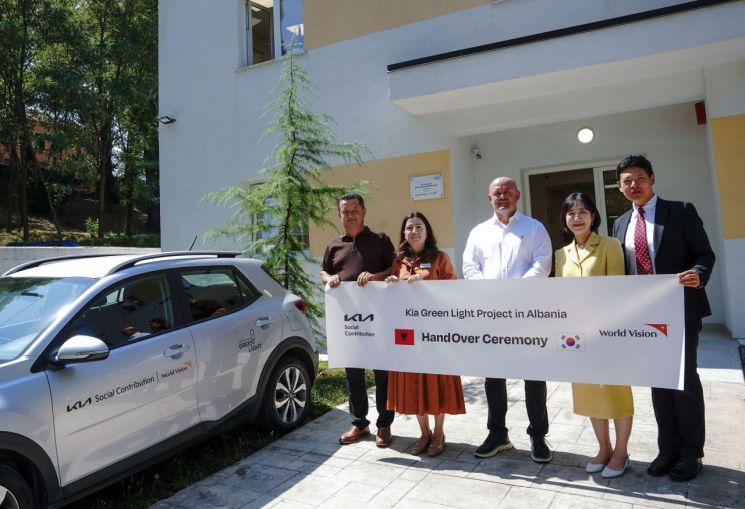
On July 31, Kia announced that it recently held a handover ceremony for the Green Light Project in Albania, officially transferring the authority to operate the community self-sufficiency model to the local community.
Previously, Kia also successfully completed the handover of the Green Light Project in Zimbabwe. As a result, Albania and Zimbabwe have become the thirteenth and fourteenth sites, respectively, to complete the local handover of the Green Light Project.
(From left) Klodian Tae, Director of Elbasan Social Welfare Office; Eljona Elmazi, President of Albania World Vision; Mariglen Disha, Mayor of Librazhd; and Eunju Lee, Head of Kia’s Sustainable Management Team, pose for a commemorative photo at the Greenlight Project handover event in Albania. Kia
The Green Light Project is Kia’s flagship global social contribution initiative, launched in 2012, and over a period of 15 years has operated in 19 sites across 15 countries in Africa, Europe, and Asia. The project not only builds infrastructure in health, education, and economic sectors for communities experiencing hardship, but also supports mobility and self-sufficiency programs. Once the project stabilizes, the authority to operate is transferred to the local community to help them achieve sustainable independence.
As part of the Green Light Project, Kia has been promoting activities since 2023 near Librazhd, Albania, to improve medical access for local residents and support economic independence for low-income families with disabilities.
Librazhd suffers from a high prevalence of disabilities due to heavy metal pollution from previous mining development, and with mountainous terrain accounting for more than 60% of its area, access to medical facilities is limited.
In cooperation with the international relief and development NGO World Vision, Kia contributed to improving public health by establishing a multi-purpose treatment center for children with disabilities, providing home-visit rehabilitation services using Kia’s mobility solutions for families with limited access, and offering mobile homecare education for guardians of children with disabilities.
As a result, a cumulative total of about 4,300 individuals have received medical benefits and income enhancement opportunities, with the home-visit rehabilitation program in particular receiving high praise from all guardians of participating children.
In addition, Kia supported increased family income for households with children with disabilities by providing specialty crop seeds to facilitate production, and by assisting with collection and transportation of agricultural products to improve sales and distribution accessibility.
Kia also collaborated with the international relief and development NGO Food for the Hungry Korea to carry out various initiatives since 2023 in the Wedza region of Zimbabwe, aimed at supporting the economic independence of vulnerable groups.
The majority of the population in Wedza works in agriculture or mining, yet climate change, low irrigation rates, and poor infrastructure have made stable crop production difficult. Additionally, lack of mining equipment has resulted in low mining productivity and poor working conditions.
Kia has undertaken several agricultural initiatives such as creating solar-powered water facilities, expanding production infrastructure with irrigation systems and fish farms, and offering management and maintenance training through community facility committees. In mining, Kia has provided extraction and safety equipment and worked to improve work environment infrastructure.
Furthermore, Kia contributed to building local capacity and expanding production in the community through on-site technical, capacity-building, safety, and equipment management training programs for local residents to help them achieve real financial self-reliance.
Through these efforts, the number of local residents who have experienced improved living conditions, increased income, and participated in self-sufficiency training has reached about 34,000. Kia plans to continue monitoring the self-reliant operating systems of the Albania and Zimbabwe sites for the next several years to ensure stable management.
Hot Picks Today
![[Exclusive] Just One KOSPI IPO by July as Overlapping Listings Blocked... Lowest in 25 Years](https://cwcontent.asiae.co.kr/asiaresize/93/2026073013574164324_1785387460.jpg)
[Exclusive] Just One KOSPI IPO by July as Overlapping Listings Blocked… Lowest in 25 Years
Dukhyeon Lee, Executive Vice President and Head of Kia’s Sustainability Management Division, stated, “The core of the Green Light Project is to enable sustainable operation led by local communities, even after the project period ends. For the five remaining sites, we will continue support through 2027, and we will actively engage in resolving global social issues going forward.”
This content was produced with the assistance of AI translation services.
© The Asia Business Daily. All rights reserved. Unauthorized AI training and use prohibited.
Credit: Source link
Comments are closed.