

Houthi threats continue endangering future of Port of Eilat shipping

The Houthis’ takeover of key points along Yemen’s western coast and of Perim Island, in the heart of the Bab al-Mandab Strait, has brought renewed attention to a threat Israel knows well and has been paying a price for nearly three years, as the group’s latest advances turn the Red Sea shipping threat into an increasingly urgent strategic problem for Saudi Arabia as well.
Even before the threat to Saudi oil routes prompted Crown Prince Mohammed bin Salman to seek US assistance, the Houthis had already registered a significant strategic achievement against Israel by almost completely disrupting regular commercial shipping to the Port of Eilat.
Nearly three years have passed since the problem emerged, and no solution remains. The IDF has repeatedly struck Houthi targets in Yemen, the state has provided assistance to the port, and an alternative import route has been established through Aqaba. None of this has brought international shipping companies back to regular, direct sailings from the East to Eilat.
Based on publicly available information, no cabinet decision has defined the restoration of commercial freedom of navigation to Eilat as a security and diplomatic objective, nor has the government presented an approved plan to bring ships back to the port.
Recent developments have changed the circumstances in which Israel is confronting the problem. The Houthi threat to Bab al-Mandab has become an urgent strategic issue for Saudi Arabia as well, and the Saudi crown prince has already requested military assistance from the US.
Israel and Saudi Arabia now have parallel diplomatic and strategic interests concerning the same maritime route. From Israel’s perspective, Saudi Arabia’s predicament creates an opportunity that did not previously exist to the same extent: to harness a regional effort around Bab al-Mandab to restore shipping to Eilat as well.
The Houthis captured Mocha, advanced along the coast, and took control of Perim, the island located inside the Bab al-Mandab Strait. They also seized Greater Hanish and Lesser Hanish islands, strengthening their hold around one of the world’s most important maritime chokepoints.
Traffic through the strait continues, and the Houthis do not currently control the passage in a way that would allow them to halt all shipping. Their new positions do, however, improve their ability to monitor maritime traffic and selectively threaten vessels they choose to target.
Bab al-Mandab is a passage only about 18 miles wide, connecting the Gulf of Aden to the Red Sea and from there to the Suez Canal. In normal periods, oil equivalent to roughly 7% of global production passes through it.
Control of Mocha, Dhubab, Perim, and the Hanish islands improves the Houthis’ ability to monitor and threaten traffic in the strait. Shipping companies and insurers price that risk into insurance premiums, and in some cases simply forgo the voyage when the destination or vessel is perceived as a potential target.
Eilat port shipping interrupted by Houthi attacks since 2023
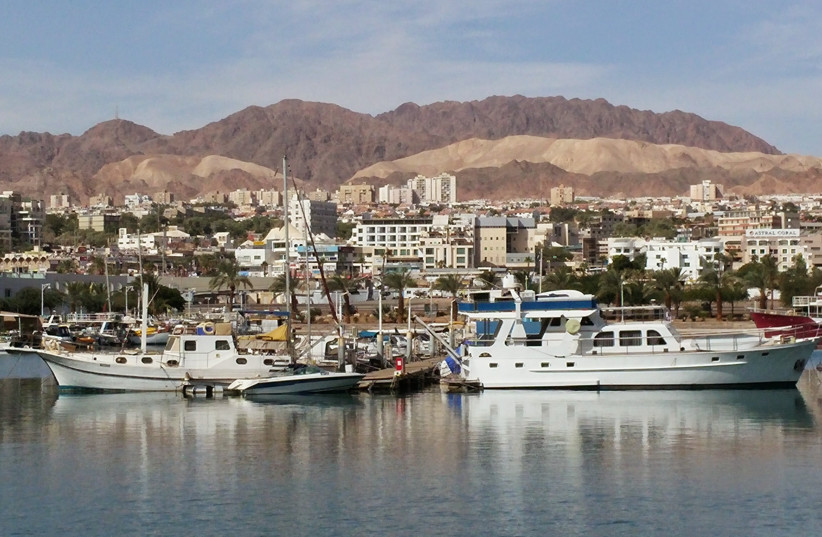
For Israel, the problem has persisted since November 2023, when the Houthis began attacking and threatening vessels linked to Israel. Major shipping companies stopped calling at Eilat along the previously standard route. The port continued to operate on a limited basis, but the commercial activity it relied on was severely damaged.
In 2023, the Port of Eilat recorded 132 ship calls and unloaded approximately 150,000 vehicles. In 2024, the port recorded only 16 ship calls, and it unloaded no vehicles. Port revenue, which stood at approximately NIS 212 million in 2023, fell by about 80% the following year.
The figures demonstrate how effective the Houthi threat was without requiring physical control of the shipping route. The threat to ships alone was enough for shipowners, insurers, financiers, and line operators to conclude that sailing to the Israeli port was not worthwhile.
The strikes carried out by the IDF in Yemen have also failed so far to bring the shipping companies back. Ultimately, the decision on whether to return to Eilat lies with shipping companies and insurers, and depends in part on their assessment of the risk along the route.
This year, a solution was found that allowed some vehicle-import activity to return to Eilat without the large car carriers themselves returning to the port. Ships arriving from the East docked in Aqaba, Jordan, where the vehicles were unloaded and then transferred to Eilat on smaller vessels.
In March alone, 5,905 vehicles were unloaded in Eilat, followed by another 3,142 in April.
The arrangement through Aqaba restored activity to the port and eased its predicament, but the direct shipping route from the East has not resumed. International shipping lines still do not call directly at Eilat as they did before the war. The large car carriers stop in Aqaba, and the cargo continues from there to Eilat.
Since 2023, Israel has addressed the problem through several channels. The IDF has struck Houthi targets in Yemen, and the defense establishment deals with the threat from Yemen on an ongoing basis. Israeli strikes have focused on damaging Houthi capabilities and responding to attacks against Israel.
Publicly available information does not indicate the existence of an approved plan in which restoring regular commercial shipping to Eilat was defined as an objective in its own right.
MK Forer pushes for action to fully reopen shipping route to Eilat
The issue was raised unusually prominently during a Knesset Economic Affairs Committee hearing in June. MK Oded Forer argued that the shipping route to Eilat was effectively closed because of the Houthis and that the government had not made reopening it a diplomatic and security objective.
“It doesn’t matter who the operator is. If ships don’t enter the port, there will be no port,” he said.
Eilat Mayor Eli Lankri said the port was almost completely shut down.
For more than two years, a significant share of government efforts has focused on the port’s economic distress. The state allowed payment deferrals, provided a loan guarantee, and approved direct assistance.
It also formulated a plan to subsidize the arrival of car carriers, under which it approved about half a million dollars per ship, aiming the bring four ships a month for three months, at a total cost of up to NIS 21 million.
The plan was not implemented. During Knesset discussions in early 2026, the situation was described as a “dead end.” According to figures presented by the port management, its debts had reached approximately NIS 30 million, while the monthly gap between expenses and revenue stood at around NIS 5 million.
Most government efforts focused on financing the port’s continued operation and trying to restore cargo traffic. Publicly available information does not indicate that any specific government body was given overall responsibility for restoring the direct shipping route to Eilat.
At the same time, the port tried to promote additional solutions. Its management examined the possibility of US assistance, approached Egypt, and attempted to advance mechanisms that would make it easier for ships to arrive through a safer or more heavily subsidized route.
None of those efforts have brought international shipping lines back to regular, direct operations in Eilat so far.
Port of Eilat’s future remains undecided
The port’s future also remains undecided. The current operator’s concession is due to expire in 2028, and the state has yet to decide what the operating model will look like afterward.
The debate over the identity of the next operator is taking place while the issue that determines whether the port can function at all – the return of ships – remains unresolved.
This also has implications for the role of the Port of Eilat in Israel’s national security doctrine. Eilat cannot replace Ashdod and Haifa in every scenario. It is not a major container port, and its infrastructure is limited.
Its importance derives largely from geography: It is Israel’s only commercial port facing the Red Sea. If activity at the Mediterranean ports is disrupted or restricted, an operational southern maritime gateway could provide Israel with an additional route.
For it to be usable in an emergency, Israel must also maintain infrastructure, workers, equipment, and a functioning logistics system during routine periods.
Israel has already been paying a direct price at the Port of Eilat for nearly three years because of the Houthi threat. The Houthis’ latest advance now makes the threat to Red Sea shipping routes a far more urgent problem for Saudi Arabia as well.
In the background lies a fact that has almost disappeared from Israel’s public agenda: An Iran-backed organization, operating from roughly 2,000 kilometers away, succeeded in prompting international shipping companies to stop calling regularly at Eilat.
Even after a long series of Israeli strikes in Yemen, the ships have not returned. Nearly three years after regular shipping to Eilat was disrupted, the government has invested money and effort to preserve the port and prevent its collapse.
It succeeded in keeping the port alive. It has still not brought the ships back.