

EU, Africa leaders talk trade and minerals in Angola summit
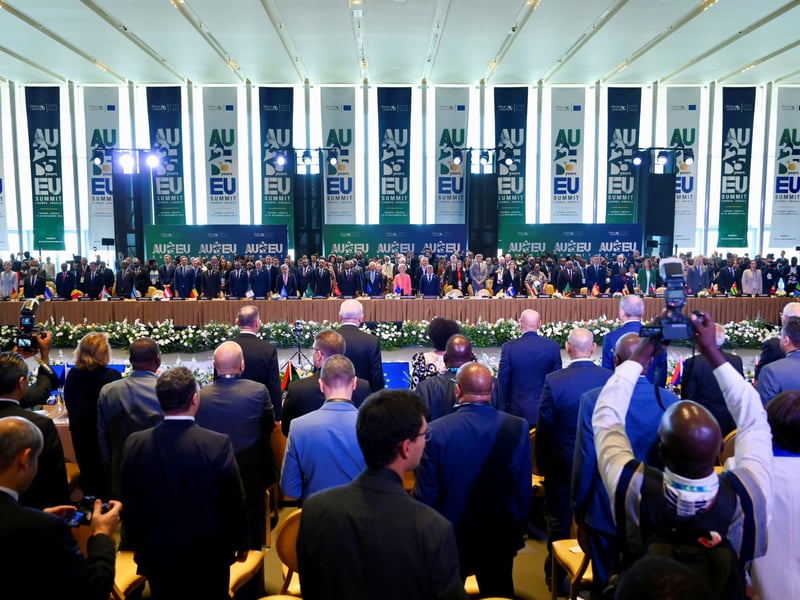
LUANDA, Angola (AFP) — European and African leaders gathered in Angola Monday for a summit to deepen economic and security ties that also presented the chance for emergency talks on Ukraine.
European Union chief Antonio Costa chaired an impromptu EU summit at a Luanda hotel in the morning, as Europe and Kyiv push to review a U.S. proposal to end the Ukraine war seen as heavily favoring Moscow.
“While work remains to be done, there is now a solid basis for moving forward,” European Commission President Ursula von der Leyen said after the meeting, which followed Sunday talks between U.S., Ukrainian and European officials in Geneva.
EU leaders including Germany’s Friedrich Merz and Poland’s Donald Tusk then headed to a conference center in the Angolan capital for a summit with their African counterparts.
South Africa’s Cyril Ramaphosa and Felix Tshisekedi of the Democratic Republic of Congo were among a stream of heads of state and government welcomed by host Joao Lourenco of Angola.
“We expect the partnership between the two continents to get stronger and stronger,” Ramaphosa said upon arrival.
“The Europe-Africa axis must increasingly become the central axis of the international community,” said U.N. chief Antonio Guterres.
‘Implementable commitments’
The seventh EU-African Union gathering, the two-day summit comes on the heels of a G20 meeting in South Africa where a U.S. boycott underscored geopolitical fractures.
It marks 25 years of EU-African Union relations — ties that analysts say need revamping if Europe wants to hold on to its role as the continent’s top partner.
“Our prosperity is more connected than ever. We both need to build the industries of tomorrow. We both need to make the most of our talent and resources and get rid of dangerous dependencies,” von der Leyen said in opening remarks. “The case for Africa and Europe to join forces is overwhelming. Let us find new ways of doing so.”
Africa has emerged as a battleground for its critical minerals and energy potential, with China, the United States and Russia also seeking to foster stronger ties.
The EU is the leading supplier of foreign direct investment to the continent and its top commercial counterpart. Trade in goods and services hit 467 billion euros ($538 billion) in 2023, according to Brussels.
The Gulf states and Turkey have also made significant inroads, granting African nations bargaining power with the EU, said Geert Laporte of ECDPM, a European think tank.
“We don’t have that situation anymore where Europe was the only partner,” he said.
Observers say Europe needs to invest in infrastructure, energy and job-creating industrial projects in Africa, and a move away from lofty statements of support.
“Africa is looking not for new declarations but for credible, implementable commitments,” said AU spokesman Nuur Mohamud Sheekh.
Minerals and credibility
Boosting trade will likely be a top priority as U.S. tariffs buffet both continents.
The EU is expected to offer expertise to help build up intra-African trade, which currently accounts for a paltry 15% of the global total, diplomats said.
It will also seek to secure critical minerals needed for its green transition and ease dependency on China for rare earths, essential for tech and electronic goods.
The 27-nation bloc will likely showcase new investments under the Global Gateway — a massive infrastructure plan that Brussels hopes can counter China’s growing influence.
Summit-host Angola is home to one of the EU’s signature undertakings: the Lobito corridor, a railway project funded in partnership with the United States to connect mineral-rich areas of the Democratic Republic of Congo and Zambia to the Atlantic coast.
EU diplomats have been at pains to present such projects as win-wins. But critics retort that the scheme repeats some extractive colonial practices and has yet to deliver significant improvements for local communities.
“Europe’s credibility now depends on whether it can support the delivery of projects that create value in Africa, not just visibility for Brussels,” said Ikemesit Effiong, of the Nigeria-based consultancy SBM Intelligence.
—
By UMBERTO BACCHI Agence France-Presse
Subscribe to our free newsletters
Our weekly newsletter Closing Arguments offers the latest about ongoing
trials, major litigation and rulings in courthouses around the U.S. and the world,
while the monthly Under the Lights dishes the legal dirt from Hollywood,
sports, Big Tech and the arts.
Credit: Source link
Comments are closed.