

Cuban official on Trump’s threats as tensions with U.S. rise
Amna Nawaz:
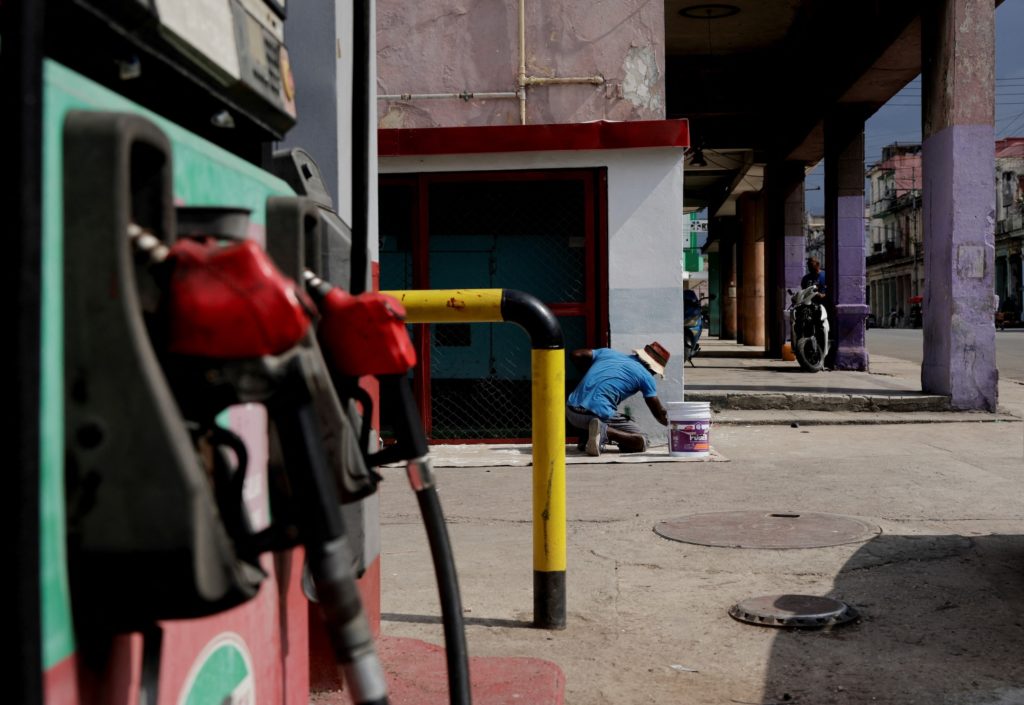
For months, the Trump administration has ramped up economic pressure and military threats against the island nation of Cuba. A de facto oil blockade means blackouts, food and water shortages for millions have worsened. Cuban officials say they’re willing to talk, but, publicly, there’s been no progress.
I spoke earlier today with Cuba’s Deputy Foreign Minister Carlos Fernandez de Cossio as he visits the U.S.
Deputy Foreign Minister de Cossio, welcome to the “News Hour.” Thank you for being here.
Carlos Fernandez De Cossio, Cuban Deputy Minister of Foreign Affairs: Thank you for having me.
Amna Nawaz:
So, this month, the foreign minister of Cuba said that there are no talks happening between the U.S. and Cuba, but that the Cuban government would continue reaching out to its contacts. Is that happening? Is that part of why you’re here in Washington?
Carlos Fernandez De Cossio:
It’s not the reason why I’m in Washington. I’m here because I’m attending the U.N. General Assembly. We have a major embassy in Washington, and it’s normal for us, for senior officials to visit and engage with our diplomatic missions.
What our position on contacts with the U.S. is that first we have diplomatic relations. So we have official channels of communication. And we have had several contacts and meetings with the U.S., that what we claim is that they had no progress.
And we say that because you only have to look at the fact that practically every week or every 10 days or 15 days, there’s a new announcement by the U.S. government of sanctions and coercive measures that punish the people of Cuba.
So you could not claim that there’s progress in any dialogue or any type of communication if hostility continues to happen. And that’s our main point. But we continue to be ready to engage with the United States when they are ready to try to solve our political differences, our bilateral political differences, which are many.
But we are firm believers that, through dialogue, through respect between the two governments, some common ground could be found.
Amna Nawaz:
When was the last time…
Carlos Fernandez De Cossio:
And that is our aspiration.
Amna Nawaz:
I apologize.
When was the last time there were any direct talks between your two governments?
Carlos Fernandez De Cossio:
I prefer not to go into details. We try to treat this discreetly.
We truly reject the leaks that have been occurring. But I can assure you there’s — meetings have occurred, and we would be ready to engage again.
Amna Nawaz:
Are you saying that…
Carlos Fernandez De Cossio:
In other words, they are not closed, they’re not suspended, they’re not shut down. Simply, there’s no progress to this moment.
Amna Nawaz:
And by your definition, progress would mean the U.S. would stop with additional sanctions?
Carlos Fernandez De Cossio:
That could be, but, in a broader sense, there will have to — we would have to identify a common goal that we want to reach that implies progress in the bilateral relationship.
Up to now, if you look at the claims of the U.S. publicly, they want to take over Cuba. That is quite an ambitious goal. That certainly is unacceptable for Cuba. Cuba’s a sovereign nation.
Amna Nawaz:
Do you take that as a real threat? Are you worried about a U.S. invasion?
Carlos Fernandez De Cossio:
We would be naive if we do not take that into account. It is constantly repeated.
U.S. senior officials are asked constantly if that is on the table, and they claim that nothing is off the table. So, a country like Cuba, looking what to what’s happened in the world and our own history, we will be naive if we don’t take that seriously.
Amna Nawaz:
Can I ask you about what’s happening on the ground in Cuba right now? Because we have seen blackouts amid the oil blockade. We have seen life gotten so much worse for Cubans. Food is expensive. It spoils without electricity. We know there are water shortages as well.
What is your message to Cubans about what you and other leaders are doing to alleviate that pain?
Carlos Fernandez De Cossio:
First of all, it is very clear that the policy of the United States is to produce collective punishment, which is an international crime, to try to induce a humanitarian crisis in Cuba, meaning that is to use the pain of each and every Cuban to try to achieve a political goal.
That, again, is an international crime. The people of Cuba understand that. And when you see in the media normally the reports of what’s happening in Cuba, they speak about the lack of energy, the blackouts and people being irritated, naturally, people being uncomfortable, naturally.
But that’s only the surface. They don’t take into account what it implies for a family that has a sick person at home and then doesn’t know how to transport them to the hospital.
They don’t take into account what implies for a person who needs an urgent surgery and has to wait in line because of, as a result of lack of energy, surgery has to be postponed, what it implies for a family that has a newborn whose life depends on a machine not stopping because of lack of power, what it implies for people having to take children to school, to do homework at night.
So it has a human face. We use statistics many times of what it implies, but this has a human face. And the main problem is that it’s not collateral damage. It is the aim of the policy. So the people of Cuba understand that. And
the government has — says, claims, and we’re doing, trying to introduce in Cuba the transformations and to take the steps that allow us to cope with this situation. That does not depend on us.
Amna Nawaz:
I mean, as you say, these are the most significant privatization steps the nation has taken in over six decades. If this does lead towards an alleviation of suffering for Cubans, if opening up the economy does help, would you continue to do so?
Carlos Fernandez De Cossio:
Yes. It is our aim.
Amna Nawaz:
You have no problem doing that?
Carlos Fernandez De Cossio:
Our aim is — the main priority here is, how do we satisfy, how do we respond to the needs of the people of Cuba? And that is the driving goal here.
Amna Nawaz:
That is an enormous shift for a communist nation to say you will continue to open up your economy.
Carlos Fernandez De Cossio:
We will continue to go down this path, but we will retain the role of the state to respond to basic needs of the population and the economic capacity to do that.
Amna Nawaz:
I have to ask you about the allegations from U.S. officials as well about the gap between Cuban leaders and what they’re experiencing and everyday Cubans.
They say the leaders aren’t feeling the pain as evenly. I want to put to you what the U.S. ambassador to the U.N., Mike Waltz, said back in July. He said: “There’s no food or fuel for hospitals. How is there fuel for the Castro private family jet? How does President Diaz-Canel afford his Hermes tie, his Rolex watch? How does the Castro family afford their 17 homes, their trips to Madrid and Moscow?”
What would you say to that?
Carlos Fernandez De Cossio:
First of all, this is claimed by the representative of one of the countries with the most inequality in the world today, an inequality that has grown dramatically in the past 20 years, and above all under the current government.
Amna Nawaz:
People here are not experiencing 20 hours a day of blackouts, though, in all due respect.
Carlos Fernandez De Cossio:
Secondly, there are no private jets within — of the Castro family. It’s totally untrue. There are no 17 homes of the Castro family. Totally untrue.
But he can claim whatever he wants when he has a microphone in front of him. All Cubans of any type — senior officials in the government are suffering the same situation of Cubans. I’m not saying that all Cubans are on equal footing. Depends on the neighborhood where you live, the amount of hours it takes, the conditions of your home.
But the level of inequality, the level of differences in Cuba is dramatically different than the ones you have in the United States. The pain is on the Cuban population as a whole, in ways that no other country perhaps has suffered, unless you put the example of Gaza in Palestine.
It’s warfare against a population of a whole country. And for an American official to claim that there are differences from the United States, a country where you have a minuscule elite in which a few people have more money than the whole population of the richest country in the world is quite hypocritical.
Amna Nawaz:
Mr. Minister, this survey says some 54 percent of people surveyed in Cuba say they ran out of food in the prior three months. There’s reports of up to 20 hours a day without power.
Are you saying that Cuban officials are experiencing that same level of pain?
Carlos Fernandez De Cossio:
I can tell you that my colleagues and myself, we have two 2.5, three hours of power a day, that our refrigerator is closed, that you can’t cool food, that we don’t have running water. And I’m talking about Cuban officials in general.
And anyone who knows me can go and check or who knows any one of my colleagues. Now there are people which are not government officials, which are simple private citizens that might live across the street from a hospital. And they don’t suffer blackouts because hospitals are protected. Clinics are protected.
And that’s just, look, where they live. And some of us have to take our food and our products and ask them, can you refrigerate this for some time? That is normal life in Cuba for everybody. The claim in the United States that there’s a difference between an elite and the people, it’s totally, totally untrue, and they can’t prove it.
Amna Nawaz:
The U.S. has claimed, this administration has claimed that Cuba is a national security threat. It’s been deemed a state sponsor of terrorism. The White House has said that the Cuban regime aligns itself with nations hostile to the U.S., that Cuba maintains close ties to other state sponsors of terrorism.
What is your response to those claims?
Carlos Fernandez De Cossio:
Most of the countries that the U.S. claims Cuba is close to, the United States has a more comprehensive and broader relationship with those countries than Cuba does.
Amna Nawaz:
We’re talking about nations like Russia, Iran.
Carlos Fernandez De Cossio:
Russia. The U.S. has a much broader relationship with China, at least, and with Russia than we do, with trade, with the exchange of different types, than we do.
Amna Nawaz:
It is an adversarial relationship with Russia, though. You would not call Russia an ally.
Carlos Fernandez De Cossio:
But they have more trade still today with Russia than we do, more contacts, more high-level meetings and visits than they have with Cuba, than Russia has with Cuba. With China, it’s the same. They claim it’s adversarial, but it’s a claim.
But they have more relationship than we do.
Amna Nawaz:
Well, what does happen next then? How do you see this ending with the pressure, with the military threats, with additional U.S. sanctions? How does this end?
Carlos Fernandez De Cossio:
We will have to cope with ourselves. And to some extent, the international community perhaps would say, this is unacceptable for one superpower to be dictating everybody having to do.
But what cannot occur and what would be treason is for the Cuban government to tell our people, look, there’s nothing else we can do. Let’s ask the U.S. government what they want us to do and how they want to organize our country and how they want to organize the Cuban economy, the Cuban political system, Cuban property, and Cuban business. That would be treason by the Cuban government and the Cuban authorities.
Amna Nawaz:
Deputy Foreign Minister of Cuba Carlos Fernandez de Cossio, thank you very much for being here.
Carlos Fernandez De Cossio:
You’re welcome.
Amna Nawaz:
We appreciate your time.
Carlos Fernandez De Cossio:
You’re welcome.
Amna Nawaz:
For more of that conversation with the deputy foreign minister, you can watch our full interview online on our PBS News YouTube page.