

Church of Uganda Launches Environmental Conservation Project
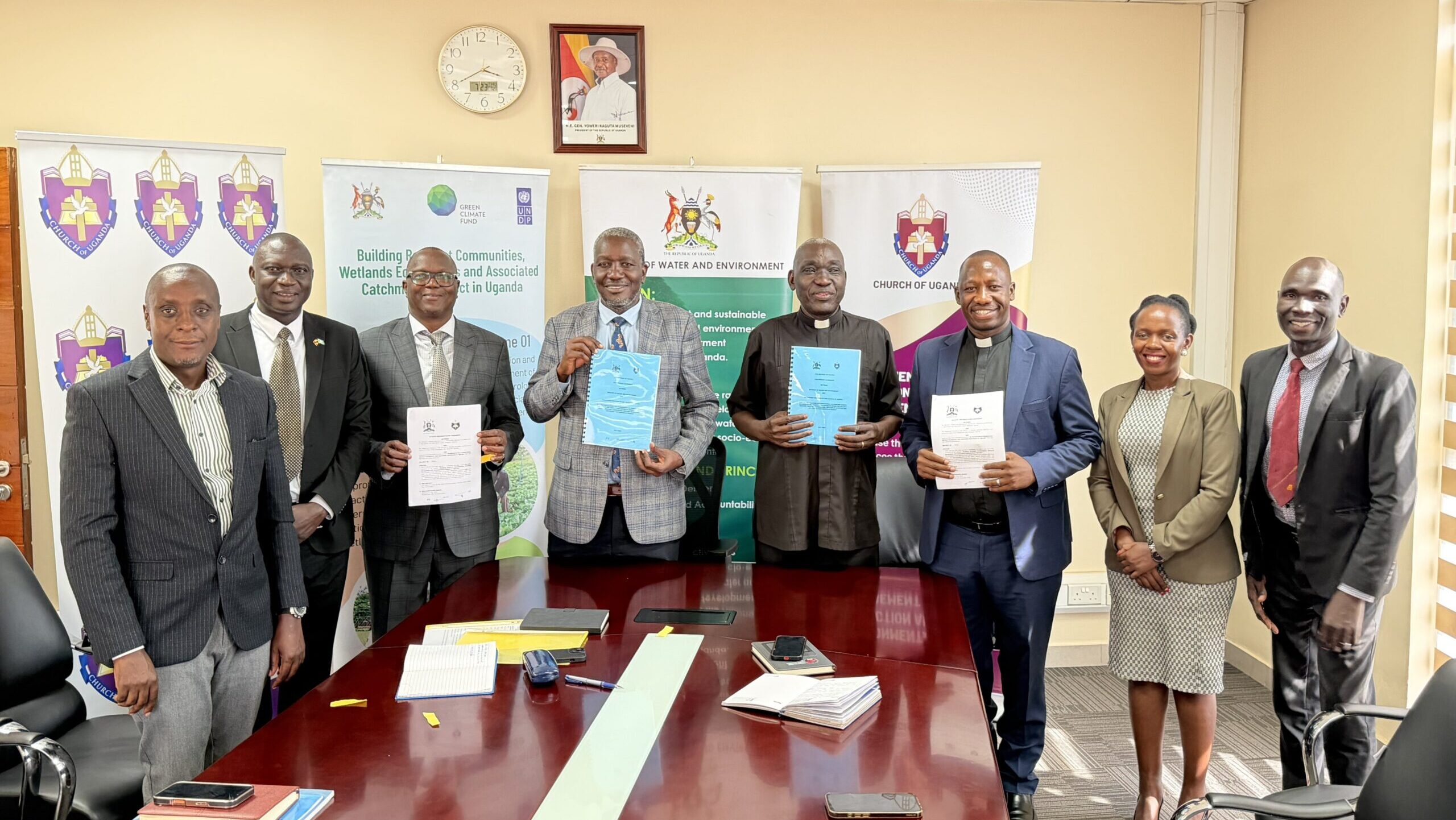
The Church of Uganda (COU) has partnered with the Ugandan government through the Ministry of Water and Environment, signing a 12-year memorandum of understanding that binds the two parties in an effort to promote environmental conservation and climate resilience.
In this memorandum of understanding, the government will install and operationalize fish feed pelleting machines at selected COU facilities across the 24 project districts.
For its part, the COU will provide suitable premises for the equipment and work with the government in managing and implementing the project.
The Rev. William Ongeng, the COU provincial secretary who signed the deal, said the partnership reflects the church’s holistic ministry focusing on both spiritual and socio-economic transformation.
“By hosting these fish feed production facilities, we are creating opportunities for employment, household income generation, and food security while supporting environmental conservation in this holistic ministry,” Ongeng told local media.
Ongeng pointed out that taking care of the earth is one of the mandates that God has given humanity, adding that environmental conservation is biblical and must be embraced by all Christians.
The collaboration between the COU and the government will enable vulnerable communities to regain their normal life and become self-reliant instead of depending on relief when climate vagaries hit their communities.
The partnership is part of the government project “Building Resilient Communities, Wetland Ecosystems and Associated Catchments in Uganda,” which seeks to strengthen climate adaptation while creating sustainable livelihood opportunities for vulnerable communities.
On the COU side, the project will be managed by the Directorate of Households and Community Transformation (COU-HCT), the church’s socioeconomic development and social services arm, which was formerly known as Planning, Development and Rehabilitation (PDR).
Director of Households and Community Transformation, the Rev. Andrew Agaba, noted that the partnership is a blessing to the locals in 24 project districts, adding that it will improve livelihoods and living standards.
Dr. Alfred Okidi, the permanent secretary in the Ministry of Water and Environment who also signed the agreement, told The Living Church, “This partnership will help bring climate-smart livelihood interventions closer to the people while promoting sustainable management of wetlands and associated catchments.”
Okidi said that public-private partnerships like this one can help the country identify climate vulnerabilities and provide a permanent solution not only to climate challenges but also to other areas.
The COU has been involved in multiple green initiatives including solar energy and renewable power. These projects often run in partnership with both local and foreign governments, international NGOs, and diocesan programs.
Uganda is among the 54 nations in Africa that signed and ratified both the United Nations Framework Convention on Climate Change (UNFCCC) and the Kyoto Protocol, then signed and ratified the Paris Agreement, thus committing itself to the adoption and implementation of policies and measures designed to mitigate climate change.
According to Okidi, partnering with the COU to mitigate and adopt to the impacts of climate change is an implementation of UNFCCC and the Kyoto Protocol, among other agreements.
Uganda is among the countries in Africa that face severe climate effects. In the Karamoja region in northeastern Uganda, for example, people regularly suffer from devastating droughts and acute hunger. In areas bordering Mount Elgon, locals are increasingly vulnerable to catastrophes like landslides. Climate-related disasters have killed more than 1,000 people in the last 10 years.
COU leadership has been at the forefront of championing climate action. In March, Archbishop Stephen Kaziimba Mugalu instituted a directive requiring confirmation candidates and the parents of baptized children to plant trees.
The church has further integrated creation care, soil conservation, and eco-friendly energy messages directly into sermons, teaching curricula, and synod communiques to enhance conservation. It officially replaced traditional wreath-laying on caskets at funerals with memorial tree planting as part of its 2026–2030 strategic plan. It continues to implement plans to plant up to 40 million trees nationwide and restore degraded ecosystems and promote alternative clean energy sources to lessen forest dependency, including firewood collection.
Sadiiki Adams, a COU communication officer, said partnerships with the government agencies and private organizations have established large-scale tree-growing projects in many deserted areas. This plan has enabled the country to make strides toward increasing tree cover and improving conservation.
While applauding partnerships between the church and the government, the Nnabagereka (the official title of the queen consort of the Kingdom of Buganda, a traditional monarchy within Uganda) asked COU to continue to expand its efforts towards conservation as caring for creation is a biblical mandate.
“The church must lead in environmental conservation by promoting tree-planting on church land, harvesting of rainwater and promoting renewable energy sources. Caring for creation is a biblical mandate,” the Nnabagereka told COU bishops during their Provincial Assembly at Uganda Christian University.
Margaret Mwebesa, climate change commissioner in the Ministry of Water and Environment, said that the church plays an important role in mobilizing grassroots communities and advancing environmental stewardship through its congregants.
This is not the first time the COU has collaborated with the government in battling the effects of climate change. In 2023, the COU collaborated with the Uganda National Oil Company (UNOC), a government entity, signing a memorandum of understanding to jointly intervene to address prevailing climate change challenges.
Since then, the two parties have partnered through the Alliance for Climate Resilience (ACR) to balance petroleum development with environmental preservation. This collaboration has focused heavily on large-scale greening and community-level conservation.
Credit: Source link
Comments are closed.