

China’s New Exit Regulations Reinforce Export Controls and Anti-Sanctions Enforcement
On July 31, China’s State Council released the Regulations on Exit and Entry Administration, which will take effect on September 15, 2026. The Regulations establish a new framework covering a wide range of issues, including the departure of Chinese citizens, the entry of foreign nationals, travel document administration, and exit-entry services.
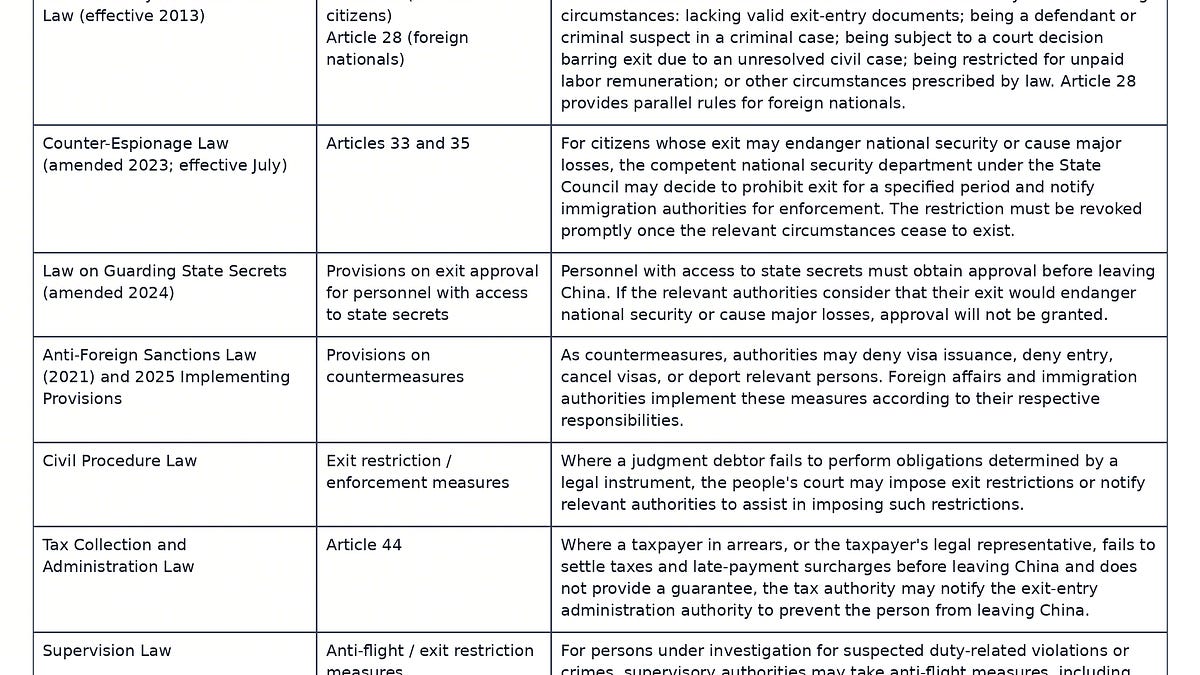
Prior to the issuance of these Regulations, China’s legal framework governing restrictions on the departure of Chinese citizens was primarily based on the Exit and Entry Administration Law, the Passport Law, the Supervision Law, the Counter-Espionage Law, the Tax Collection and Administration Law, and other relevant legislation. Most of these statutes, however, are laws enacted by the National People’s Congress with relatively high-level provisions. They generally lack detailed implementing rules and typically apply only to specific categories of persons or particular circumstances.
Exit and Entry Administration Law (Article 12)
Chinese citizens may be prohibited from leaving China under any of the following circumstances:
They do not possess valid travel documents or refuse to undergo, or evade, border inspection;
Their criminal sentence has not yet been fully served;
They are defendants or criminal suspects in a criminal case;
They are involved in unresolved civil litigation where a people’s court has ordered an exit ban;
They have been penalized for disrupting border administration or have previously been repatriated for illegal exit, illegal residence, or unauthorized employment and remain within the applicable restriction period;
Their departure is likely to endanger national security or cause significant harm to national interests;
Other circumstances prescribed by laws or administrative regulations.
Supervision Law (Article 33)
To prevent persons under investigation or other relevant individuals from fleeing abroad, supervisory authorities may, with the approval of a supervisory authority at or above the provincial level, impose exit restrictions, which are enforced by the public security authorities.
Counter-Espionage Law (Article 33)
The Ministry of State Security may:
prohibit Chinese citizens from leaving China for a specified period if their departure is likely to endanger national security or cause significant harm to national interests; and
notify immigration authorities to prevent individuals suspected of espionage activities from leaving the country.
Tax Collection and Administration Law (Article 44)
Taxpayers with outstanding tax liabilities, or the legal representatives of enterprises that owe taxes, must settle the outstanding taxes and late-payment surcharges, or provide an acceptable guarantee, before leaving China. Otherwise, the tax authorities may notify the immigration authorities to prevent them from departing the country.
In the accompanying Q&A, the Ministry of Justice, the Ministry of Public Security, and the National Immigration Administration explained the background to the issuance of the Regulations. They noted that, as China continues to advance high-level opening-up, a number of new challenges and issues have emerged in exit and entry administration. It has therefore become urgently necessary to promulgate the Regulations, following the principle of addressing the most pressing needs first, in order to improve and refine the relevant legal framework.
One noteworthy change is that violations of China’s export control regime have, for the first time, been expressly included within the scope of the exit-ban system.
Article 4 provides:
Where a Chinese citizen violates export control regulations, technology import and export administration regulations, or other relevant rules, and such conduct may endanger China’s industrial security or technological security, the competent departments of the State Council, including the Ministry of Commerce, may decide to prohibit that person from leaving China.
The accompanying Q&A further explains that this provision is mainly intended to address situations that have arisen in practice where individuals leave China and subsequently transfer technology overseas illegally, thereby endangering China’s industrial security and technological security. According to the authorities, the provision further refines and improves the existing circumstances under which exit bans may be imposed, pursuant to the authorization provided by the Exit and Entry Administration Law.
Question: What provisions does the Regulations make with respect to the administration of Chinese citizens’ departure from China?
Answer: In recent years, as the number of Chinese citizens travelling abroad has continued to increase, new issues have emerged in practice, including the illegal transfer of technology overseas after individuals leave China, thereby endangering China’s industrial security and technological security. To address these issues, the Regulations provide that where a person violates export control regulations or technology import and export administration regulations, and such conduct may endanger China’s industrial security or technological security, that person may, in accordance with the law, be prohibited from leaving China.
This may indicate that the practical reach of China’s export control enforcement is no longer limited to licensing requirements, controlled items, and cross-border transactions, but may also extend to the exit administration of individuals responsible for export control violations. For companies engaged in sensitive technology research and development, technology cooperation, exports of controlled items, and cross-border technology transfers, greater attention may need to be paid to the personal compliance responsibilities of individuals involved in technology transfer activities, with personnel compliance becoming an integral part of export control compliance programs.
Foreign media have repeatedly reported allegations that China has restricted the overseas travel of individuals involved in sensitive technologies.
For example, the Financial Times reported in March 2026 that two executives from Manus were summoned to Beijing to meet with officials from the National Development and Reform Commission (NDRC), after which they were reportedly informed that they could not leave China while regulatory review of Meta’s proposed acquisition of Manus was ongoing, although they remained free to travel within the country.
On June 25, 2025, The Wall Street Journal reported that China’s Ministry of Commerce had asked certain rare earth companies to submit lists of technical personnel, including information on their areas of expertise, educational background, and research experience. According to the report, some technical staff were also required to hand over their passports to their employers or local authorities in order to prevent unauthorized overseas travel and the disclosure of rare earth processing technology.
Bloomberg further reported in May 2026 that China had required certain senior researchers and professionals working on strategic AI projects at companies including Alibaba and DeepSeek to obtain government approval before traveling abroad.
None of these reports has ever been officially confirmed or denied, and they are better understood as unverified media allegations. Moreover, much of the reporting sought to portray such restrictions as arbitrary exercises of unchecked government authority, implying that the Chinese government could prohibit individuals from leaving the country simply because they possessed important technologies, without any legal basis for doing so. The issuance of the new Regulations by the State Council provides an important clarification in response to such interpretations and misunderstandings.
In addition, the new Regulations also provide that Chinese citizens who engage in illegal or criminal activities overseas may be prohibited from leaving China again, provided that such activities endanger China’s national security or national interests.
Article 4 provides:
Where a Chinese citizen engages in illegal or criminal activities outside China that endanger China’s national security or national interests, the relevant competent departments under the State Council, or the people’s government at the provincial level of the individual’s place of residence within China, upon verification by Chinese diplomatic missions or other relevant authorities abroad, may decide to prohibit that person from leaving China for a period of six months to three years from the date of his or her return to China.
In addition to strengthening national security-related measures, the Regulations also improve procedural safeguards.
Under Article 6, where a decision has been made in accordance with the law to prohibit a person from leaving China, the authority making the decision shall, in principle, notify the individual in writing of the facts, reasons, legal basis, and available avenues for relief.
Article 6 provides:
Where a decision is made in accordance with the law to prohibit a person from leaving China, the authority making the decision shall promptly notify the immigration authorities for implementation in accordance with the relevant provisions, and shall notify the individual in writing of the facts, reasons, legal basis, and available avenues for relief. Where notification to the individual may affect national security, the investigation of criminal cases, or other similar circumstances, the individual may not be notified.
When implementing an exit ban decision, the immigration authorities shall notify the individual in accordance with the contents of the notice received from the authority making the decision.
At the same time, in the accompanying Q&A, the Ministry of Justice, the Ministry of Public Security, and the National Immigration Administration specifically emphasized that, in implementing the Regulations, commercial secrets, personal privacy, and personal information shall be protected in accordance with the law, while balancing the needs of national security with the protection of the lawful rights and interests of the individuals concerned.
Another important feature of the Regulations is that they further clarify the implementation of China’s countermeasures regime in the context of visa issuance and the entry administration of foreign nationals.
Article 5 provides that where a foreign national has been included on a countermeasure list, the Unreliable Entity List, the Malicious Entity List, or has otherwise been made subject to countermeasures or restrictive measures in accordance with the law, and relevant legal measures such as refusing to issue exit-entry documents or denying entry are required, such measures shall be implemented by the visa authorities and immigration authorities in accordance with their respective responsibilities.
Article 5
Where a foreign national, when applying for a Chinese visa outside China or applying for entry at a port of entry, submits false materials or makes false statements, the immigration authorities or visa authorities may decide to prohibit that person from entering China for a period of one to five years.
Where a foreign national has received criminal punishment for disrupting border administration, or administrative penalties for fraudulently obtaining exit-entry documents or for illegal exit or entry, the immigration authorities may, based on the nature of the violation and the need to prevent future violations or crimes, decide to prohibit that person from entering China for a period of one to five years from the date the penalty has been fully served. Where other laws provide otherwise, those provisions shall apply.
Where a foreign national has been included on a countermeasure list, the Unreliable Entity List, the Malicious Entity List, or has otherwise been made subject to countermeasures or restrictive measures, and it is necessary under the law to refuse the issuance of exit-entry documents or deny entry, such measures shall be implemented by the immigration authorities and visa authorities in accordance with their respective responsibilities.
In the accompanying policy interpretation, the Ministry of Justice, the Ministry of Public Security, and the National Immigration Administration explicitly stated that the purpose of these provisions is to “strengthen the implementation of entry-related countermeasures” and to further improve China’s legal framework for countering sanctions, foreign interference, and “long-arm jurisdiction.”
From the perspective of institutional coordination, this means that restrictive measures previously established under the Anti-Foreign Sanctions Law, the Unreliable Entity List regime, and the legal framework for countering the extraterritorial application of foreign laws have now been more clearly integrated with China’s visa administration, border inspection, and entry management systems, providing a clearer implementation pathway for these measures.
Comments are closed.