

China and Russia launch joint Arctic scientific expedition amid security concerns
science
China and Russia have launched their fourth joint scientific expedition to the Arctic, adding another layer to a relationship that is expanding across research, energy, shipping and maritime operations as the polar region assumes greater economic and strategic importance.
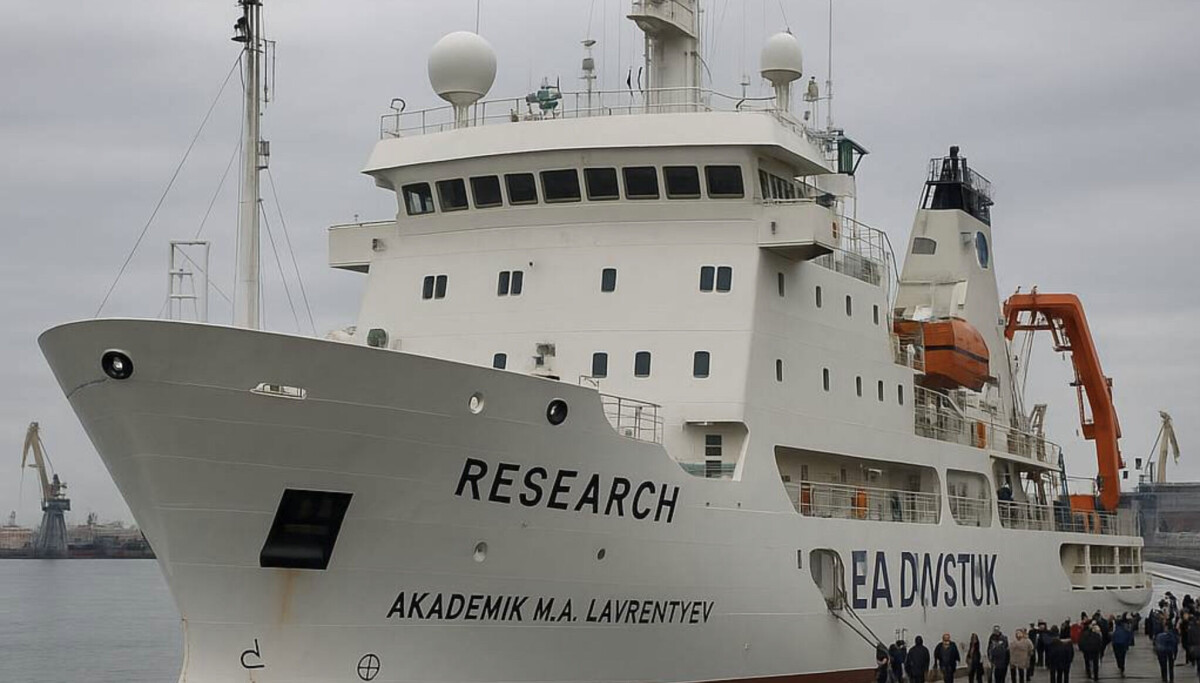
The expedition began in Vladivostok on August 20 aboard research vessel Akademik M.A. Lavrentyev, with scientists from both countries aiming to undertake about 62 days of multidisciplinary research stretching from the northwest Pacific into the Arctic Ocean.
The team will work in the Chukchi Sea, East Siberian Sea and along the Lomonosov Ridge, Makarov Basin and Amundsen Basin, studying changes in the marine environment amid rapid climate change and their links to the global climate system.
Nine Chinese scientists are participating alongside Russian researchers from the Russian Academy of Sciences’ Pacific Oceanological Institute. The expedition is jointly organized by China’s First Institute of Oceanography, Shandong University of Science and Technology and the Russian institute.
“This joint Sino-Russian scientific expedition is an important practice for in-depth exchanges and collaborative innovation in the field of marine scientific research between the two countries, and a key measure to implement the national strategy of building a maritime power,” said Du Libin, executive dean of the College of Ocean Science and Engineering at Shandong University of Science and Technology.
Four Chinese research vessels
The expedition is separate from China’s 16th national Arctic scientific expedition, which began in July and involves the icebreakers Xuelong, Xuelong 2 and Jidi, with the deep-sea research vessel Tansuo-3 also joining.
Important practice for in-depth exchanges and collaborative innovation
That four-month mission is focused primarily on climate change, sea ice, oceanography, biology, ecology and atmospheric conditions, as well as geological research on the Gakkel Ridge.
The distinction is significant because China’s overall scientific presence in the Arctic is growing rapidly. Last year’s expedition involved an unprecedented deployment of research vessels and included more than 40 manned submersible dives.
The Fendouzhe submersible alone completed 43 dives, including the world’s first manned dive to the Gakkel Ridge, reaching 5,277 meters. China’s Jiaolong submersible conducted more than 10 additional dives and operated jointly underwater with Fendouzhe.
Security concerns
Such activity is increasingly viewed in Washington DC through a national-security lens. U.S. officials have raised concerns that China’s expanding scientific operations can have dual-use applications, particularly as Chinese research vessels operate closer to Alaska and other strategically important Arctic waters.
Earlier this summer U.S. senators introduced legislation seeking to require foreign government research vessels, including Chinese ships, to obtain authorization before engaging in marine scientific research in or near the U.S. Exclusive Economic Zone.
Four Chinese research vessels deployed for this year’s national expedition have also drawn increased U.S. scrutiny.
Russian-Chinese cooperation
China’s Arctic cooperation with Russia extends beyond science. In September 2024, two Chinese Coast Guard ships and two Russian Border Guard vessels conducted a joint patrol in the Bering Sea, with the U.S. Coast Guard observing the formation about 440 miles southwest of St. Lawrence Island.
The vessels also operated north of the Bering Strait marking the northernmost point at which U.S. authorities have observed Chinese Coast Guard ships.
The patrol demonstrated how scientific and economic engagement is occurring alongside expanding maritime cooperation. China and Russia have also worked for years on the development of the Northern Sea Route, which Beijing describes as part of its “Polar Silk Road.”
Russian officials have said rising freight volumes along the route make comprehensive scientific research increasingly necessary.
China has continued receiving sanctioned Russian LNG
Chinese companies also hold stakes in Russia’s Yamal LNG and Arctic LNG 2 projects, while China is a major buyer of Russian Arctic gas. In 2025, China received 22 cargoes of liquefied natural gas (LNG) from Russian projects under U.S. and European sanctions, most of them from Arctic LNG 2.
Chinese firms also continue to supply LNG technology to Russia.
China has continued receiving sanctioned Russian LNG despite Western restrictions. A second Chinese LNG terminal is being prepared to receive Arctic LNG 2 cargoes, potentially expanding an important outlet for Russian Arctic gas.
While the joint research mission itself is civilian, it is operating in an environment that is becoming increasingly strategic.
As Arctic sea ice retreats and resource development and maritime activity expand, scientific knowledge of the region can also provide capabilities and experience relevant to navigation, seabed mapping, environmental monitoring and operations in increasingly accessible northern waters.
Comments are closed.