

Burkina Faso Gold: Foreign Firms Losing Ground Fast
The Geology of Power: Why Africa’s Gold Heartlands Are Reshaping Who Profits From the Ground Up
Across the ancient Birimian greenstone belts of West Africa, where some of the world’s most prolific gold mineralisation has been traced for centuries, a quiet but consequential revolution is underway. The question being debated is not whether gold exists in commercially viable quantities — that was settled long ago. The question now consuming governments, investors, and mining executives alike is far more politically charged: who has the right to extract it, process it, and keep the proceeds?
In Burkina Faso, that question has moved from academic discourse to active policy implementation at a pace that has surprised even seasoned observers of African resource governance. The Burkina Faso gold industry foreign firms lose ground narrative has become ground zero for a structural ownership transformation — some through negotiated exits, others through regulatory pressure, and some simply by watching the rules of engagement change beneath their feet.
When big ASX news breaks, our subscribers know first
Understanding the Birimian Belt and Why Burkina Faso’s Gold Matters
To appreciate the scale of what is at stake, it helps to understand the geological foundation of Burkina Faso’s gold endowment. The country sits atop a substantial portion of the West African Craton, a geologically stable ancient landmass whose Birimian-age greenstone belts — formed approximately 2.1 billion years ago — host a significant proportion of the region’s gold mineralisation.
These belts, which extend across Ghana, Mali, Guinea, Côte d’Ivoire, and Burkina Faso, are structurally controlled gold systems. Mineralisation typically occurs along shear zones and fault structures where hydrothermal fluids deposited gold over geological timescales. The deposits tend to be:
- Orogenic in character, meaning they formed under compressional tectonic regimes and are often found at considerable depth
- Structurally hosted, following crustal fault systems that require sophisticated geological modelling to define
- Variable in grade, ranging from low-grade bulk-tonnage deposits amenable to open-pit methods to higher-grade underground ore bodies
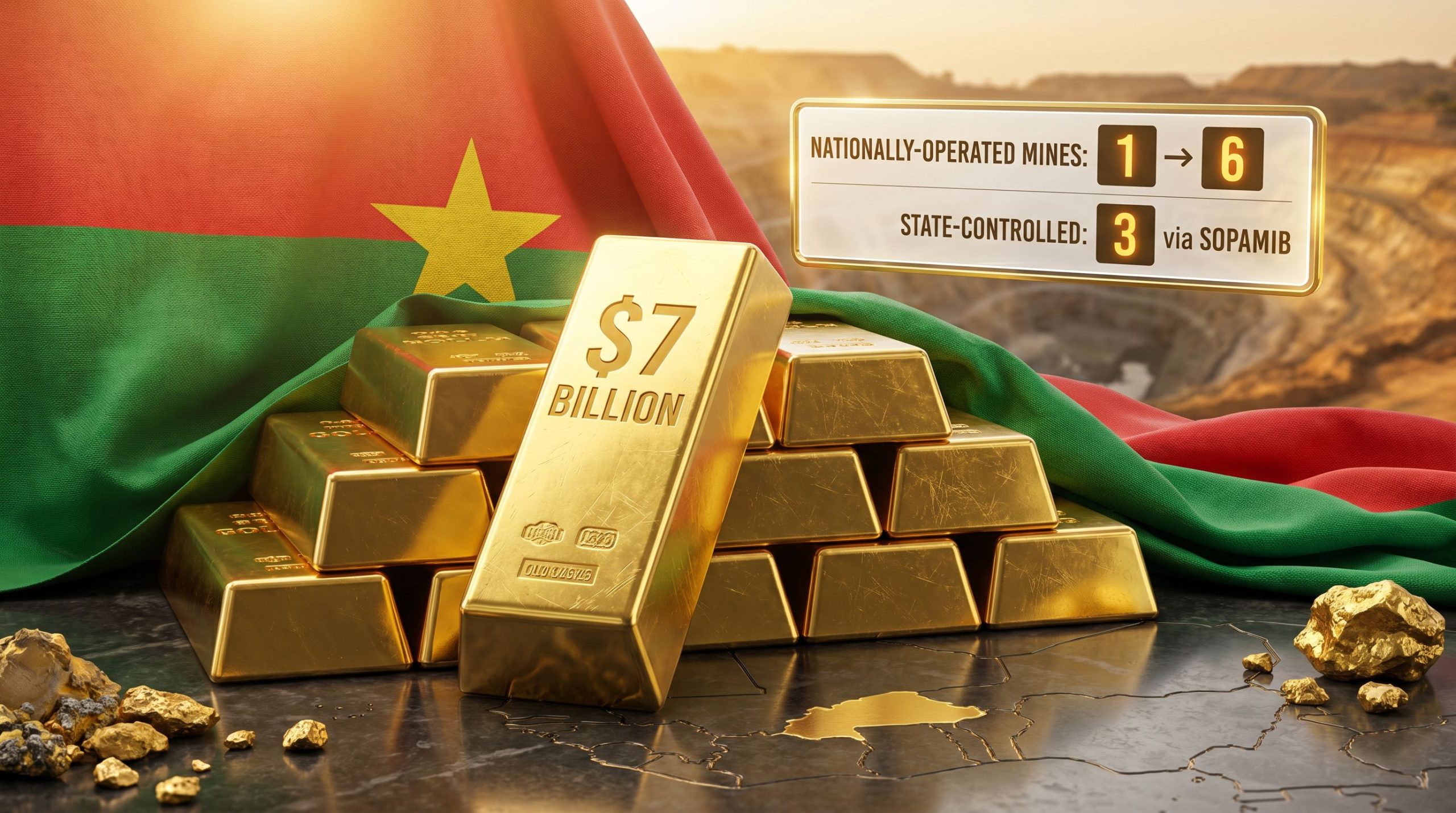
Burkina Faso’s position within this belt has made it one of West Africa’s top five gold producers. The country’s industrial mining sector is valued at approximately $7 billion, with gold representing the dominant source of export revenue and foreign exchange earnings. For multinational mining corporations, this geological endowment represented an attractive frontier — relatively underexplored compared to neighbouring Ghana, with sufficient infrastructure to support industrial-scale operations.
From Colonial Economics to Sovereignty Claims: The Long Arc of Foreign Mining Dominance
The concentration of Burkina Faso’s mining wealth in foreign hands did not happen overnight. It followed a decades-long pattern common across sub-Saharan Africa, where colonial-era extraction systems were replaced not by domestic ownership but by a new generation of multinational corporations operating under investment codes designed primarily to attract foreign capital.
Under the framework that preceded the current administration, Burkina Faso’s state held only a 10% free-carry equity stake in mining projects. A free-carry arrangement means the government receives its equity share without contributing capital — a model designed to provide some revenue participation without requiring state investment. Critics of this structure argued, with considerable force, that a 10% stake was structurally insufficient to redirect meaningful value toward national development priorities. Furthermore, mining profits were being repatriated to corporate headquarters in Canada, Australia, and the United Kingdom. As research on large-scale mining in Burkina Faso has consistently highlighted, the prevailing view among affected communities was that the existing framework left them materially worse off.
Before the current administration came to power, the practical consequence of this framework was stark: only one of Burkina Faso’s 15 active industrial gold mines was operated by a nationally-owned company, according to reporting by specialised mining outlet Mines Actu Burkina. The remaining 14 were, in operational and financial terms, foreign-controlled assets extracting value from Burkinabe soil under terms that generated comparatively modest domestic economic spillovers.
The Ownership Transformation: What Has Actually Changed
SOPAMIB and the Architecture of State Control
The most structurally significant instrument of Burkina Faso’s mining transformation is the Burkina Faso Mining Participation Company, known by its French acronym SOPAMIB. This state-owned entity was established as the operational vehicle through which the government exercises direct equity control over mining assets, rather than merely passively holding a royalty or free-carry interest.
By the end of 2025, SOPAMIB directly controlled three of the country’s 15 industrial gold mines. The most prominent transfers to state control were the Boungou and Wahgnion mines, previously operated by Endeavour Mining, a major multinational gold producer. These transactions represent a structured ownership transfer model rather than outright expropriation — a distinction that matters significantly for how international investors assess the risk environment. Consequently, understanding current gold M&A trends has become essential for companies operating across frontier mining jurisdictions.
The Mining Code Reform: Raising the Floor
Simultaneously, the government reformed its mining legislation to increase the mandatory free equity participation threshold from 10% to 15% across new and renegotiated mining agreements. While a 5-percentage-point increase may appear modest in isolation, it carries compounding significance:
- It establishes a higher baseline from which further participation can be negotiated
- It signals a policy direction that investors must price into long-term project economics
- Additional provisions were introduced allowing the state to acquire equity stakes beyond the 15% floor, creating an open-ended participation ceiling
The Rise of Domestic Private Capital: Inoussa Kanazoe and Beyond
One of the less widely reported dimensions of Burkina Faso’s ownership restructuring involves the emergence of domestic private capital as a meaningful force in the sector. This distinguishes Burkina Faso’s model from straightforward nationalisation and introduces a second tier of indigenisation.
Among the most notable domestic actors is businessman Inoussa Kanazoe, whose Soleil Resources International group reportedly acquired the BMC and Roxgold mines — assets previously held by foreign-controlled entities. The Roxgold acquisition is particularly noteworthy from a geological perspective, as the Yaramoko mine complex operated by Roxgold was recognised as a high-grade underground operation, with ore grades significantly above the West African average for open-pit deposits.
“Industry context: High-grade underground operations typically require more sophisticated mining engineering, ventilation systems, and geotechnical expertise than open-pit equivalents. The technical complexity of managing such assets domestically represents one of the genuine capability challenges embedded in Burkina Faso’s ownership transition.”
The combined effect of state acquisition via SOPAMIB and domestic private capital entry means that by the end of 2025, six of Burkina Faso’s 15 industrial gold mines were majority-owned by Burkinabe companies — a transformation from a single nationally-operated mine within approximately three years.
Ownership Transformation by the Numbers
| Metric | Pre-Reform Baseline | Status by End of 2025 |
|---|---|---|
| Nationally-operated industrial mines | 1 | 6 (majority Burkinabe-owned) |
| State-directly controlled mines (via SOPAMIB) | 0 | 3 |
| Total active industrial gold mines | 15 | 15 |
| State free equity stake (mining code minimum) | 10% | 15% |
| Foreign-majority operated mines | ~14 | ~9 |
The pace of this transformation has few direct precedents in West African mining history. Comparable ownership restructuring programmes in other jurisdictions have typically unfolded over decades, supported by gradual legislative reform rather than the concentrated policy acceleration seen in Burkina Faso since 2022.
In 2024, the Burkinabe government announced its intention to review and potentially withdraw mining permits from select foreign operators. The announcement was notable both for its directness and its deliberate ambiguity — specific companies were not publicly named, creating uncertainty across the entire foreign operator cohort.
The market reaction was immediate. Share prices of several foreign miners with Burkina Faso exposure declined sharply, reflecting the market’s assessment that permit revocation risk had moved from theoretical to credible. Companies including Endeavour Mining, West African Resources, Nordgold, Fortuna Mining, and Orezone Gold experienced price pressure in the period following the announcement. In addition, gold equities performance across the broader sector felt the ripple effects as investors reassessed frontier market exposure.
Subsequent communications from Burkinabe authorities indicated that some operators received assurances their existing licences remained valid. This sequencing — broad threat followed by selective assurance — suggests the permit review mechanism is functioning as a negotiating lever as much as an enforcement instrument. The practical effect is to alter the bargaining dynamic fundamentally: foreign operators must now engage with the state from a position of conditional tenure rather than contractual certainty.
The next major ASX story will hit our subscribers first
The National Gold Refinery: Capturing the Value Chain
The establishment of a domestic gold refinery represents a strategically important dimension of the ownership agenda that extends beyond mine-level equity. Historically, raw gold extracted in Burkina Faso was transported for refining and processing at international facilities — primarily in Switzerland and the United Arab Emirates, the world’s dominant gold refining centres.
This arrangement meant that the value-added component of gold processing, including the economic activity, employment, and technical knowledge associated with refining, occurred entirely outside Burkina Faso’s borders. A domestic refinery changes this equation by enabling the country to capture a greater portion of the gold value chain.
It also has geopolitical implications. Domestically refined gold can be held as central bank reserves, used in direct bilateral trade arrangements, or sold through channels that bypass the traditional London Bullion Market Association pricing infrastructure — a dimension that aligns with the current administration’s broader posture toward economic independence from Western financial systems.
Security Conditions and Their Interaction With Mining Economics
No analysis of the Burkina Faso gold industry is complete without examining the security environment, which has become a material variable in the economics of foreign mining operations. The country has faced sustained and intensifying militant activity linked to groups affiliated with both al-Qaeda and the Islamic State across significant portions of its territory since approximately 2015. Indeed, mining geopolitical risks of this nature are increasingly reshaping how international capital allocates across the African continent.
For mining companies, this creates a distinctive cost structure that compounds policy risk:
- Private security expenditure has risen substantially as standard mine site security requirements have intensified
- Logistics disruption along key transport corridors has increased costs associated with fuel, reagents, and equipment supply chains
- Production interruptions from security incidents have affected output volumes at several operations
- Insurance and risk premiums for Burkina Faso-domiciled assets have increased markedly in international capital markets
Foreign miners are therefore contending with multiple simultaneous headwinds: declining ore grades at maturing deposits, security-driven cost escalation, and an increasingly restrictive regulatory environment. The combination has materially altered the risk-return calculus for Burkina Faso mining assets from the perspective of international capital allocation.
Burkina Faso Within the Continental Pattern: Comparing African Resource Nationalism Models
Burkina Faso’s policy trajectory is part of a broader recalibration across sub-Saharan Africa that investors and mining companies must understand as a systemic trend rather than an isolated case. As reporting on how coups reshaped Burkina Faso’s mining sector has made clear, the political ruptures of recent years have had direct and measurable consequences for operational realities on the ground.
| Country | Primary Mechanism | Target Commodity | Ownership Approach |
|---|---|---|---|
| Burkina Faso | State acquisition via SOPAMIB + mining code reform | Gold | State + domestic private |
| Zimbabwe | Mandatory local ownership legislation | Gold | Domestic private majority |
| DRC | Mining suspension orders + licence reviews | Gold, cobalt, coltan | State-directed |
| Guinea | Mining code renegotiation + processing mandates | Bauxite | State participation |
| Tanzania | Royalty increases + state equity mandates | Gold, tanzanite | State equity |
What distinguishes Burkina Faso’s approach from classical nationalisation is its preservation of a mixed-ownership ecosystem. The continued presence of some foreign operators alongside state entities and domestic private investors reflects a pragmatic calculation: full nationalisation historically produces capital flight, technical capability gaps, and production declines. The Burkinabe model appears calibrated to capture maximum revenue and ownership benefit while avoiding the wholesale operational disruption that would accompany a complete foreign exit.
Investment Implications: Repricing Risk in a Transformed Environment
The Multi-Vector Risk Framework
For international investors with existing or prospective exposure to Burkina Faso mining assets, traditional frontier market risk frameworks require significant recalibration. The relevant risk dimensions now operate simultaneously rather than sequentially:
- Ownership dilution risk: Further equity participation requirements above the 15% floor remain possible under current legislative provisions
- Permit revocation risk: The 2024 permit review announcement demonstrated that operating licences carry conditionality that was not previously priced into valuations
- Forced transfer risk: The Boungou and Wahgnion transactions establish a precedent for structured asset transfers under government direction
- Operational security risk: Militant activity creates direct production exposure that is difficult to hedge
Where Opportunity May Persist
Despite the challenging environment for direct equity ownership of mining concessions, certain commercial activities may offer more durable exposure to Burkina Faso’s gold sector. Furthermore, mining private equity is increasingly being deployed through alternative structures to navigate the evolving ownership landscape:
- Service and supply chain relationships with domestically-owned operators, who will require technical services, reagents, and equipment supply on commercial terms
- Refinery and downstream processing infrastructure aligned with the government’s domestic value-addition agenda
- Structured financing to domestic private operators who lack access to international capital markets on standard terms
- Technical consulting and training partnerships that build domestic operational capability while generating commercial returns
“Disclaimer: The investment observations above represent analytical perspectives on market conditions and do not constitute financial advice. Investors should conduct independent due diligence and consult qualified financial advisors before making investment decisions related to Burkina Faso or any other jurisdiction.”
The Capability Question: Can Domestic Operators Sustain Production Standards?
Perhaps the most consequential long-term question surrounding Burkina Faso’s ownership transformation is whether domestically-owned operators can maintain the technical standards, capital investment, and operational efficiency previously delivered by multinational corporations.
Industrial gold mining is technically demanding. Open-pit operations require sophisticated fleet management, blast design, grade control, and environmental monitoring systems. Underground operations demand even more specialised expertise in ground support, ventilation engineering, and geotechnical risk management. The multinational companies that previously dominated Burkina Faso’s sector brought institutional knowledge, access to global capital markets, and technical talent pipelines that cannot be replicated overnight.
Three critical success factors will determine whether the transition delivers on its economic sovereignty promises. In addition, robust mining project feasibility planning will be essential as domestically-owned operators take on increasingly complex assets:
- Technical capacity development: Domestically-owned operations must build or retain the geological, engineering, and metallurgical expertise required to optimise production from complex ore bodies
- Capital access on viable terms: State and domestic private operators will need project financing from sources willing to lend against assets in a high-political-risk environment — a structurally more expensive proposition than what multinational borrowers historically accessed
- Revenue deployment discipline: The credibility of the entire economic sovereignty agenda ultimately rests on whether increased domestic revenue retention translates into measurable public goods rather than narrow elite capture
Key Takeaways: Burkina Faso Gold Industry and the Retreat of Foreign Firms
- Burkina Faso has restructured ownership of its $7 billion gold industry at a pace unprecedented in recent West African mining history
- Six of 15 industrial mines are now majority Burkinabe-owned, with three under direct state control via SOPAMIB
- The mandatory state free equity stake has been raised from 10% to 15%, with provisions enabling further participation
- Domestic private capital, exemplified by acquisitions through entities like Soleil Resources International, represents a second tier of the indigenisation agenda alongside state ownership
- Foreign operators face converging pressures across policy risk, security costs, and operational headwinds that have materially altered the investment case
- The model is architecturally distinct from full nationalisation, preserving mixed ownership to avoid capital flight while advancing domestic control
- Long-term sustainability depends on technical capacity building, capital access, and effective revenue deployment into national development priorities
- Burkina Faso’s trajectory reflects a continental pattern of African governments asserting greater sovereignty over strategic mineral assets, with implications for global mining investment flows that extend well beyond the Sahel
Readers seeking broader context on African resource sector developments and the evolving relationship between governments and foreign mining companies may find relevant reporting at Business Insider Africa, which covers market dynamics across the continent.
Want to Stay Ahead of the Next Major Mineral Discovery Before the Market Moves?
Discovery Alert’s proprietary Discovery IQ model delivers real-time alerts on significant ASX mineral discoveries, transforming complex mineral data into clear, actionable insights for both short-term traders and long-term investors — begin your 14-day free trial today and position yourself ahead of the market, or explore historic discovery returns to understand just how transformative early entry into a major find can be.
Credit: Source link