

Burkina Faso Claim 400 Militants Killed, Accuses France of Backing Armed Groups
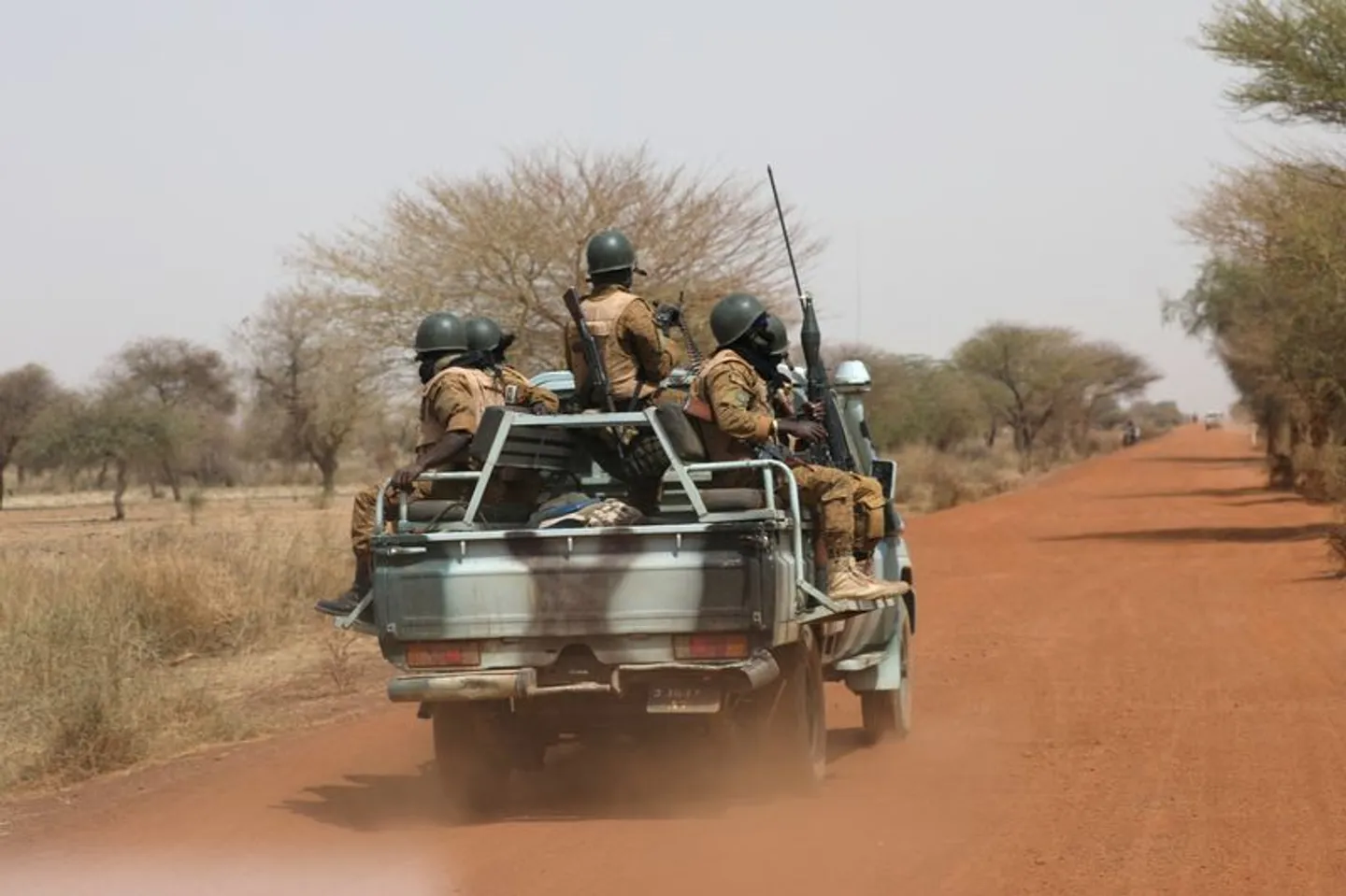
Burkina Faso’s military says it has killed more than 400-armed terrorists following a series of coordinated attacks on military bases on Monday, just a day after the country broke off ties with France, claiming that the European nation is actively supporting the rebels.
The General Staff of the Armed Forces in a statement late on Wednesday night, said the attacks were directed against positions of the National Armed Forces (FAN) and Volunteers for the Defense of the Homeland (VDP) in Gayeri (Sirba Region) and in Solhan, Sebba (Liptako Region). The attack was one of the heaviest multi-front assaults that Burkina Faso’s troops have experienced in the recent past.
Ground forces then acted swiftly to counter the attacks, with the help of air support from the military, said the army. Targeted airstrikes and ground combat “neutralized more than 400 terrorists” and enabled the recovery of a large amount of equipment, including over 250 motorcycles, 353 weapons of various calibers, ammunition, and communication equipment. The military also said three of its own soldiers had been killed in the battle: two in Solhan and one in Gayeri.
The Burkinabè military leadership could not independently determine which armed group is responsible for the attacks on June 30th.
Read More: African youth activism in response to French foreign policy in the Sahel region
The operational profile, however – simultaneous, coordinated strikes against multiple targets in the Sirba and Liptako regions – is very similar to what has been seen with the al-Qaeda-affiliated armed group Jamaat Nusrat al-Islam wa al-Muslimin (JNIM), which has been the main non-state armed group belligerent against the state in northeastern and eastern Burkina Faso.
Notably, the General Staff’s communiqué was not just a military after-action report. The coordinated attacks came a day after Burkina Faso announced it would break ties with France over alleged support by the nation to the armed groups, the statement said.
There is nothing in the statement itself that identifies specific evidence of this accusation, but it is very much part of the political narrative of the Government’s stated position. When breaking ties on June 26, Ouagadougou denounced France of having “neo-colonial ambitions, made evident by its active support for subversive networks and the terrorists who are plunging our country and the Sahel into mourning.”
Paris has denied these allegations: called it a “hostile and baseless decision” that “illustrated the troubling drift of the Burkinabe authorities.”
The timing of the attacks – on the day of the diplomatic rupture – is now the heart of Ouagadougou’s political narrative in its counteroffensive.
The General Staff also pointed out that these attacks came on the day after Burkina Faso broke ties with France, a move that had been announced yesterday. If this is a coordinated retaliation by armed groups related to French networks (as the government suggests) or it is merely a coincidence, has not been proven by independent sources.
Read More: African Liberation Day: Has the Continent Truly Been Freed?
“The operations to secure the area are continuing and intensifying in order to track down those who fled and guarantee the safety of citizens,” the armed forces stated, calling on residents to cooperate with security forces, comply with security measures, and report any suspicious individuals.
The announcement comes amid the backdrop of continued crisis. From January to March 2026, the United Nations Office for the Coordination of Humanitarian Affairs (OCHA) reported 2,640 conflict-related deaths in the Central Sahel – comprising of roughly 2,100 in Burkina Faso – and 2.8 million people internally displaced in the Central Sahel as a whole, including about 2.1 million in Burkina Faso alone.
The government of Captain Ibrahim Traoré, which has held power since a coup in September 2022, has expelled French troops, and pivoted to Russia, has been increasingly painting the insurgency as being connected to Western — and specifically French — interference.
Wednesday’s communiqué takes that argument to the battlefield, making the June 30 attack a reflection of France’s opposition to the nation’s sovereignty.
Due to the limitations on media access in conflict zones in Burkina Faso, it has not been possible to verify the casualty statistics independently. The figures claimed are based on the military’s own declaration.
Muhammad Mahad Samija
Muhammad Mahad Samija is a student of Political Science at Government College University, Lahore. He can be reached at [email protected]
Credit: Source link
Comments are closed.