

Ansar Allah’s Red Sea Advance Has Exposed Saudi Weakness
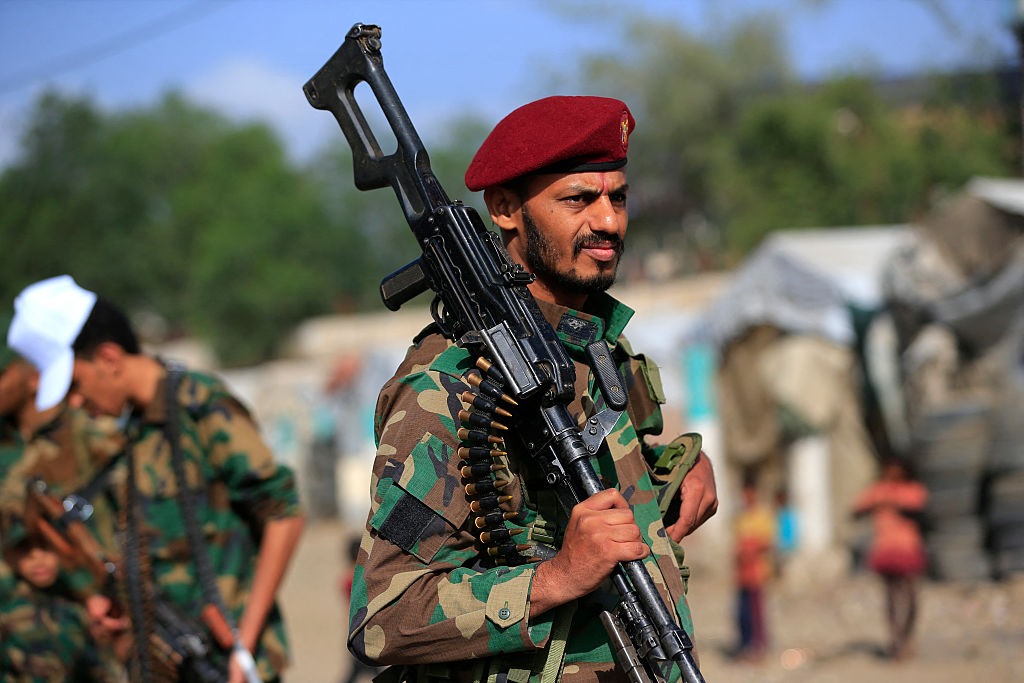
On September 9, Yemen’s Ansar Allah, or “Houthis” as they are also known, descended from the highlands down roads and riverbeds to the Tihamah coastal plain and captured the port of Mokha from the Saudi-based government the following day. By September 11, they had taken Perim Island in the Bab al-Mandeb Strait. Since then, they have used that position to blockade Israel and exercise leverage over the Saudi kingdom.
Ansar Allah went on to shut down the 745-mile-long East–West pipeline that transports four to five million barrels per day from Saudi Arabia’s eastern oil fields to its Red Sea export terminals, possibly with the assistance of Iraqi militias. In response, the price of global Brent crude rose to $108 a barrel; it is now hovering at $102. For comparison, the figure in January, before the US-Israeli war against Iran began, was $60 a barrel.
Meanwhile, fighting in Yemen continues. Around 1,500 soldiers are injured and another five hundred are confirmed are dead on the government side alone; battles are taking place in Al Jawf, Marib, and around Taiz as Ansar Allah seeks to secure the highlands overlooking their new territory.
This attack did not come as a surprise to Yemenis. Tensions have been building in the country in recent months over a political stalemate that Ansar Allah sees as intolerable. The group is currently in the midst of fighting a civil war, which has been frozen since 2022, against an array of Saudi-backed forces across multiple fronts.
Ansar Allah dominates the coalition that is the country’s de facto leadership, controlling territory home to more than three in four Yemenis and fighting a government that is internationally recognized but highly dysfunctional. The group comprises an uneasy coalition of a diverse set of actors who share little except a common enemy. Ansar Allah made no secret of their designs on the Red Sea coast even during ceasefire. The Saudi maritime blockade and the exigencies of the war economy mean that Mokha has long been eyed as a potential second lung to Hodeidah, the Ansar Allah–controlled port to the north.
Since 2023, the Saudis have dangled a promise of cash for peace in front of Ansar Allah. But the group also wants Saudi reconstruction funds to fix the destruction wrought by a long air war that destroyed infrastructure and killed more than 150,000 Yemenis between 2015 and 2022 (this figure is likely a significant undercount).
The prospect of the Houthis being backed, even if just financially, by the Saudis to maintain order has historic precedents. The country’s former President Ali Abdullah Saleh, and before him the imamates of Fiver-Shias, the Houthis’ coreligionists, enjoyed qualified support from the kingdom. But the Houthis have long been unwilling to foster relations with the Saudis. After all, Ansar Allah are close allies of Iran, which is currently winning a war waged against it by the United States, alongside Israel, since February.
Sana’a and Tehran are playing a long-term game against what they see as an Israeli war of aggression against the multiple nations of the Middle East. The region is now involved in a giant escalation trap driven by the US and Israeli war against Iran and its regional allies. The Houthis face pressure from the Islamic Republic to open a southern front against Saudi Arabia, whose territory has been used to stage strikes against Tehran.
One analyst with ties to the region, with whom Jacobin spoke on condition of anonymity, described the Ansar Allah response in July when the Saudis hit Sana’a international airport as a plane carrying the Houthi delegation for the funeral of Iran’s former Supreme Leader was trying to land. Ansar Allah responded by striking the Gulf monarchy’s Abha Regional Airport. It was clear then that retaliation was on the cards. “They [Ansar Allah] told us, ‘Wait and see what we can do, and we will,’” the analyst told Jacobin. “They said escalation is coming. In this stalemate, it is now not an option to keep their supporters and troops idle.”
Ansar Allah sees its domestic political enemies as weak. “The fundamental problem is that the Yemeni National Resistance Forces (NRF) and the wider anti-Houthi coalition are a hodgepodge of groups with different religious, ideological, political, and regional backgrounds,” Mohammed Al-Basha, a Washington, DC–based risk adviser and founder of the Basha Report, told Jacobin. “Some were former adversaries . . . and they are not united around a common long-term political vision for Yemen,” he added.
In August and early September, Ansar Allah’s military conducted shaping operations against the NRF, led by Tareq Saleh, a warlord mostly loyal to the official Saudi-based government of Yemen and nephew of Ali Saleh, whom the Houthis assassinated in 2017 for double-crossing them. Ansar Allah saw Saleh as the weak link in a pro-Saudi alliance. He had irked the Saudis after he had tried to maintain ties with the United Arab Emirates after both nations went to war in Yemen in January. Riyadh drove the UAE — officially at least — out of Yemen, and Tareq Saleh plodded on, chastened. Unlike the Houthis, who are embedded in Iranian missile production networks, neither Saudi Arabia nor the UAE was sending the NRF advanced weapons to defend its enclave, an analyst told Jacobin.
Ansar Allah presumably chose this moment to join the war due to the disarray of its enemies, the collapse of the political process, and diplomatic pressure from Iran, which wishes to climb the escalation ladder ahead of the US midterms in November.
Much of the media has characterized the attack against Tareq Saleh as a sudden seizure, but it seems to have been more a product of a longer campaign. Al-Basha has documented a weeklong Houthi program of disrupting supply lines and softening targets with drones and missiles in advance of their invasion.
Control of this new territory will strengthen Houthi control of the Bab al-Mandeb Strait. The seventeen-mile-wide choke point, which Saudi Arabia increasingly depends on for its oil exports since Iran closed the Strait of Hormuz, presents the group with significant opportunities to raise funds from international maritime traffic, which is easily spooked by drone, missile, and even artillery attacks.
The group already militarized much of the Red Sea when it went to war in 2023 against Israel over its genocide in Gaza, building relationships in the process with major buyers of oil transiting the Red Sea, according to Farea Al-Muslimi, a research fellow at Chatham House. The seizure of the lowlands expands their capacity to control a portion of the international trade going through the region. Al-Muslimi says that while the Houthis deny charging tolls on Red Sea shipping, they have developed what might be loosely called “business arrangements” with several nations, including China and Qatar. “Post-October 7, Yemen has developed under-the-table deals with some countries to let their ships go through [the strait] without being attacked,” he added.
Control of Mokha and the surrounding coastline also helps the Houthis consolidate their smuggling network, vital for technology transfers from Tehran. Possession of the ancient port of Mokha and several small islands along the coastline will be a boon to Ansar Allah’s capacity to evade the Saudi blockade. The Houthis work with many smuggling networks in the Horn of Africa, including those of al-Shabaab in Somalia, which also provides them with mercenaries in Yemen. The Shabaab-Houthi alliance will not be lost on Tareq Saleh, who is rumored to be living dangerously in Somalia.