

Angola’s northern escarpment forest is disappearing before our eyes
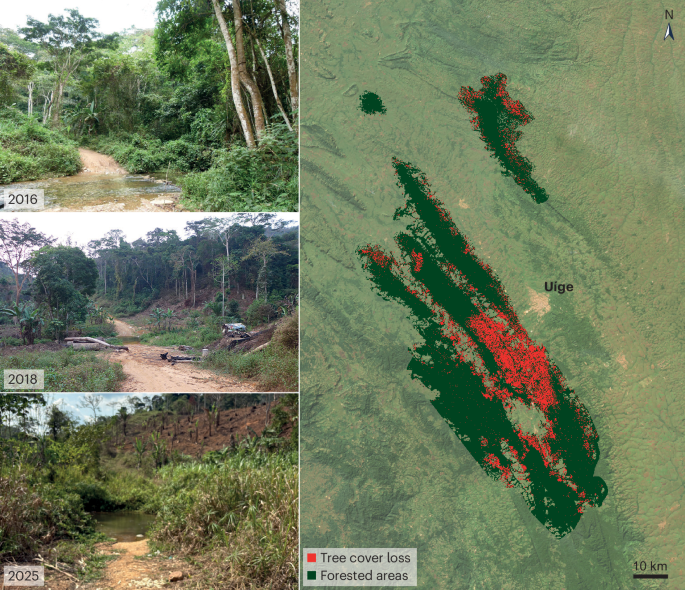
The SPFE is unique in that it is a biogeographical melting pot in which elements from the west-central African forest systems of Cameroon and Gabon meet elements from southern and eastern Africa, the latter probably linked by a shared dynamic history of the large drainage system of the Congo Basin4. In addition, the SPFE encompasses the only remaining large remnants of rainforest in Angolan territory south of the Congo River. The importance of this area and its conservation value were brought to the attention of the Angolan authorities in 2010, when it was officially proposed for inclusion in the strategy for expanding Angola’s protected areas, which one of us (B.J.H.) presented to the Minister of the Environment in a report5 and which was integrated into the strategic plan for Angola’s protected area network (B.J.H., unpublished report) in 2011 with recommendations. We and others have been collecting the biodiversity data required for the implementation of this plan since 2012 but they have only recently become available and accessible3,4. This prompted the Instituto Nacional da Biodiversidade e Áreas de Conservação of the Ministério do Ambiente in 2019 to commission a multidisciplinary research team, including the authors of this Correspondence, to conduct intensive biodiversity surveys and develop a strategy for SPFE protected areas to be implemented as part of the agenda of the project ‘Expansão e Fortalecimento do Sistema de Áreas Protegidas em Angola’ (Expansion and Strengthening of the Protected Areas System in Angola). This initiative was supported by a grant from the Global Environment Facility under the auspices of the United Nations Development Programme, and led to the preparation and submission of a comprehensive report in 2020 with detailed recommendations for the designation of the SPFE as a rainforest national park. This was positively received by national authorities during an official hearing in 2021, and we had high expectations for timely implementation. However, four years after this hearing and after several articles and reports highlighting the urgency of protecting this unique ecosystem, nothing concrete has yet materialized.
On the contrary, the last remaining forest areas are shrinking at an alarming rate, and deforestation has increased markedly over the past two decades. During this period, the central Serra do Pingano has lost 43%, and the SPFE as a whole 21%, of its original forest area6, which represents a loss of 526 km2 of forest, with additional areas being severely degraded. This includes habitats for exceptional endemic plants and animals such as the endangered Pingano balsam (Impatiens pinganoensis)7, the near threatened Angolan dwarf galago (Galagoides kumbirensis) or the sunrise firebelly (Eleuthemis eogaster) and the Angola longleg (Notogomphus kimpavita). Several forest-dependent amphibians still lack formal taxonomic designation and may go extinct before they are scientifically recognized4. A very recently discovered population of the critically endangered African forest elephant (Loxodonta cyclotis) in the Serra Vamba may face a similar fate (N. Baptista & P. Vaz Pinto, personal communication).
Credit: Source link
Comments are closed.