

Adéwálé Májà-Pearce · At MOWAA: Nigeria’s New Museum
Given Nigeria’s rich cultural heritage – Nok, Igbo Ukwu, Ìfẹ́, Benin – it’s not surprising that it has 53 national museums, although it’s hard to say how many are currently functioning. In 1996 I visited the Owo Museum in Ondo State, attached to one of the oldest palaces in West Africa, only to be told by the security guard – an elderly man with a bow and arrow – that there was nothing to see. Everything had been stolen, including the famous 15th-century terracotta heads. The museum has never made a public statement about this; the state government’s website says it ‘houses artefacts from the old Owo Kingdom including royal regalia, archaeological finds and historical Yoruba artworks’. Shortly after my visit, officials announced that thirteen other museums had been burgled in the preceding three years, an unusual admission in a country wary of publicising its incompetence. The federal government has said nothing recently, for example, about the bandits and jihadists controlling large swathes of Nigeria, even though Trump authorised US airstrikes against them last December and dispatched a hundred American troops in February to advise the Nigerian army.
The government has, however, added its voice to the clamour for the return of artefacts taken during the colonial period – above all the Benin bronzes, which were looted after the annihilation of the Kingdom of Benin by a British expeditionary force in 1897. Most are now in public and private collections around the world; the British Museum has the largest number. Demands for their return to Nigeria were originally met with scorn, but museums in Germany, the Netherlands and the UK (although not the BM) have since pledged to the oba of Benin, now a non-sovereign monarch, to return their holdings. They are understandably concerned for the objects’ future, so there has been widespread support in Europe and the US for the Museum of West African Art.
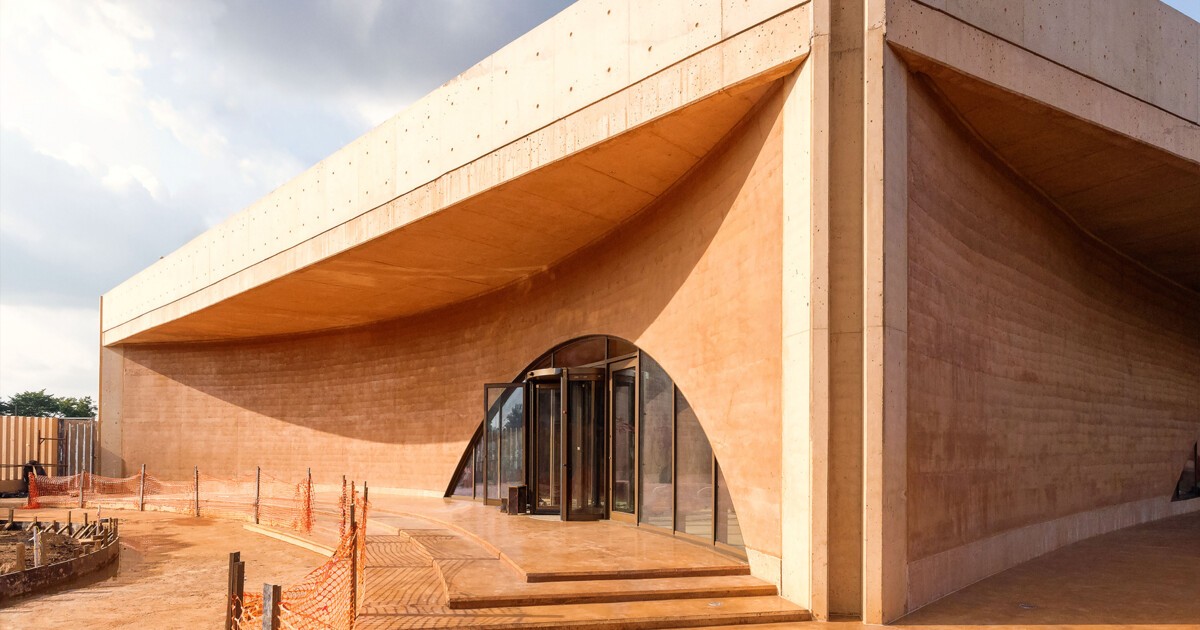
MOWAA, which calls itself ‘an independent non-profit institution dedicated to the preservation of heritage, expansion of knowledge and celebration of West African arts and culture’, spans fifteen acres in Benin City, the capital of Edo State in southern Nigeria, and incorporates some of the surviving walls, moats and gates of the vanished kingdom. It was designed by the Ghanaian-British architect David Adjaye. Work began in 2021 with an initial grant of $2.75 million from Godwin Obaseki, then governor of Edo; it is scheduled for completion by 2028. The project has raised $25 million in funding (a quarter of its projected cost), mostly from the Ford, Getty, Mellon and Open Society foundations, as well as the governments of Denmark, France and Germany. By the end of last year only the main building, covering a single acre, was open. It is thoroughly impressive – I paid a visit before the official opening last November – and contains climate-controlled storage facilities, field archaeology units and labs for testing materials, as well as two galleries, a library, shared workspaces and a hundred-seater auditorium. Still under construction are a rainforest gallery, a boutique hotel, a sculpture park and artists’ studios. Nigeria has no other museum like it.
According to Shadreck Chirikure, an archaeologist at Oxford and a MOWAA consultant, the museum has the potential to ‘put to bed the idea that Africa has no space and capacity to look after its heritage’. MOWAA’s Ore Disu argues that African works which have left the continent via colonial plunder or the modern art market should be returned, either through ‘restitution efforts’ or loans and travelling exhibitions: ‘Africans shouldn’t have to travel abroad to see a high-quality exhibition with our works sitting alongside those from other cultures.’ At the same time, she’s wary of the concept of museums. ‘Ethnographic museums, in particular, are tied to the history of dehumanisation and “othering” … MOWAA seeks to focus on precolonial African perspectives, geographical boundaries and religion before Eurocentric values shaped these definitions.’ The rainforest gallery, where more than two thousand trees have already been planted, will document oral histories and folklore linked to the area’s indigenous tree species.
MOWAA is also keen to celebrate contemporary work. The first exhibition was supposed to be Nigeria Imaginary: Homecoming, featuring eleven Nigerian artists. But the day before a scheduled private view for 250 local and foreign dignitaries, around forty protesters, some armed with wooden clubs, forced their way into the main building. The guests, who had already assembled in Benin City, were hurriedly escorted to ‘secure locations’ and the opening of the museum was postponed indefinitely. It seems the protesters believed that MOWAA was portraying itself as a ‘Benin Royal Museum’ (this had, in fact, been one of the project’s working titles). They were also under the mistaken impression that it had already received many of the bronzes to which the current oba, Ewuare II, lays claim. One of the protesters told me: ‘We consider the opening and the commissioning of MOWAA illegal, an insult on our revered throne.’
Insisting on its ‘deep respect’ for the Benin throne, the museum denied that it was interested in what is known generically as Benin royal art, which includes works in brass, ivory and wood: ‘MOWAA does not hold, nor have we ever claimed title to, any Benin bronzes … Our focus for the last four years has been firmly on broader West African art, research, education and conservation, with a strong focus on modern and contemporary as well as historical works from Nigeria and beyond.’
Not all of this was true. Obaseki’s initial payment was specifically intended for ‘the development and construction of [a] Benin Royal Museum’, but he backtracked in favour of the renamed MOWAA when the oba insisted that the artefacts should be returned directly to his palace, ‘in consonance with the wishes of the people of the Benin kingdom’. The federal government agreed with the oba, even though the palace has no museum, and declared that it would assume stewardship of the pieces in the interim, at which point the deliveries from overseas collections were put on hold. Where or how they might be looked after in Nigeria is still a mystery. On my trip for the aborted opening, I called in at the Benin City National Museum, opened in 1973, which is home to a few badly displayed bronze and terracotta figures and can’t begin to compete with MOWAA.
We don’t yet know whether the oba will build his own museum for the valuable artefacts – the last Benin bronze head sold for £10 million in 2016, more than four times the price a decade earlier – but the dispute is demoralising. In Benin City, I went to the palace but was told I couldn’t see anybody: the oba was preparing to receive ‘important’ delegates. I was directed to the dusty, dimly lit library, where I was dismissed by a man who was berating a female member of staff. Imperiousness at all levels is ingrained in the palace culture, especially at the top. A fortnight after I returned to Lagos, Obaseki’s brother, an actor called Don Pedro, was attacked by armed men while he was playing football: ‘I was … beaten severely, manhandled … stripped naked and taken into the palace of the oba of Benin … where I was made to kneel publicly.’ His offence? ‘I went to London and in a public statement I said: “May Edo people live long and prosper.” I should have said: “May the oba live long and prosper.”’ Neither the palace nor the police has commented on the assault.
The day after the protest at MOWAA, Monday Okpebholo, the governor of Edo, threatened to revoke the land title granted to the museum ‘in the overriding public interest’ and declared his allegiance to the oba ‘to ensure the monarch plays his role as the custodian of the rich cultural heritage of the Benin people’. As I argued in the LRB of 12 August 2021, the Benin artefacts should remain where they are until Nigeria is ready to look after them. MOWAA’s aims are laudable and achievable, but its overseas funding remains a source of suspicion to Nigerians. As Disu points out, even the most liberal organisations ‘come with their own agendas’. They also have to negotiate local sensibilities and parochial power struggles.
Disu is right to query the motives of Europeans and US foundations, but Nigeria is a complicated recipient of Western largesse: elites welcome it so long as domestic players, for whom it may not have been intended, get their share. Among those elites are wealthy Nigerians who could rival Western donations to MOWAA if they chose to. They haven’t.
Credit: Source link