

A Look at the Sahel (II)
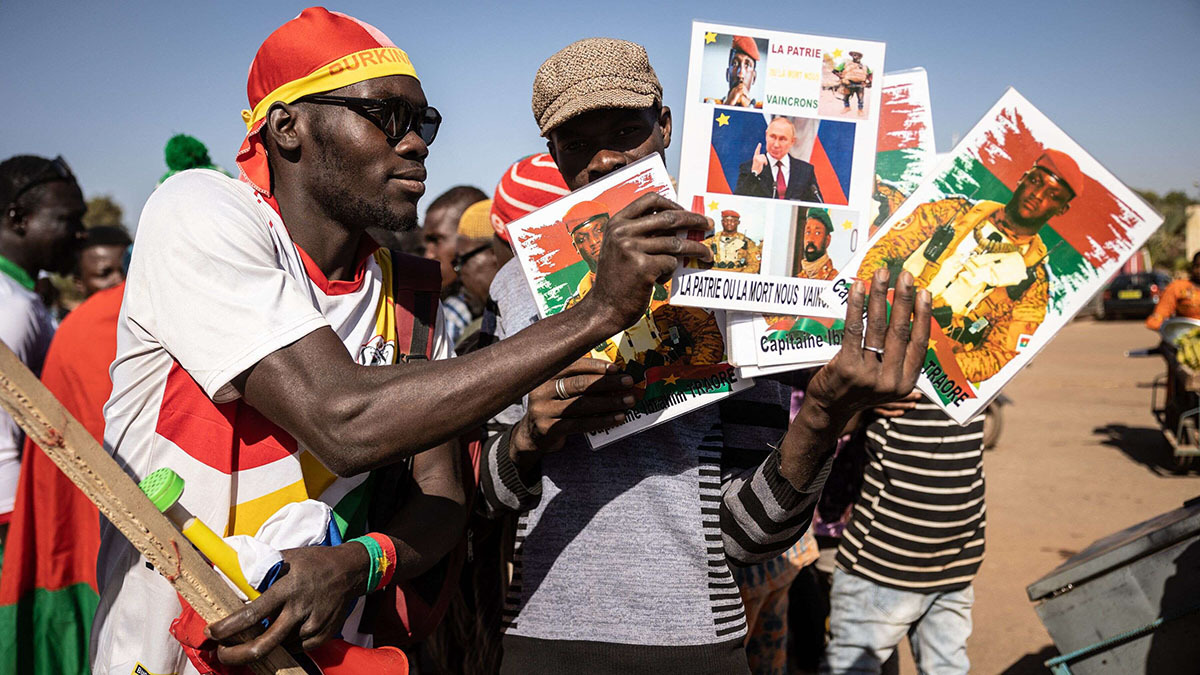
And whilst last week we turned our attention to Mali, today we are going to focus on Mauritania and Burkina Faso. The aim is to provide the reader with a holistic view of everything that is happening, for if we consider just one aspect or one country, we will not be able to fully grasp the scale of what is taking place.
Burkina Faso
In Burkina Faso, the first half of 2026 has served to consolidate the authoritarian and personalist nature of the regime led by Captain Ibrahim Traoré. Traoré, born on 14 March 1988 in Kéra (Mouhoun province), represents a generation of young military officers trained under the influence of Thomas Sankara’s revolutionary nationalism, anti-imperialist Pan-Africanism and a deep resentment towards the ineffectiveness of the former colonial powers (France in this case), coupled with the failure of traditional liberal democracies to combat jihadism. This would be a very good topic for reflection and debate, and one which we, with our 21st-century Western mindset and outlook, do not yet seem prepared to tackle: can we combat a cruel and ruthless enemy, prepared to do anything, who observes no rules or restrictions in order to achieve its objectives, whilst maintaining our scrupulous respect for moral norms and constraints? Is it possible to achieve victory in this way? But we shall leave that for another time.
Educated at the University of Ouagadougou, where he stood out for his activism in the Burkina Faso Students’ Association (ANEB) and in Marxist-leaning groups, Traoré entered the Georges-Namoano Military Academy in 2009, serving with valour and distinction on international missions such as the UN’s MINUSMA peacekeeping force in Mali, where he was decorated for his bravery during the defence of bases in the Timbuktu region in 2018. His rapid rise and subsequent accession to power through a coup d’état in September 2022 were a response to the troops’ frustration at the logistical neglect and rampant corruption prevailing within his country’s Ministry of Defence, where political leaders were “handing out suitcases full of cash” whilst soldiers were dying without ammunition in Djibo or Arbinda.
Despite his initial popularity, the reality of exercising power has severely eroded the regime’s internal cohesion. By January 2026, the presidential intelligence services had foiled at least five organised attempts at coup d’états and assassination plots against Traoré, instigated by disgruntled officers within the Burkinabe army, forcing the junta to decree the total and irrevocable dissolution of all national political parties by the end of that same month, thereby outlawing the activities of any organised opposition faction.
The military rift
The deep-seated internal tensions within the Burkinabe regime were laid bare on the night of 28 February to 1 March 2026, when loud explosions and the sound of automatic gunfire were heard in the vicinity of the Faso Presidential Palace in Ouagadougou. The incident sparked intense alarm amongst Traoré’s supporters, organised into civilian militias known as the ‘Wayiyans’, who mobilised via social media to seal off access to the presidential complex in the face of what they believed to be the outbreak of a military coup.
Although the spokesperson for the military presidency and intelligence sources insisted that the commotion was due to an accidental incident caused by a negligent shot fired at a lorry carrying hydrocarbons and highly flammable products – which resulted in the vehicle catching fire and destroying six official escort vehicles in the presidential car park – independent reports confirmed a pattern of latent military insubordination. The incident coincided with the refusal of numerous garrison officers and commanders of combat units deployed in the north to respond to an urgent mandatory summons to the capital. This act of defiance towards the military hierarchy reflected the commanders’ dissatisfaction with what they considered to be disastrous management of the war and the imbalance of resources favouring civilian militias over the regular army.
With regard to military operations on the ground, the Junta has focused most of its propaganda rhetoric on the results of Operation Lalmassga (a term meaning ‘Wall of Ice’ in the local language). According to the official spokesperson for the Armed Forces of Burkina Faso, Colonel Abdoul Aziz Ouédraogo, co-ordinated offensive actions by ground troops and VDP militias succeeded in neutralising more than one hundred suspected jihadist fighters in February 2026 alone, enabling the physical recapture of several northern towns that had been uninhabited since 2019, such as Tongomayel, Béléhédé and Pobé-Mengao. The operations involved the use of recently acquired artillery units, funded directly by contributions from local taxpayers.
However, the indiscriminate deployment of VDP militias has led to a serious escalation of the inter-ethnic atrocities so common in the area. During the so-called ‘Green Whirlwind 2’ operations carried out in early March 2026 in Solenzo province (Boucle du Mouhoun region), VDP militiamen, acting in conjunction with special forces units of the regular army, systematically raided various rural settlements of Fulani herders. The operation culminated in the execution of more than 130 unarmed Fulani civilians and the mass looting of thousands of head of cattle, in what international human rights organisations regard as a systematic campaign of ethnic cleansing and forced displacement, driven by institutional prejudice that equates the entire Peul community with the fighting cadres of JNIM.
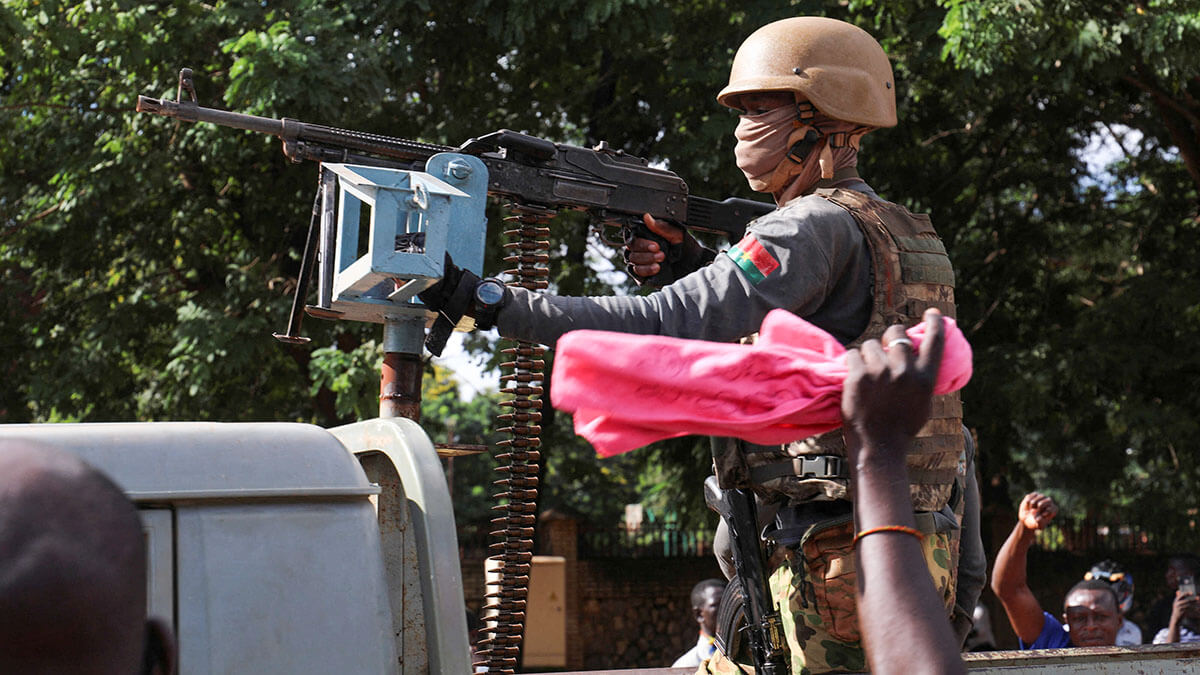
This spiral of reciprocal atrocities is further fuelled by brutal reprisals from the ranks of the insurgents. Between 1 and 5 April 2026, in retaliation for the VDP’s activities in the department of Sourou (Boucle du Mouhoun region), JNIM elements carried out raids on the towns of Gonon, Lanfièra, Mara and Tiao, summarily executing more than one hundred adult men whom they accused of having acted as guides or informants for government army patrol units, adding yet another twist to a spiral of violence that is as complex as it is unstoppable.
The military junta’s inability to bring lasting stability to the north and east of the country has led to the development of an atmosphere of intense media paranoia within the nation. Any journalistic reporting that refutes Captain Traoré’s alleged military successes is suppressed through state censorship and coercion, confirming a worrying drift towards totalitarianism.
An example of this information crackdown is the decision taken in May 2026 by Burkina Faso’s Higher Council for Communication, ordering the indefinite suspension of all analogue and digital platforms belonging to the French broadcaster TV5Monde. The sanction was based on the European channel’s broadcast of in-depth reports denouncing the Solenzo massacres and providing data demonstrating the government’s loss of effective territorial control to JNIM and the Islamic State in the Sahel.

Mauritania
Set against the backdrop of totalitarian drift and chaos in Burkina Faso stands Mauritania, a key player for our security within the broader context of events in the Sahel.
Mauritania currently remains an oasis of institutional stability and democratic security amidst the chaotic environment of the western Sahel. This relative success is based on the implementation of a pragmatic defence doctrine and intensive diplomatic activity aimed at consolidating its partnership with international security actors from the NATO bloc and the European Union, presenting itself as the only reliable partner and valid interlocutor remaining on Africa’s north-western flank.
During the first half of 2026, President Mohamed Ould Cheikh El Ghazouani has pursued an intensive foreign policy agenda aimed at securing security funding and fortifying its border against the spread of the conflict in Mali.
However, despite its internal stability, Mauritania is not immune to asymmetric threats. On 23 March 2026, the US Embassy in Nouakchott issued an emergency security alert following credible intelligence reports indicating a high risk of a terrorist attack planned by JNIM sleeper cells against US citizens and consular staff in the capital, urging people to avoid areas frequented by Westerners and unprotected night-time outings.
The main source of external instability for Mauritania lies in the deterioration of security controls along its 2,200-kilometre-long border with the Republic of Mali. During the first half of 2026, diplomatic tensions between the military junta in Bamako and the democratic government in Nouakchott have reached extremely serious levels due to direct accusations levelled by General Assimi Goïta, who maintains that Mauritania provides logistical cover, territorial shelter and rear-area medical assistance to FLA separatist fighters and JNIM terrorists during their incursions into Mali.

Mauritania has categorically rejected these allegations, accusing in turn the Malian Armed Forces (FAMa) and their Russian mercenary partners of repeatedly violating its sovereignty through armed incursions to pursue alleged fighters who cross the physical border.
One example of these illegal incursions took place in the border region of Ahl El Kory, where joint patrols comprising Russian armed contractors and Malian soldiers stopped a Mauritanian commercial vehicle. According to survivors of the incident who managed to flee into Mauritanian territory, the assault forces summarily executed six civilian passengers and inflicted fatal injuries on a seventh, whose throat was slit following a brutal interrogation, prompting a strong protest from Nouakchott.
To defuse a potential large-scale border conflict, the Mauritanian Minister of Defence, Hanana Ould Sidi, led an official emergency delegation to Bamako on 15 June 2026, meeting with General Goïta at the presidential palace. Although the meeting resulted in an exchange of formal declarations of brotherhood, neighbourly solidarity and a commitment to reactivate the bilateral border committees, the massive deployment of additional military forces by Nouakchott and the constant patrols by Russian and Malian drones in the border area keep the border region in a state of high, pre-war tension.
As we can see, the main pillar underpinning the spread of instability and jihadism is, at the same time, the weakest link in the entire structure, and we would do well to focus all our efforts on supporting, bolstering and sustaining the Mauritanian government in order to send a clear message to all regional, state and non-state actors. We have far more at stake here than we realise.
Credit: Source link
Comments are closed.