

Insurgent Attacks in Mali Cast Doubt on Junta-led Security in Sahel
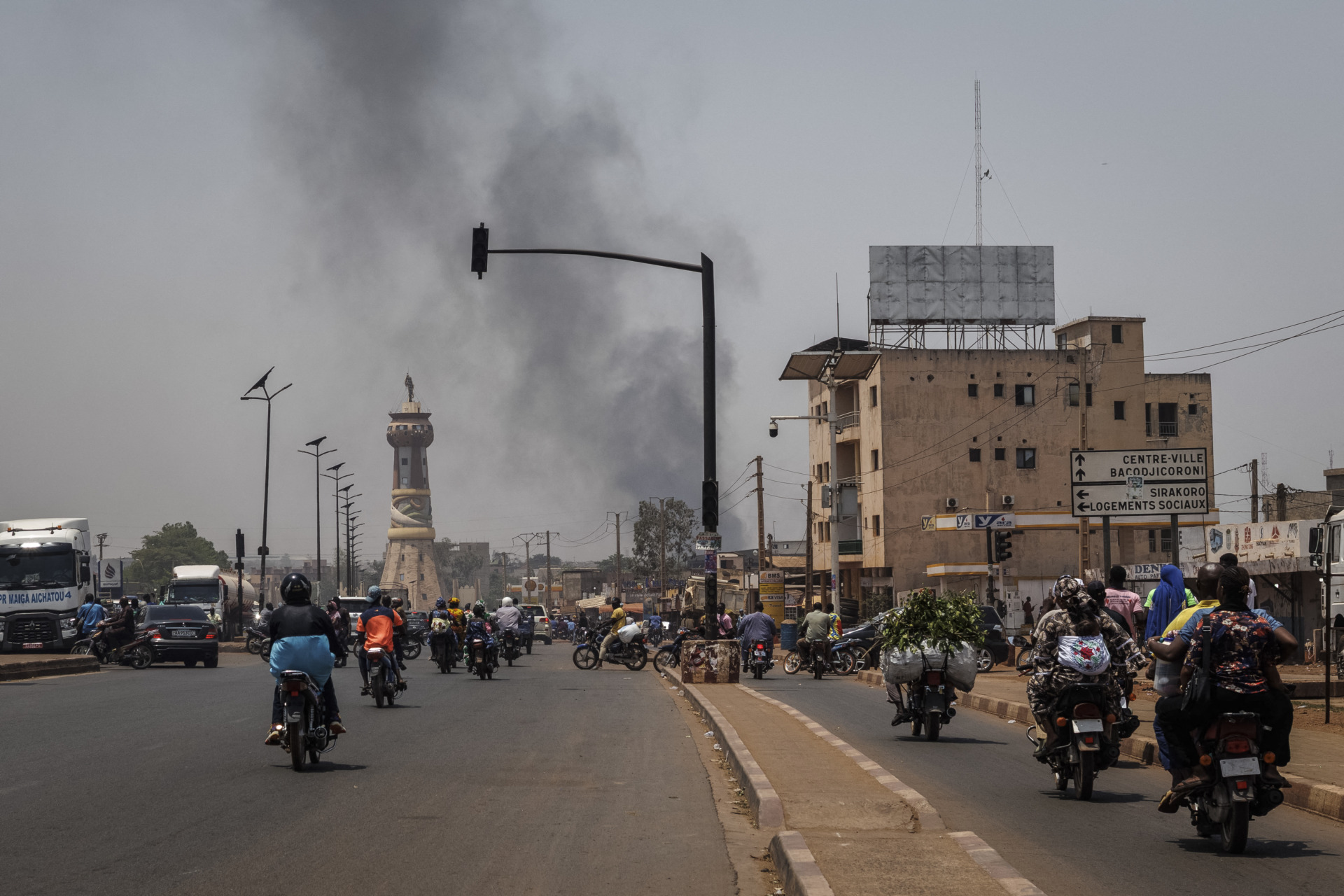
Before dawn on April 25, explosions and sustained gunfire shattered the quiet around Kati, a military garrison town 15 kilometers (9.3 miles) northwest of Mali’s capital Bamako in the country’s south. Within hours, simultaneous attacks claimed jointly by the jihadist armed group JNIM (Jama’at Nusrat al-Islam wal-Muslimin) and the Tuareg separatist FLA (Front de Libération de l’Azawad) were underway across the country. By the next day, the ruling military junta announced that Defense Minister Sadio Camara had succumbed to injuries sustained during an attack on his residence. There has since been media speculation that the junta’s intelligence chief, Modibo Koné, also died in the same wave of attacks, or at the very least, that he had been seriously wounded. By contrast, the junta had issued a statement after the attacks saying the situation was under control, even as fighting continued across the country, illustrating the persistent gap between official communication and operational reality.
The militant attacks represent the most direct challenge to junta leader Assimi Goïta’s control of the country since he seized power via coup in 2020, and they occur at a moment when the military regime’s position had already been significantly degraded. JNIM’s months-long blockade of landlocked Mali, which began last September and has included attacks on more than 130 fuel tankers, has prevented food and fuel imports from Senegal and Côte d’Ivoire, with impacts including forcing school closures across the country. At the end of March, the junta publicly denied releasing more than 100 JNIM prisoners to secure a resumption of fuel convoys through a temporary truce that was originally slated to end around Eid al-Adha at the end of May. Taken together, the blockade and recent attacks have illustrated how the group’s capacity to strangle the Malian state transcends the battlefield.
The recent events are a direct test of the junta’s proposition that Russian-backed security assistance and the suspension of civil liberties could deliver stability where democratic governance and Western-backed security assistance, including from France and the United States, had failed over the course of preceding decades. And the resurgent sweep of militant attacks is bound to resonate across similar juntas in the region, such as those in Burkina Faso and Niger, that had deposed their own western-allied governments.
An Earlier Jihadist-Separatist Alliance
Over the course of several months in 2012, a similar jihadist-separatist coalition routed Malian armed forces across the country’s north. The jihadists aspired to establish an Islamic emirate across northern Mali, while the separatist Mouvement National pour la Libération de l’Azawad (MNLA) sought self-determination for the Tuareg ethnic group. The coalition took shape as Malian Tuareg fighters who had served in then-Libyan leader Muamar Qaddafi’s security forces returned from Libya after his regime collapsed in 2011, bringing with them weapons and combat experience. They found willing partners in al-Qaeda in the Islamic Maghreb (AQIM) and Ansar Dine, a Malian jihadist movement supported by AQIM. Their short-lived alliance allowed them to seize an area greater than the size of Texas before fracturing violently, with jihadist factions turning on their erstwhile Tuareg partners once the Malian military had been expelled from the north.
The recent attacks unfolded across multiple fronts and mark the first major offensive coordinated between these unusual bedfellows in more than a decade. Although JNIM and the FLA espouse similar objectives as their jihadist-separatist predecessors, their recent coordination represents a tactical alliance rather than a strategic merger. Ultimately, their divergent long-term end states make more permanent integration unlikely, as the structural tensions that pulled them apart in 2012 remain. For the time being, however, both groups clearly see value in showcasing a contested Malian state that is unable to protect its own emblems of authority. For JNIM, that showcase serves a longer strategic logic of institutional attrition, wearing down the junta’s will and resources until the structure collapses from within.
General Camara, the late defense minister, also was the primary custodian of Mali’s relationship with Moscow and the official most responsible for the Wagner Group’s initial deployment at the end of 2021. This contributed to the eventual expulsion of French military forces in 2022 as well as the withdrawal of the United Nations peacekeeping mission in 2023, which had both deployed in 2013 as jihadi forces threatened to push south toward the capital. Following the death of Wagner leader Yevgeny Prigozhin after his failed challenge to Moscow in August 2023, the group was reconstituted under the direct control of the Russian Ministry of Defense and rebranded as Africa Corps.
Beyond rebranding, there has been a substantive change in mandate, and this pivot has come at the cost of operational effectiveness on the ground. Unlike Wagner, which sold itself as a frontline combat force to reverse the deterioration of Mali’s security environment, Africa Corps now operates as a training-and-advisory mission oriented toward preserving Russian access and influence. According to information from the Armed Conflict Location and Event Data (ACLED) project cited in Africa Defense Forum, battles involving Russian fighters in Mali fell from 537 in 2024 to 402 in 2025, with Africa Corps averaging just 24 incidents per month by early 2026. The demands of the conflict in Ukraine have further drawn down the personnel available for Africa Corps deployments, constraining Russia’s capacity to sustain even this reduced tempo.
Reverberations from Kidal
The distinction in mandate between Wagner and Africa Corps matters for understanding what occurred in Kidal. In November 2023, Malian and Wagner forces captured the city after more than a decade of jihadist control. The achievement appeared to validate the junta’s security partnership with Moscow. Now, in the wake of the April 25 attacks by JNIM and FLA, Africa Corps accepted an escorted withdrawal from the same city, surrendering that gain without a fight.
What happened in Kidal encapsulates the trajectory of the AES (Alliance of Sahel States) model itself. The AES juntas — Mali, Burkina Faso, and Niger — expelled Western partners and consolidated power on the argument that those partnerships had failed to provide the security they sought. They further withdrew from the Economic Community of West African States (ECOWAS) and formed their own defense alliance within the AES. Now, they are presiding over a measurably worse security environment than the one they inherited. Moreover, they have staked their legitimacy on this tradeoff, and the scope and scale of the attacks has laid bare the growing risks of this approach.
Since 2012, Sahelian militaries have cited insecurity as a pretext for at least five unconstitutional seizures of power. Three removed democratically elected presidents — Amadou Toumani Touré in Mali (2012), Ibrahim Boubacar Keïta in Mali (2020) in a coup Goïta led, and Roch Marc Christian Kaboré in Burkina Faso (2022). One military coup removed the civilian transitional government that had replaced Keïta, in a power consolidation Goïta engineered from his previous position as transitional vice president in 2021. The fifth military overthrow — and most instructive for present purposes — removed Lieutenant Colonel Paul-Henri Sandaogo Damiba in October 2022, nine months after he himself had ousted Kaboré, on the grounds that he had done no better for Burkina Faso’s security than the president he replaced.
Goïta now finds himself closer to Damiba’s position than he was when he initially seized power, and recent events suggest a leader whose hold on power is more uncertain than at any previous point in his tenure. While Camara’s death removes Goïta’s most visible competitor within the junta, it also adds to a vacuum in the country’s security architecture at a time when the junta has progressively hollowed out what little political legitimacy remained of the Malian state. In May 2025, the junta dissolved all political parties, and the military-appointed transitional council subsequently granted Goïta a renewable five-year presidential term, extending his hold on power until at least 2030.
A foiled coup attempt in August put the military’s uneven loyalty to the ruling junta on display and led to the arrest of dozens of soldiers, including two generals. The recent offensive may sharpen dissent within the officer corps, as many will seek to cast blame for the intelligence failure that culminated in coordinated nationwide attacks that pierced the regime’s inner sanctum.
Accordingly, the chances of a palace coup or a junior officer mutiny — which were already heightened following the fuel blockade since the fall — have increased. Part of what made the Russian arrangement attractive to the junta was the prospect that Wagner, and then Africa Corps, would be an insurance policy for the regime. That held until April 25, marking an inflection point at which the Malian junta’s leaders will have to decide whether the Russian relationship still serves their interests.
Epicenter of U.S. Counterterrorism in the Sahel
For nearly a decade, Mali was the epicenter of U.S. efforts to counter terrorism and violent extremism in the Sahel; coups in 2012 and 2020 triggered the suspension of most foreign assistance per Section 7008 of the annual U.S. congressional appropriations bill that prohibits the obligation or expenditure of funds for “the government of any country whose duly elected head of government is deposed by military coup d’état or decree.”
However, in recent months, there have been several indications that the Trump administration is considering revisiting this posture. In February, the Treasury Department lifted sanctions on three senior Malian officials, including the late defense minister. They originally had been designated in 2023 due to their facilitation of Wagner’s malign activity in Mali. The sanctions removals followed a visit by the State Department’s Africa lead to Bamako to explore the conditions for a revised bilateral relationship – to “chart a new course,” as the department put it — with ongoing discussions focused on intelligence-sharing, permissions for surveillance drone overflight, and access to minerals such as lithium and gold.
The recent events paradoxically increase U.S. leverage in Mali. Not only has the junta’s Russian partner been publicly embarrassed by the militant offensive, but the central premise underwriting the junta’s security strategy is now visibly under strain. Washington had reportedly already been exploring a minerals-for-security deal with Bamako before this weekend, possibly inspired by the agreement signed with the Democratic Republic of the Congo (DRC) in December, which offered economic and security cooperation in exchange for preferential access to the country’s critical mineral reserves. The DRC arrangement has drawn in private security actors as well, among them Erik Prince’s Vectus Global, which has since deployed personnel and drones to support Congolese forces. This could be a template the United States may be considering to bring Sahelian juntas back into the fold.
The recent offensive in Mali confirmed what JNIM’s trajectory has long suggested – that the junta’s approach is failing — and the structural conditions make the current threat environment considerably worse than the aftermath of the 2012 crisis. JNIM can expand its reach into Bamako at will, even without the force posture to seize and hold the capital. The group also clearly has expanded its operational toolkit to include drone capabilities, economic sabotage (the blockade and attacks on supply chains), and a multinational network that transcends the borders of any one Sahelian country. Meanwhile, the Malian state has fewer resources and diminished legitimacy to draw on, and no credible or operational regional security architecture exists – especially in light of the withdrawal of AES states from ECOWAS last year.
Neighbors Watching
Mali was Russia’s beachhead in the Sahel, and the reputational damage from April 25 will register with other African governments that have looked to Moscow for security guarantees. The Alliance of Sahel States has marketed its approach as a more effective alternative to Western-led security arrangements. The other members of the alliance are watching, as the credibility of the junta model as a solution to the Sahel’s insecurity is actively being stress-tested.
Farther afield, Africa Corps has been pressing for a foothold in the Central African Republic, where President Faustin-Archange Touadéra has resisted transitioning away from Wagner, whose units had been an integral part of his personal security detail for several years. And Russian military instructors from Africa Corps arrived in Madagascar following the Gen Z uprising and subsequent coup in late 2025. Both governments sought Russian engagement for regime protection, but the latest events in Mali might give these and other Russia-curious governments cause to revisit that calculus.
Even farther afield, Russia’s credibility was already fraying before this weekend. Russia’s inability to prevent the collapse of the Bashar al-Assad regime in Syria and the U.S. rendition of Venezuelan leader Nicolás Maduro in January each signaled the limits of what Moscow can actually deliver for its partners. With Africa Corps’ humiliating departure from Kidal, regimes that have courted Russian security cooperation can now draw their own conclusions about what that offer is actually worth when its partners come under sustained pressure.
FEATURED IMAGE: A column of black smoke rises above buildings as traffic passes the Africa Tower monument in Mali’s capital Bamako on April 26, 2026. Shock attacks, synchronized by Tuareg rebels of the Azawad Liberation Front (FLA) coalition and the jihadist Group for the Support of Islam and Muslims (JNIM), targeted several areas in the vast, arid country on April 25-26 in several areas, including Kita near Bamako, Kidal, Gao and Severe.
Tuareg rebels meanwhile announced an agreement allowing Russian forces backing Mali’s army to withdraw from the northern city of Kidal, which they had said was “totally” under their control. (Photo by AFP via Getty Images)
Credit: Source link