

Will Asians become Uganda’s 57th tribe?
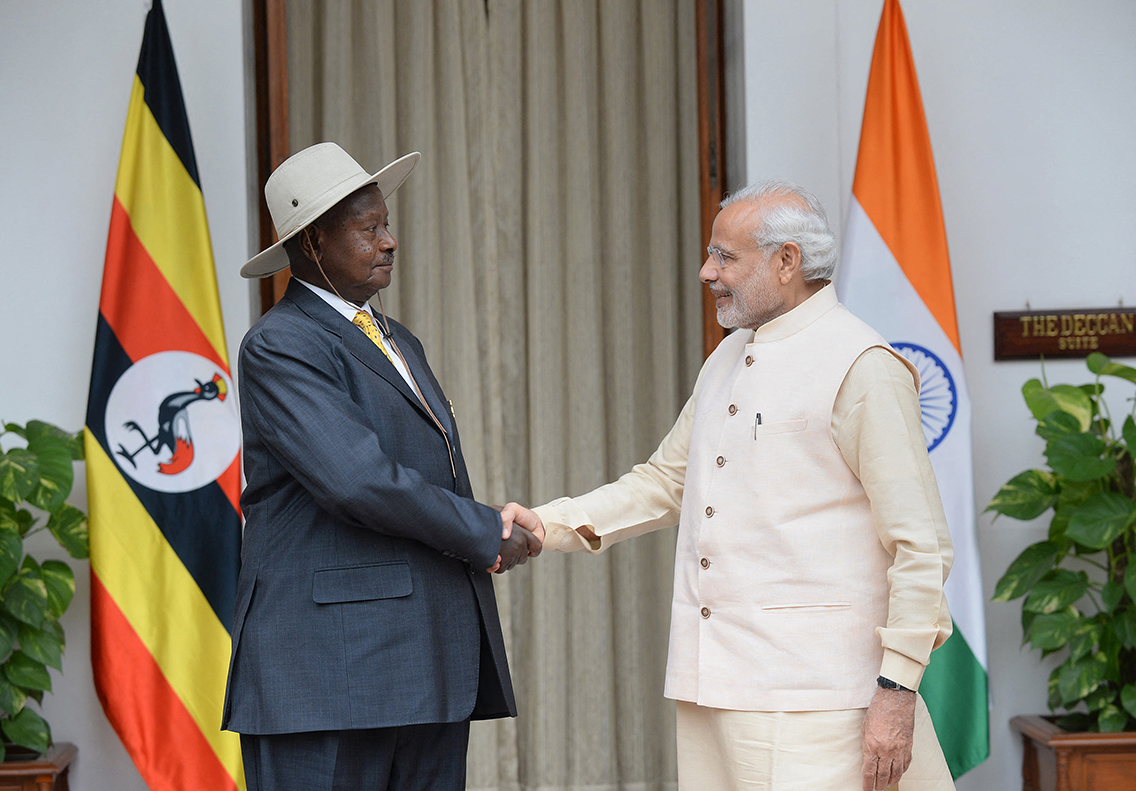
Uganda is considering a proposal to recognise its Asian community as one of its indigenous tribes. If this becomes law, some 27,000 Asians of mostly Indian origin with roots in Uganda going back centuries will become constitutionally indigenous.
In an ironic twist, Uganda, which earned global opprobrium when, in 1972, the dictator Idi Amin expelled the entire Asian community – many of them official citizens of the country – is now considering a proposal to confer indigenous ethnicity on the Asians. If the proposal becomes law, they will become the 57th officially recognised tribe of Uganda.
Kenya led the way by officially designating its Asian population as the country’s 44th tribe in 2017.
The proposal is believed to have gained substance when President Yoweri Museveni, hosting the annual Hindu festival of Diwali in 2017 at State House, was requested to recognise the community as a native Ugandan tribe.
Patel Sanjiv, the Indian Association leader in Uganda, had complained that young Asians born and raised in Uganda faced identity difficulties when applying for national identity cards and passports.
The community reiterated the same request during subsequent Diwali celebrations Museveni hosted, including in December 2021 and October 2025.
It now seems that the community’s Diwali prayers might be answered.
Parliament Speaker Jacob Oboth said: “We are looking forward to recognising them [Asians] as indigenous groups,” in India’s capital, New Delhi, where he attended the 26-27 October BRICS Parliamentary Forum. Uganda became a BRICS partner country in 2025.
Oboth said that Asians have contributed to Uganda’s development and are represented in the country’s political institutions, including Parliament and Cabinet. Uganda’s current Trade Minister, Sanjay Tanna, is a Ugandan of Asian origin. His nephew is an MP.
Question of citizenship
The issue of citizenship is not just an Indian issue, according to Makerere University’s retired don, Prof Mahmood Mamdani (father of current New York Mayor, Zohran Mamdani), “it is about the many minority groups in this country”.
Speaking at an open lecture back in 2022, he said:
“So, the citizenship question, to me, is the question of indigenous and non-indigenous. If Uganda is going to say that only indigenous Ugandans have citizenship by birth, that means you have closed the door on your citizenship; you should be prepared for the door to be closed on you also.
“But if Uganda wants to live in the world, then it has to agree to rules applicable to everybody who is Ugandan. We have to look at the history of this country.
“All the communities in this country whose history I know have admitted people from outside, and once they have been admitted into the community, they have not been defined as non-indigenous. Why define someone as non-indigenous?” Mamdani wondered: “It means you can’t be assured of their loyalty. It means you’re telling them ‘your stay is temporary’.”
Back to the present, Oboth referred to the 1972 expulsion, saying Museveni—who came to power in January 1986—later restored the community’s lost property. He praised Asians for having since become an important part of Uganda’s social and economic life.
Centuries-old presence
It is generally believed that Asian presence in Uganda traces back to at least 1880, when traders from Cutch and Gujarat on the West Coast of India used the Monsoon winds to sail down to the East African coast where Omani Arabs had established flourishing cities.
Some of them, including the legendary Allidina Visram, made the trek to the interior and reached the Ugandan kingdoms, opening trading routes back to the East African coast.

In the late 1890s, a large number of Indian workers, mainly from Punjab, were brought by the British colonial government to work on the proposed railway line from the seaport of Mombasa in present-day Kenya to Uganda.
The British believed this would open up the ‘highly lucrative trade’ (mostly of ivory, copper, tobacco, wild animal skins as well as some grain) of the interior and defray the cost of what came to be known as the ‘Lunatic Express’.
The hugely expensive and technically challenging project was finally completed in 1901, with the Uganda terminus at Port Frances (now Kisumu in Kenya) on Lake Victoria.
The Uganda Railway would later transport copper from Kilembe mines in south-western Uganda and tobacco from northern Uganda to the international markets for the British colonialists.
At the end of their contracts, many of the Indian labour force chose to remain in East Africa, some working for the railways, others going into professions such as building contractors, running workshops, teaching, medicine and trade.
Veteran journalist and columnist Timothy Kalyegira, writing in 2022, recounts: “Europeans occupied senior positions in the civil service and public administration, Asians were present in commerce and commercial agriculture, and indigenous Africans were usually at the bottom of the socio-economic ladder. By the late 1950s, the Asian population in East Africa was 360,000-strong, with about 87,000 of them resident in Uganda.”
Economic cost of expulsion
In July 1982, during Dr Milton Obote II’s government, Planning and Economic Development minister, Sam Odaka, outlined the severe economic damage caused by Idi Amin’s 1972 purge as being “the collapse of commercial and industrial networks.”
Odaka said that the sudden expulsion of over 50,000 Asians—who had previously managed over 90% of Uganda’s commerce and trade—obliterated the core manufacturing, distribution, and retail systems of the country.
The expulsion had created the Mafutamingi crisis—Swahili for the affluent few. He noted that handing over complex commercial properties, factories and estates to unskilled military cronies and allies of Amin caused severe mismanagement, industrial decay, and critical shortages of basic commodities.
The departure of the Asian community stripped the government of approximately 90% of its tax revenue base. This drop crippled public finances and forced successive administrations into hyperinflation and a reliance on external borrowing.
Odaka then used these economic points to justify the Obote II government’s controversial policy of restoring expropriated assets to their original owners.
He argued that reviving the country’s broken industrial sector and regaining international credibility required inviting back the Asian business class and ensuring legal protections for their properties.
Analysts and economists have estimated that the economic reverberations caused by the 1972 expulsion persisted until at least 1992.
But questions persist about whether the Asian community is fully committed to integration with the majority indigenes, including in matters of intermarriage, for example.
However, the Asians, it seems, are determined to see Uganda as their home and have no other loyalties.
Crédito: Link de origem