

Nigeria’s billionaires and the men who built America
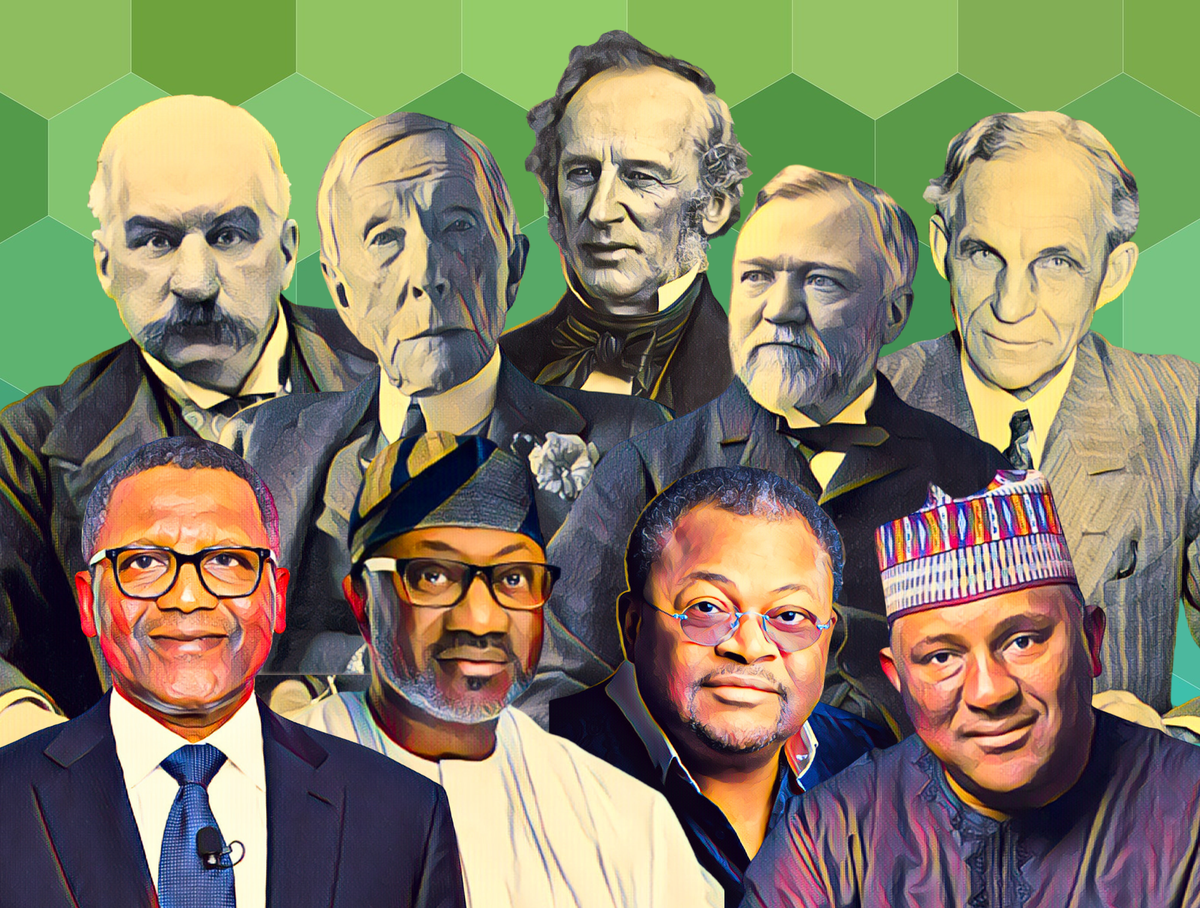
The History Channel broadcast a series in 2012 called The Men Who Built America, casting the spotlight on five industrialists who turned a farming republic into the largest economy on earth in the space of two generations.
Cornelius Vanderbilt moved the goods. John D. Rockefeller refined the fuel. Andrew Carnegie made the steel. J.P. Morgan financed all of it and eventually owned much of it. Henry Ford put the product within reach of the people who assembled it.
The period they worked in ran from the end of the Civil War to the Depression. The United States entered it as an agricultural country with no national currency and left it with more industrial output than Britain, Germany and France combined. The five of them were called robber barons while they were doing it and captains of industry afterwards, and both descriptions were accurate.
Nigeria’s four Forbes-listed billionaires are running their own version of that revolution, and running it against a state that never built what the Americans took for granted.
Aliko Dangote, Abdulsamad Rabiu, Mike Adenuga and Femi Otedola are worth $72.5 billion between them, and they are building refining, upstream oil, truck assembly, cement, telecommunications and banking in a country where the government built almost none of it.
The clearest illustration arrived this month.
Dangote opened the largest share sale in African history on Sept. 14, offering 4.1 billion shares in his refinery at 525 naira each to raise about 2.15 trillion naira. It is the first refinery listed for public subscription in the Nigerian Exchange’s 66-year history.
One of the buyers is Otedola, who has committed $100 million to the offer while spending two years buying and recapitalising Nigeria’s oldest bank.
Dangote is Rockefeller and Vanderbilt at once
Rockefeller never drilled for oil. He worked out that the money sat in the refining and the infrastructure around it, and he built or bought all of it: the refineries, the cooperage that made the barrels, the tank cars, the pipelines, the terminals. By 1880 Standard Oil controlled roughly 90% of American refining capacity, which meant every producer in Pennsylvania negotiated on his terms.
Dangote ran that logic through cement first, owning the limestone, the plants, the trucks and the jetties rather than buying any of it, and Dangote Cement became the largest producer on the continent.
The refinery is the same idea applied to oil. It cost about $20 billion, occupies 2,635 hectares at the Lekki Free Zone and draws crude through 1,100 kilometres of subsea pipeline. Maintenance completed in February 2026 lifted distillation capacity from 650,000 barrels a day to 700,000, making it the largest single-train refinery in the world, and by May it was supplying roughly 90% of Nigeria’s domestic petrol while exporting to Britain, France, Spain, Italy and the Netherlands as Europe’s largest supplier of jet fuel.
He is now drilling his own crude.
West African Exploration and Production, which Dangote owns 85% of, holds a 45% working interest in Oil Mining Leases 71 and 72, blocks he bought from Shell in shallow water about 22 kilometres from the Bonny terminal where the first discoveries were made in 1966. Production restarted in December 2025 at 4,500 barrels a day from the Kalaekule field, and the venture has contracted three jack-up rigs to start drilling in December against more than 1.6 billion barrels of oil in place.
Buying crude has cost him. The refinery imported $3.74 billion of foreign oil in 2025 because domestic supply fell short, which is the gap the upstream business exists to close.
Then there is Vanderbilt.
Vanderbilt started with boats, moved to railroads and ended up owning the infrastructure everybody else’s freight travelled on. Dangote has done the same thing in reverse order, and he is now building the trucks himself. Dangote Sinotruk West Africa, a joint venture he owns 65% of alongside China’s Sinotruk, assembles vehicles at a plant in Ikeja with capacity for 10,000 trucks a year and roughly 3,000 jobs, and it exports into West Africa.
He told his own executives the reason plainly. One of the biggest challenges in the market is logistics, because Nigeria does not have a proper transport network.
Dangote Group is also preparing to order ships from Chinese yards, with first deliveries as early as 2029, because the refinery alone will need about 1,800 vessel calls a year once its capacity doubles.
Forbes values him at $51.3 billion. He was the first Nigerian to get included on the Forbes world’s billionaires list in 2007.
Adenuga and Ford
Ford’s contribution was not the car. It was the price. The Model T sold for $825 in 1908 and $260 by the mid-1920s, and the five-dollar day he introduced in January 1914 doubled his workers’ wages and turned them into customers.
Mike Adenuga did the same thing to a minute of telephone time.
Glo launched on Aug. 29, 2003 charging one kobo per second from its first day. The incumbents were billing up to 50 naira a minute and had told regulators that per-second billing was technically unfeasible. Within months every operator in the market had adopted it, and no government policy put phones into Nigerian hands faster than that single decision.
Ford built the River Rouge complex so he would never have to buy another company’s steel, and bought iron mines, rubber plantations and a railroad to feed it. Adenuga applied the same instinct to bandwidth, building Glo-1, an $800 million submarine cable from Britain to Nigeria completed in 2010, the first successfully delivered by an individual African company.
Forbes values him at $7 billion.
Rabiu and Carnegie
Carnegie entered steel in 1872, late and against established producers, after watching the Bessemer process in Britain. He beat them by controlling his costs completely, buying the ore, the coke works and the transport, measuring everything, and reinvesting profits rather than paying them out. He sold to Morgan in 1901 for $480 million.
Abdulsamad Rabiu ran that playbook against the largest cement producer in Africa.
BUA Cement is building a three-million-tonne plant at Ososo in Edo State for December 2027 and a brownfield expansion of similar size at Sokoto for December 2028, taking installed capacity to 20 million tonnes a year. Profit rose 381% in 2025, and Forbes now values him at $12.2 billion, roughly double a year earlier.
He has been explicit about the reasoning. The company is not pursuing growth simply for the sake of becoming bigger, he told shareholders, but because scale matters in an industry like cement.
Carnegie moved from bridges to rails to structural steel. Rabiu has moved from cement into sugar, flour, pasta, rice, edible oils and now instant noodles.
Otedola is JP Morgan
JP Morgan found distressed institutions, put his own money into them, installed his own governance and made the rest of the market follow.
Femi Otedola is doing that to an entire banking system.
He took the chairmanship of First HoldCo in January 2024 and has spent two years buying the stock, including 222 billion naira ($165 million) on 1.77 billion shares in a single July purchase, his largest. He currently holds close to 30% of the bank and says publicly that he intends to pass 51%.
First HoldCo took a one-time charge of 748 billion naira in January 2026 to recognise legacy non-performing loans it had been carrying for years. Profit after tax fell 92%, and Otedola explained it himself rather than leaving it to the analysts.
“At First HoldCo we decided to clean house properly,” he wrote. “We took a huge one-time hit of ₦748bn to admit old bad loans instead of pretending they do not exist. That is why profit looks like it crashed by 92%. Painful headline, but it is a serious long-term move.”
Most chairmen would have provisioned it over five years and protected the headline. He took it all at once and told everybody why.
What followed is visible in every measure the market uses.
First HoldCo posted a return on average equity of 31.63% in the first quarter of 2026 and 30.37% at the half year, higher than any tier-1 bank in Nigeria or South Africa. The median across the five largest Nigerian banks is 24.80%. Across the six largest South African banks it is 16.20%. Capitec, the most expensive bank on the continent, managed 29.12%.
International money is now obliged to hold it. First HoldCo is one of only six Nigerian companies admitted to the FTSE Frontier 50, the index of the fifty most liquid stocks across the twenty-six frontier markets.
That is a revolution conducted from the private side of the table. Morgan twice put his own money behind the United States Treasury, in 1895 and in the panic of 1907, when the country had no central bank and his balance sheet was the nearest substitute. Otedola has reversed the direction: an entrepreneur buying into a bank, absorbing its worst losses in public, spending his own capital to set a standard the regulator has not yet imposed, and daring the system to follow him.
He is 63, and he is building Nigeria’s oldest bank into one of the largest on the continent.
He made his debut on the Forbes world’s billionaires list in 2009, becoming the second Nigerian after Dangote to make it to the list. Forbes valued him at $2 billion this week, his highest ever.
Crédito: Link de origem