

GITEX 2026: NIGERIA’S DIGITAL FUTURE DEPENDS ON LOCAL INFRASTRUCTURE, SKILLS, INNOVATION -NITDA DG – NITDA
By Lukman Oladokun
The Director General of the National Information Technology Development Agency (NITDA), Kashifu Inuwa, has reiterated the Federal Government’s commitment to building a private sector-driven, government-enabled digital economy, describing technology as the cornerstone of Nigeria’s ambition to become a trillion-dollar economy.
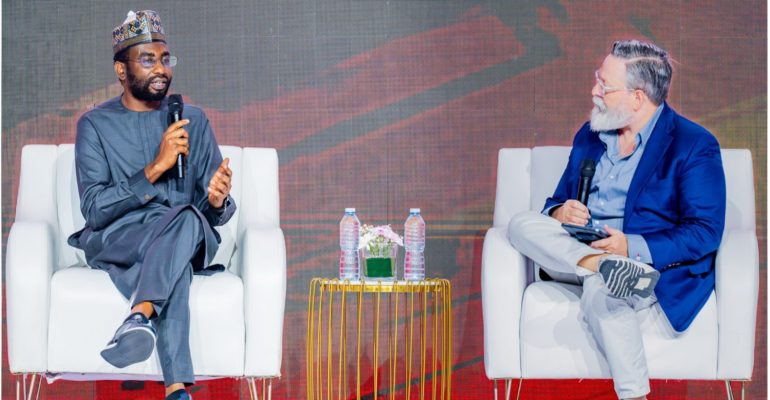
Reacting to responses from Rhett Power, a Forbe USA columnist on the theme “The Nigeria First Approach to Building Digital Sovereignty” during a fireside chat at GITEX 2026 in Lagos, Inuwa said President Bola Ahmed Tinubu has been serving as Nigeria’s “Chief Marketing Officer” by creating an enabling environment for businesses to thrive and attract investment into the country’s digital ecosystem.
According to him, digital transformation is no longer optional for economic growth. “Today, you cannot talk about business or the economy without talking about digital technology. If we are serious about building a trillion-dollar economy, digital technology will play a critical role. Technology is a powerful tool that can help organisations and individuals achieve two, three or even ten times more productivity, leading to greater prosperity and wealth creation across the country,’’ he said.
The NITDA boss noted that while digital technologies present enormous opportunities, Nigeria must also ensure it has control over the infrastructure that powers the digital economy.
He explained that value creation in the digital age depends heavily on data, connectivity and computing power. However, without adequate control over how data is collected, stored, processed and governed, nations may struggle to fully realise the benefits of technological advancement.
To address this challenge, he highlighted the Federal Government’s National Cloud First Policy, which encourages government institutions and large organisations to prioritise cloud adoption when deploying digital solutions.
“Building and maintaining digital infrastructure is expensive. There are operational costs, technology refresh cycles and significant investment requirements,” Inuwa said. “Cloud adoption allows organisations to focus more on innovation and service delivery rather than spending resources managing infrastructure.”
He stressed that the policy is not designed to exclude global technology companies or create barriers to international investment. “Contrary to suggestions that it could be protectionist, the policy is the exact opposite. We are inviting hyperscalers and major technology companies to come to Nigeria, invest in Nigeria, build with us and operate in line with our laws and regulations while utilising Nigerian talent.”
According to him, Nigeria’s vision for digital sovereignty extends beyond hosting data locally. It also includes ensuring Nigerians participate actively in building, managing and operating digital services and infrastructure.
“We want our people to acquire the skills and capabilities needed to build and run these services. We want these services developed within our jurisdiction and in accordance with Nigerian laws,” he said.
Inuwa clarified that the policy does not prohibit the use of public cloud services. Rather, it introduces a classification framework that recognises certain categories of information as sovereign data requiring stronger protection.
He identified defence-related information, financial transaction records, healthcare information and citizens’ personal data as strategic assets that should remain within Nigeria’s borders for reasons of national security, economic stability and citizen protection.
“There are technologies that allow organisations to process workloads on public cloud platforms while ensuring sensitive data remains stored within the country,” he noted.
The NITDA Director General further argued that the policy is already creating a stronger investment case for data centre operators and digital infrastructure developers. By providing clear regulatory direction, investors can have greater confidence that their infrastructure will attract users and generate value.
Inuwa observed that Nigeria has historically served as a major gateway for internet connectivity across the region. As local computing capacity expands, he said the country is strategically placed to provide digital services and infrastructure to neighbouring countries, particularly landlocked nations seeking access to reliable cloud and computing resources.
Addressing the issue of coordination across different levels of government, Inuwa said NITDA continues to work closely with state governments to align digital policies and regulatory frameworks.
“Our mandate is national, but we collaborate extensively with states to ensure digital transformation reaches every part of the country,” he explained. According to him, President Tinubu’s broader vision is centred on national prosperity and inclusivity, ensuring that no state is left behind in Nigeria’s digital journey.
“In any network, you are only as strong as your weakest link,” he said. “That is why the vision is to ensure every state is connected, every state has the right policies, and every state develops its own digital talent capable of building solutions that can scale nationally.”
Speaking directly to entrepreneurs attending the conference, Inuwa highlighted the government’s growing efforts to create opportunities for startups beyond the fintech sector.
He pointed to Nigeria’s success in financial technology as evidence of how deliberate government policies can unlock innovation. According to him, the Central Bank of Nigeria’s cashless policy created the conditions that enabled the country’s fintech ecosystem to flourish and produce globally recognised companies.
Building on that model, he said the government is now extending digital transformation to other critical sectors citing the recent establishment of the National Health Technology Office, which is expected to accelerate the digitalisation of healthcare services and create new opportunities for health-tech innovators.
“We are doing the same thing in agriculture, education and other sectors,” he said. “These are opportunities for entrepreneurs to identify challenges and use technology to build innovative solutions.”
Inuwa encouraged Nigerian startups to embrace disruptive thinking and create entirely new business models capable of transforming industries, drawing parallels with how companies such as Uber redefined transportation through technology.
“What the President wants is not business as usual. He wants Nigerians to harness the power of technology to create new value propositions and solve real problems. We want to see startups building the next generation of solutions across health-tech, agri-tech, ed-tech and many other sectors.”
He reaffirmed the Federal Government’s commitment to creating an environment where innovation, investment and digital talent can thrive, positioning Nigeria as a leading technology hub on the African continent.
Credit: Source link