

Senior SNA Officers Complete Advanced Training at Dhagabadan Military School
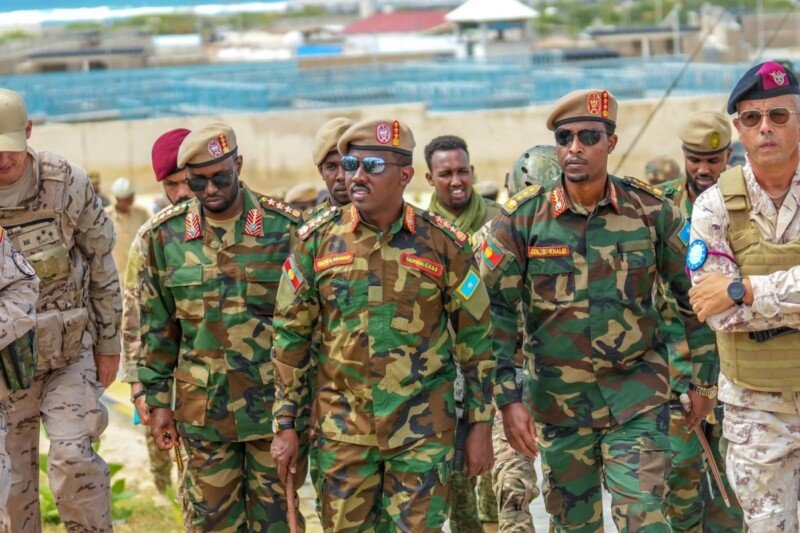
MOGADISHU — The Commander of the Somali National Army, Brigadier General Ibrahim Mohamed Mohamud, has formally graduated a cohort of officers following a training program at the Dhagabadan Military Training School in Mogadishu.
The graduation ceremony was attended by the Commander of the Somali National Army, the Commander of the Land Forces, and the Commander of the Training and Doctrine Command. The training was conducted with support from the European Union Training Mission in Somalia (EUTM-Somalia), represented by Brigadier General Elio Manes.
The program focused on enhancing the officers’ knowledge, professional skills, and leadership capabilities. This training is part of broader efforts to professionalize the Somali National Army as it continues operations against Al-Shabaab and other militant groups.
The Dhagabadan Military Training School has been a key institution for training Somali forces, and the graduation of these officers represents a continued investment in the country’s military capacity.
Strengthening Leadership and Professionalism
The training program is part of a broader pattern of efforts to strengthen the leadership and professionalism of the Somali National Army. Commander Ibrahim has emphasized the importance of skilled leadership in the ongoing fight against Al-Shabaab, noting that well-trained officers are essential for effective military operations.
In May 2024, the Deputy Commander of the Somali National Army, Major General Maadeey Sheikh Nur Ufuroow, and the Commander of the Land Forces, General Dayax Abdi Abdulle, graduated officers from a heavy weapons training program. The program focused on the use of heavy weapons, which are essential for operations against Al-Shabaab.
The European Union Training Mission in Somalia (EUTM-Somalia) has been a key partner in these efforts. The EU mission has provided training and support to Somali security forces since 2010, with a focus on building the capacity of the Somali National Army. In January 2026, Brigadier General Elio Manes officially assumed command of EUTM-S, marking a leadership transition intended to enhance the capabilities of the Somali Security Forces. “Our priority will be to enhance collaboration with Somali counterparts enabling them to progressively manage their own security initiatives,” Manes stated.
Operating under its 9th Mandate, EUTM Somalia continues its mission of developing security forces accountable to the Federal Government of Somalia. The mission offers strategic counsel to security institutions based in the Mogadishu vicinity, alongside specialized mentoring in training methodologies.
Elite Forces Training and U.S. Partnership
The graduation builds on a series of capacity-building initiatives at military academies across Somalia. The Danab (Lightning) Special Forces, widely regarded as Somalia’s most capable counter-terrorism unit, have been at the forefront of high-risk operations against Al-Shabaab. In August 2026, a new cohort of Danab Commandos graduated at the Balidoogle military base after completing advanced training supported by the United States.
“The Danab are one of the most capable forces on the continent,” AFRICOM Commander Gen. Dagvin R.M. Anderson has said. “I am very proud of our engagement building that counterterrorism force.”
The United States has been a central partner in supporting Somali security forces. In August 2026, nearly 80 officers from the Somali Police Force and NISA completed a year-long training program on modern crime scene investigation, supported by the U.S. government. Justin Davis, the U.S. embassy’s chargé d’affaires in Somalia, said the programme was designed to bring the two security institutions together to develop common investigative skills and improve cooperation.
The U.S. has also trained Somalia’s elite Crisis Response Team (CRT), a specialized rapid-reaction unit tasked with responding to terrorist incidents, hostage situations, and high-risk operations.
Expanding International Military Training
Somali officers have recently completed advanced training in several countries, reflecting a broad international effort to professionalize Somalia’s armed forces. Somali officers graduated from the Rwanda Defence Force Command and Staff College in June 2026, earning Master’s degrees in Security Studies from the University of Rwanda. The course brought together 108 senior officers from 20 countries across Africa and the Middle East, focusing on leadership, strategic planning, joint operations, and regional security challenges.
Captain Mohamed Muse Mohamed graduated from the Royal Military Academy Sandhurst in the United Kingdom, marking the first time a Somali National Armed Forces officer had done so in four decades. Prime Minister Hamza Abdi Barre presided over a graduation ceremony for a new cohort of elite Somali commandos, known as GorGor, who underwent specialized training provided by Türkiye.
In August 2026, the 21st Brigade of the Gorgor Commandos returned to Mogadishu after completing approximately three months of advanced military training in Manisa, Türkiye, focusing on combat skills, military discipline, and operational readiness. Another group of Somali officers completed advanced training at the National Defence University’s War College in Türkiye.
Critical Note
The graduation of officers from the Dhagabadan training program and the broader expansion of international training partnerships represent significant investments in the professionalization of the Somali National Army. The support of EUTM-Somalia, the United States, Türkiye, Rwanda, and other partners underscores the importance of international cooperation in building the capacity of Somali forces.
However, the effectiveness of these gains will depend on the government’s ability to retain trained personnel and provide them with the resources needed to conduct effective operations. The sustainability of these gains depends on the government’s ability to retain trained personnel and provide them with the equipment and resources needed to apply their skills. Forensic capacity building is often undermined by low pay, lack of equipment, and institutional fragmentation.
The reliance on international partners for training and support, while valuable, also raises questions about the sustainability of Somalia’s security sector reforms in the absence of continued external support. The government must ensure that the expansion of elite units is accompanied by broader reforms to the regular army, including improvements in logistics, intelligence, and institutional capacity. Without such systemic changes, the country risks over-relying on a small number of highly trained units while the wider military remains under-equipped and under-prepared.
Recommended Reading On ftlsomalia.com
Credit: Source link