

Senegal: Are Intersex People Collateral Victims of LGBTphobia?

Senegal’s birth certificates rigidly declare people male or female.
Debates in Senegal over an attempted but rejected constitutional ban on same-sex marriage have revealed the unwitting and dangerous exclusion of intersex people from Senegalese law.
The proposed amendment would have strictly enshrined the gender binary, even though it is known that about 1.7% of the general population — approximately 300,000 people — are intersex. Intersex people have sexual characteristics that may resemble one or the other biological sex, without fully corresponding to the stereotypical anatomy of female and male bodies.
Intersex is neither a sexual orientation nor a gender identity, but a biomedical description.
For Erasing 76 Crimes, Sadio, an observer of Senegalese political life, explains the implications of intersex people’s social invisibility, as well as the misconceptions arising from confusion distinguishing intersex people from transgender people.
Intersex people seem invisible, but the social risks are real
In Senegal, Article 52 of the Family Code (Law No. 72-61 of June 12, 1972), which pertains to the information to be included on a birth certificate, requires that the child’s sex be declared: “In addition to the information required under Article 40, paragraph 8, the birth certificate shall state: the year, month, day, time, and place of birth; the child’s sex; and the given names assigned to the child….”
“We rely on karyotyping [chromosomal analysis] to determine an individual’s sex based on their chromosomes. In reality, though, there are not enough genetic testing centers in Senegal. Yet intersex people deserve to be recognized and must be recognized on an equal footing with everyone else,” Sadio says.
Furthermore, at the local level, no legal provision includes the term “intersex” or allows for a deferral of sex registration, as Senegalese law is strictly binary (male/female).
In this legal environment, while intersex people are not subject to any laws or penalties for being intersex, they are also not afforded any protection. Yet they remain particularly vulnerable, with sexual characteristics and an appearance that sometimes put them at odds with social expectations related to the sex assigned at birth.
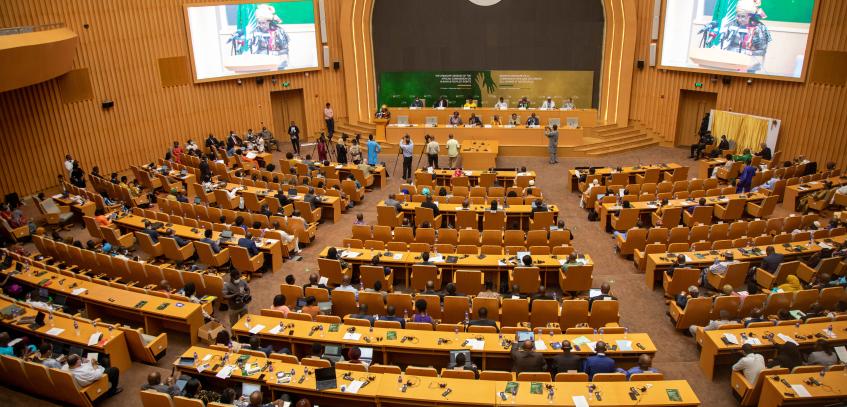
Resolution 552 of the African Commission on Human and Peoples’ Rights
However, this disregard of intersex people runs counter to the African Charter on Human and Peoples’ Rights, of which Senegal, like many other African countries, has been a party since 1981.
The charter is a legally non-binding document aimed at protecting the fundamental rights of individuals, recognizing the rights of peoples, and establishing mechanisms for filing complaints through the creation of the African Commission on Human and Peoples’ Rights (ACHPR).
Resolution 552, entitled “Resolution on the Promotion and Protection of the Rights of Intersex Persons in Africa,” was adopted by the Commission in 2023. It aims to promote and protect the rights of intersex persons, in particular by putting an end to non-consensual genital normalization practices (surgery, hormone treatments, sterilization), while combating discrimination, infanticide, and the abandonment of intersex children.
A final line in the resolution calls on African states to train their officials in ensuring that intersex people have access to their fundamental rights.
A confusing legal environment in Senegal
However, this resolution has had no tangible impact in Senegal to date. No legislative, regulatory, or policy measures related to intersex people have been adopted in Senegal since the Africa-wide resolution was passed 2023.
Furthermore, aside from the binary gender designation on birth certificates discussed above, there are no restrictions in Senegal on medical interventions on intersex minors, nor has any specific legal recognition procedure been established.

Nevertheless, Law No. 2026-08 of March 27, 2026, amending Article 319 of the Senegalese Penal Code—adopted this spring—seeks to criminalize any expression of gender that does not conform to binary norms. According to its wording: “Any public representation—whether through speech, writing, images, gestures, sound, or any other means whatsoever—intended to promote homosexuality, bisexuality, transsexuality, bestiality, necrophilia, or any other similar practice constitutes advocacy of an unnatural act.”
While the law itself does not define “transsexuality” or what constitutes “any other similar practice,” the wording is vague enough to encompass anyone whose appearance does not strictly correspond to the sex assigned at birth.
“The general public sees things only through the binary lens of men and women, and as for effeminate young men, they are invariably labeled as gay—and vice versa for their female counterparts, who are equated with lesbians. Intersex people, as long as they deviate from gender stereotypes, are labeled as such. The general public is uninformed about intersex conditions,” Sadio says.
A few academic forums for discussing intersex issues
Nevertheless, intersex issues are discussed at some academic forums such as the 4th Scientific Conference on Rare Diseases, held on Saturday, Feb. 28, at Cheikh Anta Diop University (UCAD) in Dakar. During the 2026 event, social advocates drew attention to the situation of intersex children.
“More anecdotally, students hear about it in their cytogenetics classes at the university, but it’s often presented from a purely descriptive perspective,” Sadio says.
In Senegal, where the treatment of intersex people is an emerging issue, there are no organizations dedicated to intersex people.
“Senegal is not a Northern country, and often intersex people are unaware that they are intersex because they do not think to go to the hospital for karyotyping tests. It is a neglected area of academic research that attracts little media attention and therefore does not generate political interest in creating legal space to move beyond the male-female gender binary paradigm,” Sadio says.
Credit: Source link