

Brazil, Partner Nations Strengthen Security Against Transnational Crime Through Riverine Exercises
For decades, South America’s great rivers were viewed primarily as commercial arteries and instruments of regional integration. Today, however, many of these waterways have become strategic corridors for drug trafficking and transnational organized crime. From the Amazon Basin to the Paraguay-Paraná Waterway, criminal organizations exploit the vast terrain, limited surveillance, and transnational nature of river systems to move drugs, weapons, timber, and other illicit goods.
One of the clearest examples is in the Brazilian Amazon, where control of routes along the Solimões and Negro rivers has fueled growing competition in recent years among the First Capital Command (PCC), the Red Command (CV), and Colombian armed groups involved in cocaine trafficking, illegal mining, and illicit timber trade. Controlling these waterways means controlling one of the principal routes used to move cocaine produced in the Andean countries to international markets.
The scale of the threat is reflected in recent operations by Brazilian security forces. In May, the Amazon Integrated Task Force to Combat Organized Crime (FICCO) seized approximately 2.5 metric tons of drugs, along with rifles and ammunition, from a vessel intercepted on the Solimões River near Coari. Earlier, in February, another operation near Manacapuru resulted in the seizure of more than 4 metric tons of narcotics, 10 high-caliber firearms, and thousands of rounds of ammunition following a confrontation with traffickers using high-speed boats on the same river.
These incidents illustrate how an increasing share of narcotics trafficking logistics is shifting to the Amazon’s vast river network. While securing land borders once represented the primary challenge, authorities today must monitor extensive waterways that cross multiple countries and allow criminal organizations to constantly change routes, schedules, and methods of transportation. Access to thousands of miles of rivers, secondary channels, and sparsely monitored areas gives these groups an operational advantage that is difficult to counter using traditional approaches.
In response, armed forces across the region have strengthened their capabilities through multinational exercises, the development of common operating procedures, and the integration of advanced surveillance technologies to respond more effectively to transnational threats in riverine environments. “Multinational riverine exercises strengthen interoperability and situational awareness across waterways that are increasingly exploited by transnational criminal organizations and illicit networks,” the Brazilian Navy told Diálogo in a statement.
The operational challenge: Securing fluid terrain against adaptable criminal networks
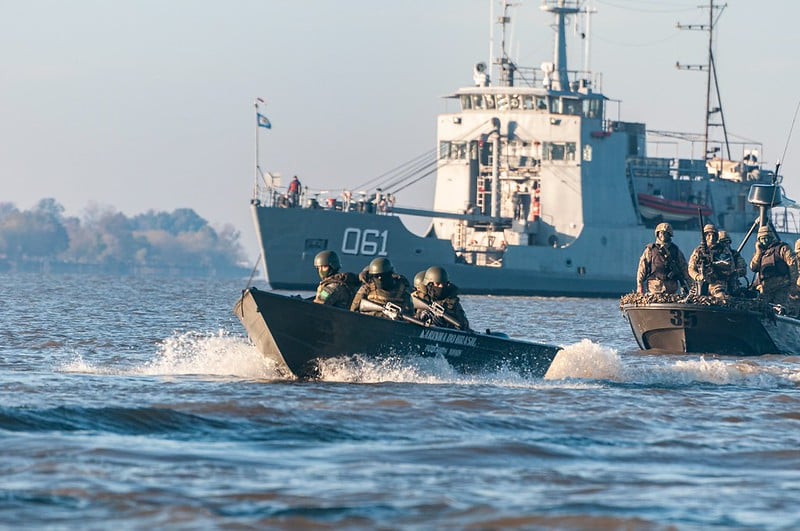
One example of how countries are strengthening these capabilities is ACRUX XII, conducted April 20-25 near Corumbá in Brazil’s Pantanal region in the state of Mato Grosso do Sul. The exercise brought together more than 700 personnel from the navies of Brazil, Argentina, Uruguay, Paraguay, and Bolivia along the Paraguay River, one of the principal arteries of the Paraguay-Paraná Waterway.
“This exercise prepares our armed forces to jointly defend the Paraguay-Paraná Waterway, one of the principal economic corridors for our countries and Paraguay’s main outlet to the sea, thereby ensuring the free flow of commerce among our nations,” said Navy Captain Rodrigo Alberto Galeano Acosta, chief of the Combined Joint Staff for the operation.
The choice of the Pantanal underscores the region’s strategic importance. Situated along one of the continent’s principal commercial corridors, it also serves as one of the main entry points for Bolivian cocaine into Brazil. Thousands of miles of rivers, channels, islands, and seasonally flooded areas make continuous monitoring of illicit activity extremely challenging.
As a result, the tactical response must differ from that used in traditional land environments. Rather than securing fixed locations, forces must maintain dynamic surveillance across vast areas while developing rapid-response capabilities, mobility, and real-time information sharing. During ACRUX XII, participating forces conducted simulated patrols, river traffic control, amphibious landings, and riverbank security operations. These scenarios help standardize procedures, strengthen interoperability, and prepare participating forces to respond in a coordinated manner to real-world threats in riverine environments.
The exercise also integrated naval platforms, air support, and advanced surveillance systems. A UH-12 helicopter operated alongside the Brazilian Navy vessels Parnaíba and Paraguassu, expanding the force’s surveillance range and ability to collect operational information in real time.
One of the exercise’s most significant innovations, however, was the use of drones. Equipped with infrared sensors, they enable forces to detect vessels and suspicious activity even during nighttime operations or in low-visibility conditions.
“Drones are a technology that is transforming operational environments, both in strike missions and surveillance operations. During ACRUX XII, they enabled monitoring of the operational area while expanding reconnaissance and nighttime surveillance capabilities,” the Brazilian Navy said.
The combined use of boats, helicopters, and drones reduces one of criminal organizations’ greatest advantages: their ability to exploit darkness, dense vegetation, and the complex geography of river systems to conceal vessels and drug shipments.
Interoperability, intelligence, and a regional response to transnational threats
ACRUX is part of a broader framework of regional naval cooperation. Among the most prominent initiatives is Operation NINFA, conducted jointly with the Paraguayan Navy along the Paraguay-Paraná Waterway to establish common procedures for patrols, river traffic control, and countering criminal activities that exploit porous borders.
“Multinational exercises enable participating forces to share knowledge and strengthen mutual ties while expanding their understanding of the operational area and environment,” the Brazilian Navy explained.
Even more significant is BRACOLPER, which annually brings together Brazil, Colombia, and Peru in the Amazon region. Established in 1974, it is one of the region’s longest-running multinational riverine exercises. Activities include joint patrols, waterway control, territorial recovery operations, and intelligence sharing.
“We hold command meetings and intelligence exchanges, and the deeper we develop these efforts, the more we realize how much we can contribute to our navies and our countries,” said Brazilian Navy Vice Admiral João Alberto de Araujo Lampert.
What unites ACRUX, NINFA, and BRACOLPER is the recognition that the threats moving through South America’s major waterways cannot be addressed by any single nation. Drug trafficking, smuggling, arms trafficking, and other illicit activities exploit the transnational nature of rivers and the challenge of securing immense territories.
These exercises therefore represent far more than routine training. They are an investment in operational readiness against the evolving threat posed by organized crime by enhancing surveillance of strategic waterways, accelerating information sharing, and developing common procedures that enable participating forces to respond more rapidly and in a coordinated manner to increasingly mobile and sophisticated criminal networks.
In a continent where many of the principal drug trafficking routes follow rivers that cross multiple national borders, naval cooperation and interoperability have become essential tools for strengthening regional security, protecting legitimate commerce, and improving the collective capacity to counter transnational threats.