

A black monkey with bright orange lips has finally been confirmed as a new species in Congo |
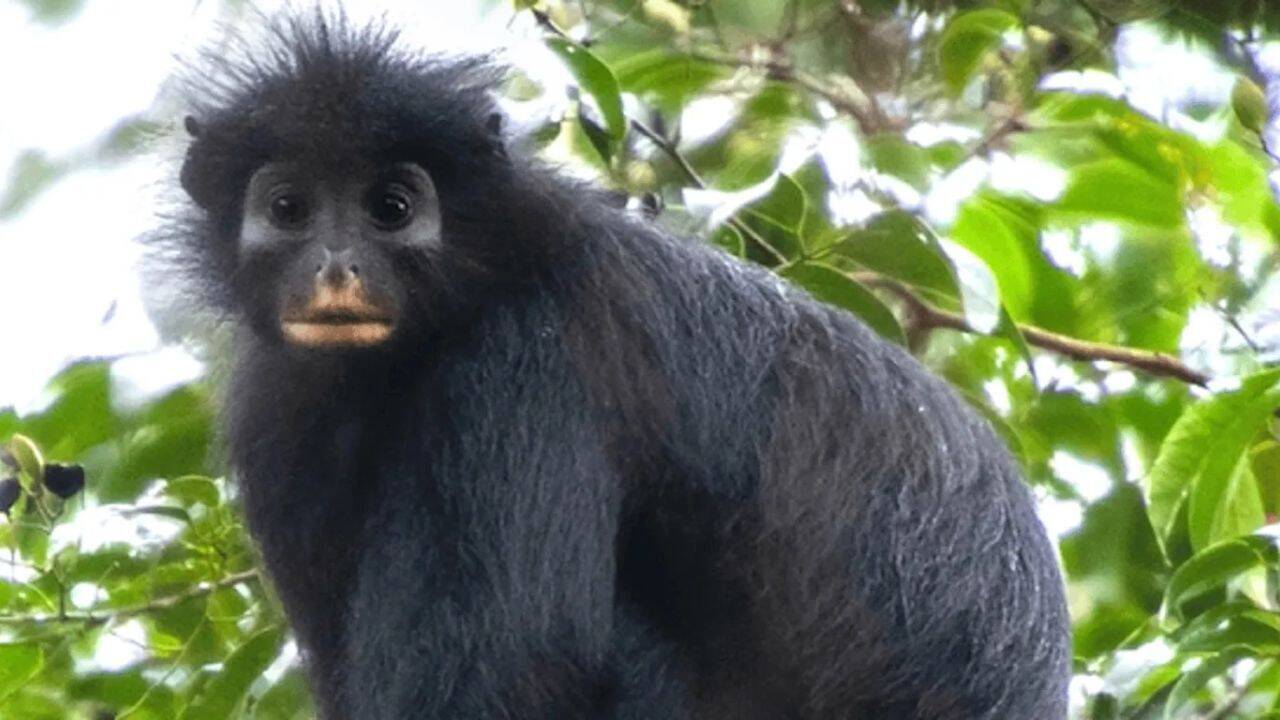
For years, people living near the forests of the Democratic Republic of Congo had spoken about an unusual monkey they called the Likweli. It was known locally, but outside those communities it remained little more than a rumour, partly because it stayed high in the rainforest canopy and was rarely seen. Even conservationists working in the area struggled to document it properly. That has now changed. After years of fieldwork, recordings and genetic analysis, scientists have confirmed that the distinctive black monkey with vivid pinkish-orange lips represents an entirely new species. The discovery offers another reminder that even well-studied groups of mammals can still hold surprises in some of the world’s least explored forests.
How scientists discovered the new monkey species in Congo
The story stretches back to 2008, when conservation workers in Lomami National Park first caught sight of an unfamiliar monkey moving through the upper branches. The encounter produced only a blurred photograph, leaving unanswered questions about what had actually been seen.A decade later, another sighting renewed interest. This time, scientists from the Democratic Republic of Congo, the United States and Germany launched a more determined effort to locate the animals. Their work combined observations in the forest with audio recordings of the monkeys’ calls, photography and DNA studies, eventually confirming that the population was genetically different from every known African monkey species. The newly recognised primate has been given the scientific name Colobus congoensis, honouring the country where it lives.
Why the new monkey species remained hidden for so long
The monkey’s ability to avoid detection is no accident. It spends much of its life in the highest layers of dense tropical forest, making direct observations difficult even for experienced field teams.Speaking to the BBC, Junior Amboko, a PhD student at Florida Atlantic University who helped lead the research, explained just how rarely people encounter the animals.As part of our search, we interviewed people in 52 villages close to where the animals live. And only people in eight villages [had ever seen] them, as per the BBC. He also described the animals as being “kind of shy”, saying they generally remain hidden among the treetops.That combination of inaccessible habitat and elusive behaviour helps explain why the species escaped formal scientific recognition despite being familiar to some local communities for generations.
What makes the new monkey species with orange lips unique
The first feature that catches attention is the monkey’s face. Against its dark fur and black skin, its pinkish-orange lips stand out immediately, making it unlike any other known African colobus monkey.Scientists are still unsure why those markings evolved. Professor Kate Detwiler of Florida Atlantic University suggested to the BBC that the bright colouring could serve as a visual signal, perhaps helping monkeys identify one another or playing a role in attracting mates. The species is also recognised by its deep, resonant vocalisations.“You often hear them, but don’t see them,” Amboko told the BBC, describing how the calls frequently reveal the monkeys’ presence long before observers manage to spot them.Those recordings became an important part of the evidence used during the investigation.
How the new monkey species supports the Congo rainforest ecosystem
Although the Likweli is new to science, it belongs to the wider group of colobus monkeys found across parts of Africa. These monkeys are known for lacking thumbs, an adaptation that helps them move efficiently through forest canopies.According to Professor Detwiler, quoted by the BBC, colobus monkeys are important plant-eating mammals within rainforest ecosystems. “These are really important African monkeys that don’t have thumbs,” Prof Detwiler told the BBC.They are these herbivores of the canopy that are a critical part of the ecosystem. We think they have a lot to do with processing seeds and germination in the forest. Exactly how Colobus congoensis fits into that ecological picture remains an active area of research.
Why the new monkey species could be at risk of extinction
Scientists believe the Likweli occupies only a limited section of forest where suitable food and habitat are available. That restricted range raises concerns about its long-term survival.The monkeys are reportedly hunted for bushmeat, adding another pressure to a population whose size is still unknown. Researchers hope that official recognition as a distinct species will strengthen future conservation measures and improve legal protection.The next stage of the project will involve estimating population numbers and studying the monkeys’ behaviour in greater detail. Many aspects of their social lives, breeding patterns and movements through the forest remain undocumented.
Why the discovery of the new monkey species is important
The formal identification of Colobus congoensis is significant because discoveries of entirely new African monkey species are uncommon. According to the BBC, this is only the fifth African monkey species to be described by science in the past 75 years.It also highlights the value of combining local knowledge with long-term scientific fieldwork. Communities living near the forest had recognised the Likweli long before researchers confirmed its genetic uniqueness. By bringing together those local observations with modern techniques such as DNA analysis and acoustic recording, scientists were finally able to demonstrate that this quiet resident of the Congo rainforest represents a previously unknown branch of Africa’s primate diversity.
Credit: Source link
Comments are closed.