

Baghdad Moves Toward Washington and Away from Tehran
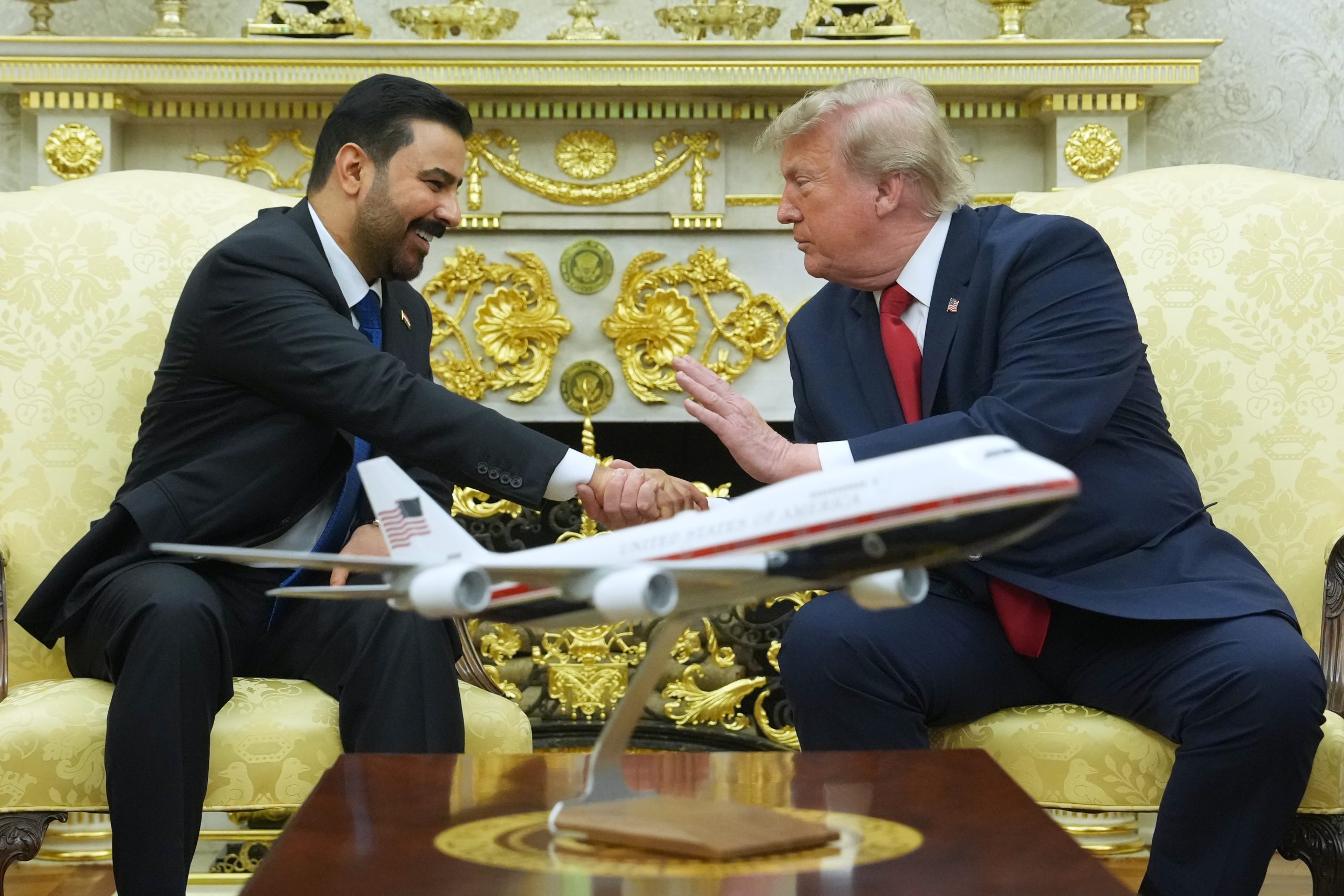
(AP Photo/Julia Demaree Nikhinson)
Bottom Line Up Front
- The visit of Iraqi Prime Minister Ali al-Zaidi to Washington this week showcased Baghdad’s intent to align with the U.S.-led vision of economic and political integration and reject Tehran’s resistance-based ideology.
- Zaidi’s meetings highlighted U.S.-Iraq economic cooperation, but also included U.S. prodding to implement the promised demobilization of Iran-aligned Iraqi militias by the end of the U.S. military mission in Iraq on September 30.
- Backed by Tehran, pro-Iranian militias are resisting Zaidi’s effort to disarm them, relying on their arsenals and their strong social base of support among Iraqi Shias who view the militias as protectors.
- U.S.-Iraq business deals will focus on the energy sector, particularly developing new oil export routes that avoid the Strait of Hormuz, including reviving a long-dilapidated Iraq-Syria pipeline.
On Tuesday, Iraqi Prime Minister Ali al-Zaidi, on his first foreign trip since taking office in May, met with U.S. President Donald Trump, kicking off a week of meetings with the White House, U.S. Congress, and U.S. business leaders. The economic focus of the trip signals Baghdad’s alignment with Washington’s vision of a prosperous Middle East, economically integrated within itself and with the West, and the rejection of Tehran’s implacably anti-U.S., resistance-oriented ideology. In an editorial in the Washington Post, published as he departed for the U.S., Zaidi framed the visit in transformational terms, writing: “Today, [the Iraqi people] understand that the time has come to write a new chapter in Iraq’s relationship with the world and with its strategic partners, one founded on integration into the global economic and financial system. I carry to the United States a message of confidence: that a sovereign Iraq stands apart from regional alignments and conflicts, and chooses instead the path of development, with an open hand extended to its friends.”
The Trump team used the visit to send a message that U.S. policy toward Iraq is not subordinate to policy toward the Islamic Republic of Iran and highlight that Iran’s closure of the Strait of Hormuz has isolated Tehran even from its allies in the region. The Strait closure has reduced Iraq’s oil revenues by nearly 70 percent — a sharp blow to a neighboring state that Iranian leaders advertise as an ally. More broadly, the Trump team is signaling it hopes to bring Iraq into an expanding regional coalition of Arab states that value economic advancement and political stability more than pursuing an Iran-centric strategy of pressuring and combating Israel and the U.S.
U.S. strategy toward Iraq resembles its policy toward the post-Assad leadership in Syria and the Beirut government headed by President Joseph Aoun, who himself will be visiting Washington in the coming days. After ousting the regime of President Bashar al-Assad, Damascus eliminated Iran-aligned militias and Iranian advisors from the country. Aoun’s government is participating in a U.S.-brokered dialogue with Israel to establish a roadmap to disarm Iran’s main regional ally, Lebanese Hezbollah, and facilitate a withdrawal of Israeli forces from south Lebanon. U.S. officials assess that, strategically, assembling a region-wide coalition of moderate Arab states will help contain Iran and increase U.S. leverage in war-ending settlement talks with Iranian leaders.
The primary U.S. objective to wean Iraq out of Iran’s orbit requires Zaidi to implement his stated plans to disarm and demobilize the Iran-aligned militias that spearhead Iranian influence in the country. Washington seeks not only to reduce Iranian influence in Iraq but also to end militia participation in Iran’s defense effort. Since the U.S.-Iran war began, the militias have attacked not only U.S. forces based in Iraq but also U.S. diplomatic facilities and installations in neighboring Arab Gulf states, particularly Kuwait. Zaidi’s pre-departure Washington Post editorial suggested that he and Trump occupy common ground on the issue. He wrote: “I lead a government committed to ensuring that the state possesses the legitimate monopoly on the use of force. In less than 60 days, my government has made progress on disarming a significant number of armed groups and opening the door for their integration into state institutions. And I have worked on strengthening the rule of law and providing opportunities and essential services.”
During his meeting with Trump on Tuesday, Zaidi stressed that the departure of U.S. troops by September 30 will remove the justification for the militias’ existence, and he expects to complete their disarmament by that date. Immediately after the meeting, U.S. Department of War officials confirmed the U.S. troop departure deadline. In the weeks prior to the visit, Zaidi sought to demonstrate his determination to curb militia influence by replacing a pro-militia national security adviser and securing demobilization pledges from the leaders of the Asa’ib Ahl al-Haq and Kataib al-Imam Ali militias. He also produced an agreement from the powerful Shia cleric Muqtada al-Sadr to integrate his Saraya al-Salam militia forces into the national military structure. Still, U.S. officials include financial pressure to hold Zaidi to his commitments. Last week, Zaidi acceded to U.S. demands that Iraqi financial institutions prevent U.S. dollars from flowing to Iran and its militia allies, in exchange for the U.S. lifting a four-month suspension in shipments of American currency to Baghdad, according to U.S. and Iraqi officials.
However, experts doubt the remaining militias will ever disarm, noting that they still wield considerable armed force and have deep roots among the Shia population. Many Iraqi Shias do not trust the regular army and security forces and view the militias as protectors. A coalition of several Iran-aligned groups calling itself the “Islamic Resistance in Iraq” — most prominent among which are Kataib Hezbollah (KH) and Harakat Hezbollah al-Nujaba — publicly opposed Zaidi’s trip to Washington last week. Since Trump declared the ceasefire with Iran terminated last week, one Iraqi armed group attacked U.S. forces at the al-Asad air base in western Iraq, and additional anti-U.S. attacks are likely as long as the U.S.-Iran exchanges of fire persist.
Even as the revival of the U.S.-Iran war hung over Zaidi’s trip, U.S. and Iraqi leaders highlighted the transformative potential of U.S.-Iraq economic cooperation. Zaidi brought a large delegation to Washington, including virtually all the ministers responsible for aspects of Iraq’s economic and monetary policy. His editorial previewed the centrality of U.S.-Iraq economic integration in his trip, writing: “Our discussions will focus on investment. We want leading American companies to consider opportunities in developing Iraq’s infrastructure, its energy sector, manufacturing, technology and digital economy. Iraq will do its part in pushing through vital reforms … Iraq possesses the resources to become a leading economic hub in the region, with one of the world’s largest proven oil reserves, abundant natural resources, a capable workforce, and a substantial domestic market.” U.S. and Iraqi officials expect several deals to be finalized before Zaidi returns to Iraq on Friday, including multiple oil-and-gas memoranda of understanding (MOUs). One pending deal envisions U.S. oil major Chevron developing Iraq’s West Qurna-2 and Nasiriyah oil fields. An agreement for the Starlink satellite Internet system to provide service to Iraqis is also expected. Zaidi has also floated establishing a joint long-term, $400 billion U.S.-Iraq energy fund.
During the visit, experts from the two governments also discussed plans that would permanently immunize Iraq from an Iranian closure of the Strait. While offering obvious benefits to Iraq, export routes that bypass the Strait would significantly reduce Iran’s strategic leverage against the U.S. Under a recent preliminary agreement brokered by the U.S. envoy to Iraq and Syria, Tom Barrack, Baghdad and Damascus will reconstruct an existing crude oil pipeline from Iraq’s Kirkuk oil fields to Syria’s port of Baniyas on the Mediterranean coast. The Iraq-Syria pipeline exists, but it has fallen into significant disrepair since its closure in 1982 when the Assad regime shut it down in order to help its then ally, Iran, in the 1980-88 Iran-Iraq war. Experts assess it will require three years of work, in which Chevron and other U.S. firms are expected to participate, to put it back into operation. There are also concerns about the security of the line, which would run through Iraq’s western Anbar province and eastern Syria, where ISIS cells remain active. Regional reports suggested Syrian foreign minister Asaad al-Shibani would visit Washington to join Zaidi and sign an agreement to reopen the pipeline. Zaidi has also been accelerating talks with neighboring Jordan on another alternative — a long-discussed oil pipeline from Iraq’s main oil fields in Basra to Jordan’s Red Sea port of Aqaba. It is unclear whether the funds and logistical bandwidth exist in Iraq or if its neighbors will support moving forward with both pipeline projects simultaneously.
Less clear is whether Iraqi leaders will respond positively to U.S. suggestions that the country leave the Organization of Petroleum Exporting Countries (OPEC) altogether. Trump and his team have long sought to weaken the cartel, and an Iraqi pullout would land a strong blow to the group, coming just a few months after the United Arab Emirates (UAE) left the organization. Qatar exited the group in 2019 to focus on its liquified natural gas (LNG) exports. During the Tuesday Oval Office meeting with Trump, Zaidi told reporters that Iraq has no plans to leave the group. But he reiterated demands for OPEC to allot it a larger production quota — even if Iran’s quota would need to decrease to accommodate Iraq. He told reporters: “Iraq is one of the founding members of OPEC … our right is to receive a fair share for Iraq.” At the height of the Iran War and the Iranian closure of the Strait of Hormuz, Iraqi oil exports declined by nearly 80 percent, threatening Iraq’s solvency, and Baghdad will need to increase production to compensate for the financial losses.