

The endless border battle of South Africa continues
-
AFP, MUSINA, South Africa
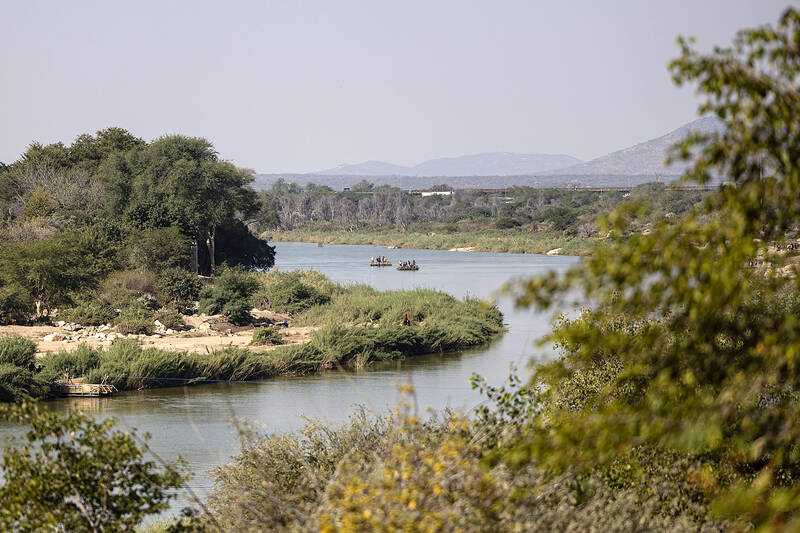
Perched on weathered wooden rafts, small groups of people hauled themselves and their bundles of cargo hand over hand along a rope strung across the crocodile-infested Limpopo River.
Minutes later, they were in South Africa, having bypassed the border post at Beitbridge, a short distance away.
By the time patrol officers spotted them, the clandestine migrants had disappeared into the thorn scrub.
Photo: AFP
The short crossing is one of countless illegal passages along South Africa’s porous border with Zimbabwe, where migrants and smugglers routinely slip through efforts to seal the busy frontier.
At the official border post, streams of people moved in the opposite direction, heading across a bridge over the Limpopo and into Zimbabwe — part of a flood of foreign nationals fleeing deadly anti-immigrant protests in South Africa.
Thousands had awaited the journey home inside sprawling white tents serving as a repatriation center 20km away for foreigners pouring in from all corners of South Africa.
South Africa has long been a magnet for migrants, but for weeks, it has been swept by protests and violence against foreigners, who stand accused of taking jobs and resources.
At least four foreign nationals have been killed in attacks linked to the protests, police said, although some African governments repatriating their citizens have put the death toll higher.
More than 21,000 people had been housed and processed at the rapidly built repatriation center, said its manager, provincial home affairs chief Albert Matsaung.
As soon as some leave, more arrive.
“This is a moving target. We will never say we’re closed, we will never say we’re finished,” he said.
Inside the tents, families slept shoulder to shoulder on thin mattresses while children chased one another between bags packed for the journey north.
Zimbabwean couple Munyai Tungamirai and Patricia Nhamo were returning after paying smugglers US$20 to ferry them across the river in 2024 in search of employment.
“It is risky, but I had to do it to feed my family,” Tungamirai said. “During winter, there is not much water, so it’s easy to cross.”
Tungamirai found work on an orange farm in Tzaneen, about 200km south of the border.
However, when anti-immigrant groups began targeting undocumented migrants, his employer told him to leave, fearing labor inspections and vigilantes going door to door in search of foreign nationals.
Cradling their one-year-old son, the couple said they hoped to return within a year, this time with valid passports.
Meanwhile, Leonard Moyo vowed he would never come back.
“Here in South Africa, it’s like apartheid. They don’t like us,” said the father of two, who arrived in 2010 and had been working for a construction company. “I would rather die in my country.”
For border authorities, the steady flow of departures has done little to resolve a longer-term problem of irregular immigration.
Since June 7, more than 46,000 migrants have been repatriated and deported through Beitbridge, most of them Malawians, followed by Zimbabweans, Border Management Authority commissioner Michael Masiapato said.
Nationally, the number of people who have left exceeds 60,000, with nationals of Ghana, Nigeria, Uganda and Kenya taking flights organized by their governments, he said.
Yet, officials acknowledge many could easily find their way back through informal crossing points scattered along the frontier, even with increased patrols and surveillance technology announced by South African President Cyril Ramaphosa.
“It will be a bit of an embarrassment if we do all these activities and all of a sudden people walk back into the country illegally,” Masiapato said.
South Africa has 71 ports of entry — 52 land crossings, 10 international airports and nine seaports — but vast stretches of its border remain unfenced.
“Because we do not have a physical barrier yet, you cannot guarantee a foolproof no illegal immigration,” Masiapato said. “I suppose that is just the reality, not just for South Africa but the rest of the world.”
Housekeeper Veronica Magaya said she is happy, “because I am going home alive.”
After her employer gave her two days to leave, Magaya and her family spent a freezing night in the open, without blankets, before securing transport to the border.
“I have suffered a lot,” said Magaya, who arrived eight years ago on a valid passport that has since expired. “I do not want to return to this country even for a day.”
Credit: Source link