

Historical Parallels: FDR, Churchill, and Strategic Blindness
I mean, you have the most blatant amateurs that I think we’ve had certainly since FDR. I mean, everybody tried to tell FDR over and over and over again. They did Churchill as well and said, “Look, we’re 100% for defeating the Nazis. We understand that, but there is no point in creating a situation that is beneficial to the Soviet menace.” And they openly said, you can read this in the General Staff Notes from the Imperial General Staff of the British Army, “Stalin’s communist Russia represents a far greater and more permanent threat than Nazi Germany.”
People tried to tell him these things over and over and over again, and what did we get back from FDR? “I have a hunch Uncle Joe’s a good man and we can work with him.” After which, with all the information, the people around him, everyone from Harry Dexter White to Harry Hopkins and Felix Frankfurter and Henry Morgenthau, most of these are what we would call today Zionist globalists, who were pro-communist, fed him a lot of nonsense, which he eagerly ingested and repeated.
So we had no strategy for the Second World War. And when it became clear that we were finally going to enter Central Europe, that’s when, of course, Churchill shows up too late to the party with no real voice anymore because he’s now a vassal state of Greater America, and says, “Ike, it would be good if we controlled Berlin, Prague, and Vienna. It would be useful if you took those right away.” It was too late. And the rest is history.
We all know the history and people still read, “Oh, World War II is great.” No, it wasn’t. It left us in a terrible state of conflict and hostility that lasted almost 50 years that we could have all done without. Then when it finally was overcome, we couldn’t wait to double down on it once again in the hopes of destroying this Russian state that had recently liberated itself from communism.
Trump and Istanbul: The Same Old Ignorance
So, what do we have with Donald Trump and Istanbul? The same kind of ignorance, the same foolishness, demonstrating once again that he is most influenced not just by the people around him, but those who talk to him just before he opens his mouth. Because if you’d have asked Trump some of these questions 2 weeks ago, I think you would have probably gotten a different answer. On more than one occasion, he says, “I don’t want to send any more money to Ukraine. I want the Europeans to deal with this. I want out.” Well, how do you get out when you essentially step in and effectively take over, which is what he’s done?
This is, of course, music to the ears of the globalist cabal, about Macron. I don’t know how he’s doing right now, but certainly Starmer and Starmer’s successor, who is another Starmer in different clothing. So the whole thing, I think, was deeply disappointing.
The Dissenters: Hungary, Slovakia, Poland, and Croatia
Now, there are others who were there who didn’t say much, and they’re the ones that we should look at very carefully. And I’m talking specifically about the Hungarians, the Croats, they’re singularly disinterested in this war against Russia, the Slovaks, even the Poles. If you look at the Poles recently and the return of the Order of the White Eagle by Zelensky to Poland, because they’re sick of Ukrainians for a whole range of reasons. They’re also disinterested in losing another 10,000 Polish soldiers in a war with Russia, which is what they did earlier. So he said, “Here’s your white chicken, take it.” This is what Zelensky said to the Poles.
And then they celebrated this Nazi Bandera and his friends who were not satisfied just to kill Jews. They wanted to kill Poles and killed over 100,000 of them. And this was celebrated in Ukraine. Insane. Makes no sense.
So I think they are going to be more and more influential because Slovakia and Poland, Hungary, they border Russia. They border Ukraine. In other words, they have an interest in what happens there. And at some point they’re going to step up.
But as far as we’re concerned, everybody wants us involved, but if you’re going to try and fight Russia, or if you’re going to try and establish, I think Trump’s notion that he was thinking about a no-fly zone over Ukraine. I mean, if he tries to do this, what are the Poles, Hungarians, and Slovaks going to do? What are the Romanians going to do? Are we going to start flying all of our sorties out of Sweden and Finland? Are we going to start flying them out of Denmark, Norway? England. I don’t know if anybody’s thinking about it, but that’s insane. So I think the whole thing was a catastrophe except for Donald personally, and he enjoyed himself immensely.
Is There a Real Shift in US Policy?
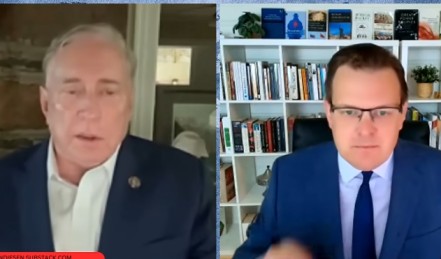
GLENN DIESEN: Yes, seemingly so. But what do you make of the shift by the United States though? That is all this talk, as you mentioned, about a no-fly zone. Again, perhaps it shouldn’t be exaggerated. It was more of a casual response. I don’t think he thought this one through at all. But also now licensing the manufacturing of Patriots to the Ukrainians, or these comments by Rubio that all these strikes into Russia are a good thing. I mean, does this signal in your mind a shift in the US, or is it just throwing a bone to the Europeans? Because as you said, the main objective of the Europeans appears to be to pull the US into a war now with Russia. Well, it’s already, I guess, in a war with Russia, but deepening its involvement.
And I guess towards this end, Europeans are willing to swallow any insults coming their way, if it’s about Spain or about Greenland or Meloni. Or as a journalist asked Mark Rutte, “Have you no self-respect?” Because we didn’t used to be this much of satellite states before, but I guess, yeah, it was quite remarkable. I mean, embarrassing, but remarkable. Anyways, my question was just, do you see a shift in US policy, or is this just talk? Because it’s hard to tell sometimes with Trump.
Poking the Cobra: Misjudging Moscow
DOUGLAS MACGREGOR: No, I think that’s a legitimate question. I said on one level it’s dangerous, very dangerous. You know, again, if you go back to Casablanca in January of 1943, this is where FDR suddenly announced his demand for unconditional surrender. And Churchill was shocked. And you can see the film, he sort of turns around, “What? We’ve never discussed that.” Even Stalin, who is by no means a humanitarian, Stalin was smart enough to say, “We think we should negotiate with these people. And we have contacts. And the Germans may be willing to come to some sort of a negotiated end to this. Why are you doing this?”
Well, FDR decided. He decided in isolation. He decided it looked and sounded good. And somebody said, “Well, where’d you get this?” And there was some confusion. Somebody said, “Well, U.S. Grant during the American Civil War, true American, unconditional surrender.” Why am I bringing that up? Because that’s Donald Trump. It’s off the top of his head. “Oh, I thought this was a good idea.”
Now, what do you do if you’re a Russian? That’s the question. And I think the Russians are taking all of this very seriously. And what have we continually done poorly? We have always misjudged Moscow. We have always dismissed them out of hand. We grossly underestimated them from day one. And even now, we continue to effectively dismiss them out of hand militarily. Now, how one could do that at this stage is incomprehensible.
But Glenn, I’m sure you’ve seen it. I see it all the time here in Washington. “Russians, they won’t do anything.” See, it’s the idea that you poke the cobra. And you poke the cobra. The cobra sits there but doesn’t strike. “See, he won’t strike.” And you poke the cobra. And eventually, what does the cobra do? He strikes. You die. That’s what we don’t get. That’s where we’re headed. That’s what we’re pushing for.
Bullying the Unbullyable: Losing Global Support
The other thing I think is that there’s a tendency on the American side to bloviate a great deal. To talk out of turn, to make promises we can’t keep, and when all else fails, we bully people. You cannot bully the Russians, you cannot bully the Iranians, you cannot bully the Chinese. Forget it, it’s over, it’s done. So what do you hope to achieve?
I think we’re losing a lot of support in the Gulf as well as in Europe from a lot of people. It’s not popularly appreciated or known here in the United States, but it’s real. I think that’s only going to get worse. So I’m afraid, I think it’s very dangerous, but I don’t think President Trump has any idea how dangerous his statements are and how foolish he looks in front of the world and how easily he’s being manipulated by the wrong people, whether it’s the Israelis or the Europeans. It doesn’t matter.
Economic Collapse and the Limits of Western Power
GLENN DIESEN: Yeah, well, I think this tendency to underestimate the Russians, it’s probably from the hegemonic peace. Because during the Cold War, we knew that we had to be cautious. But after the Cold War, when you have a hegemonic peace, by definition, if you’re going to— security depends on being so powerful, doesn’t matter what the Russians think. The whole logic is that it’s safe to ignore the Russians. Once one admits you have to take into consideration their concerns, you essentially recognize that the hegemonic era is over. So I think this is a leftover of the unipolar moment.
But the Europeans though, how are you reading their intentions or strategy? Because they keep making the point that we need to have an immediate ceasefire, peace. As soon as this is in place, we can put our troops in Ukraine, Ukraine a kind of NATO membership. Is this stupidity or belligerence? Are they seeking to prevent a peace or are they bought into their own war propaganda that this is an imperial war by Russia, has nothing to do with NATO expansionism? I mean, how are you assessing the Europeans there?
DOUGLAS MACGREGOR: Well, I don’t know what the average European who votes thinks. I have some inkling of it in Germany. My experience with most Germans is that they’re very unhappy with the government in Berlin. They don’t support all-out war against Russia. They’re much more concerned about the wave of criminality that has come into the country since 2015, thanks to all of these non-Europeans they have. They would like to rid themselves of that problem.
Beyond that, I can’t say too much. We know that Germany, and I would argue Great Britain as well, we could say that to some extent about ourselves, is deindustrialized. So they’re on the verge of economic collapse. The financial system won’t support them much longer. And people say, well, how can you say that? Well, all you have to do is look at the numbers of people that can’t find work in Germany. Look at the numbers of people who are officially on the dole, who are dependent entirely on checks from the government. I include in that number vast numbers of these unwanted migrants. Same thing is true in Great Britain.
What does war always breed? War breeds inflation. And right now, in order to cope, what are we doing? Well, we’re raising interest rates. We have no choice. We really don’t control them anymore. And if you look at the 10-year bond in the United States, which is very, very important, everybody, if you bring on anybody who is an expert in the bond market, whether it’s somebody like Gundlach, or Luke Gromen or any number of people and look at oil inflation and the bond market for the interest rates. Oil has already inched up to almost $80 a barrel. Now that the Straits are shut down again, they’re going to remain shut down for some period of time.
I don’t know how long that is. People think that we’re going to be on a yo-yo, pause this week, war next week, pause the following week, war the next week, so forth. The markets can’t cope with that. And eventually, all of the efforts undertaken by the financial gurus that surround Trump, his friends and billionaires in New York City, to suppress the cost of oil by shorting oil repeatedly, exploiting all these public statements at the right point in time, that’s going to fail. It’s not going to work anymore.
And when that does, if you look at the bond market today, the 10-year bond is up to something in the neighborhood of 4.5% or higher. Everyone I know tells me the same thing, and I’m not an expert on this, but I don’t think you have to be to figure this out. When that 10-year bond rate, interest rate hits 5%, we’re through. We cannot service the debt. We cannot borrow any longer. The destruction of credit, which is inevitable at that point, it’s going to bring everybody in the West down. And that’s where we’re headed right now.
A lot of people, including me, I thought Trump understood the danger, which is why I thought he made an intelligent statement when he signed the MOU. Everybody knows that that MOU is anathema to Donald Trump and his administration and to everybody in Washington. It’s essentially an admission that we are not the hegemonic power. That’s your point. We’ve surrendered. Everybody says, oh, it’s a surrender document. Well, what we’ve said is we’re not the hegemon anymore. And that’s perfectly, perfectly fine with me and most Americans because we don’t want to spend the money on that nonsense. It’s unnecessary. We don’t have to be the hegemon. We have to defend ourselves and our true interests.
But that’s not the attitude in Washington. So I think we’re going to hit that wall. We’re going to hit that 5%. It’s going to break and then we’re going to be in freefall. That’s going to bring everything to a screeching halt. Now, when does that happen? I don’t know. It could happen next month. It could happen at Christmas. It could happen in October, but I think we’re headed there. I don’t see how you stop it.
Europe’s Fragility and the Class War
DOUGLAS MACGREGOR: The Europeans, I think, don’t believe that. I think they believe that somehow or another magically we can rig the system and carry on with this enormous debt load. I don’t think so. I think the British, I used to think it would be the French, but beginning to think the British are the first to go under. You have to look at their gilt market. They have similar problems. They almost went under under Liz Truss. Everybody since Liz Truss has essentially been putting band-aids on the economy and on the financial system. That’s not going to last much longer.
Britain is very close to open warfare in the streets. I mean, you can only tolerate Pakistani rape gangs and other thuggish elements in your unwanted migrant population from hunting British citizens who are not armed until finally somebody says enough’s enough. So I think bad things are coming.
The other thing is this overlaps with not just economic disappointment, but with a very serious class war. And I think that’s true in much of Europe because the globalist elites are largely out of touch with the majority of people in the population. They don’t care. If you listen to people like David Betz, he’ll tell you that the people in Parliament don’t understand the world just 20 kilometers away. They have no idea what’s going on. I think that’s more and more the case in Paris. You have this sort of bureaucratic parasitic class that sustains itself and thinks that life will go on regardless. And they don’t care what happens to the population as long as they get to hold their position of authority and get their paycheck.
In the United States, it’s all the people that are invested in pension funds, which we’re borrowing against at a very high rate. And those people are going to lose everything. That’s my generation. These are the so-called boomers that have been paying into these things for years. All of this is going to happen. That is finally going to change everything.
But in the meantime, the danger is the stupid remarks we’re making about the things that we really cannot do, and if we try, we’ll fail, are essentially bait for the Russians. We’re baiting them. Prove that you’re serious. Prove that you can do this. And the one thing I would give President Putin great credit for is that he’s avoided taking the bait.
Russia’s Military Advance and the Drone Factor
DOUGLAS MACGREGOR: And he is progressing. I mean, somebody, I sat down the other day with someone who’s experienced in these Russian matters and understands the military and the problems they have. All militaries have problems, by the way, and the Russians have theirs. But along the forward line of troops that continues to advance westward, there’s no question about that. It’s slow because if it were not for these thousands of drones that have to be dealt with, I think things would be over in a few days. But when you finally create a cauldron and you surround it, it takes 2 weeks to reduce it, to destroy the people that are in there, and then move in, and then you move forward. But they’re getting closer and closer and closer to the edge.
But the drone is an irritant. It is not the strategic game changer that people in the West think it is. It’s a serious strategic irritant to Moscow. Their public is furious over it. The Russian people are sick of it. And so when Peskov comes out and says effectively the ceasefire is over, war is now, and this is not really new because we’ve been listening to many people, including Sergei Lavrov, say we’re already in World War III.
You know, that would have been enough for me had I been a Secretary of State or something to immediately go to the White House and say, look, we can’t allow this. We’ve got to sit down and talk with these people. The last thing humanity needs is World War III. Well, the Russians are prepared to fight it. We are not. And neither is Europe, as you know. The little Lilliputian armies aren’t going to be able to do anything. And when you look at the numbers of troops that we have on the ground, about 110,000, 113,000, maybe more, what are you going to do with that? And then you have to fuel it and sustain it and move it. You have to protect it against all these threats. We’re not prepared for any of that.
So what are we going to do? Rely on air power? Our air power is largely committed to the Persian Gulf and the war with Iran. I don’t know what is really on the backs of these people’s minds. I think most of the time it’s a bluff, but I do think there’s a certain amount of self-delusion that we are really the same power and in the same position as we were in 1991.
Are We Already in World War III?
GLENN DIESEN: Do you agree with that sentiment of Sergey Lavrov that we’re already in World War III, or are we heading there, or how do you see it?
DOUGLAS MACGREGOR: I think if I were in his position, viewing the things that are being done that are fundamentally antithetical to Russian national security, I would feel that way. On the other hand, I would be very interested in disabusing him of that thinking, and I would take concrete steps to reassure him. We don’t want to do that. We act as though we’re the only people that count, and whatever they think is irrelevant.
It’s this parent-child relationship that Trump attempts to establish everywhere he goes with everyone and the rest of the world. Well, I told them they have a chance and they want a deal. Well, if they want a deal, they’ll have to do what I say. Yeah, really, Mr. President? Haven’t you heard him talk about, oh, the Iranians are desperate. They want a deal. Well, guess what? The Iranians are in a full war footing. Are we? No. And if you’re going to fight them in the region where they live on their doorstep, you better think long and hard about what that means because you’re in for a long fight and a real war. And again, we’re not prepared for that. I don’t give a damn what he says publicly. We’re not. The Navy has now admitted that they have more launchers and more tubes for missiles than they have missiles to fire. It’s out in the open.
GLENN DIESEN: That’s kind of extraordinary. Yeah.
DOUGLAS MACGREGOR: Well, what are you doing?
The NATO Summit and the Renewed Threat Against Iran
GLENN DIESEN: About Trump though, this talking down to all these people. It’s not just Trump though. I think it’s also, again, part of the hegemonic order after the Cold War, that is, diplomacy was replaced with this teacher-student relationship. That is, we’re no longer doing mutual understanding for compromise. Rather, it’s the civilizational teacher telling the rest of the world how they should make unilateral concessions to be more like us. We continue to say these things, but the rest of the world isn’t listening anymore.
But I’m glad you mentioned Iran and all, because at this NATO summit, they didn’t only go after Russia. Trump was quite vocal about Iran, that is, he argued that the memorandum of understanding is dead, the ceasefire is over. He called the Iranian diplomats scum. Is the US now heading back into all-out war? Because as you said before, the assumption is often that we have this escalation control, we can do this yo-yo thing, we go to war, we do a pause, war, pause.
But the Iranians, they have their internal politics too, it seems. That is, their hawks are being proven right that their opponent wouldn’t abide by these deals. And at some point, why would they want to end the fighting if this off-and-on fighting is always on their opponent’s terms? I mean, at some point, they wouldn’t grant this escalation control to the US. Again, that’s why I’m a bit skeptical. I don’t see the strategic value in going back to war against Iran, not like this at least.
The War Against Iran: Strategy, Nuclear Threats, and Israeli Influence
DOUGLAS MACGREGOR: Well, first of all, this is a Jewish war waged against Iran. I say Jewish because it’s by no means exclusively Israeli. It involves the Jewish lobby here in the United States and the massive numbers of billionaires that constitute the backbone of it. They effectively own lock, stock, and barrel, not just Donald Trump, but the Hill.
Mr. Netanyahu, when he embarked on this war, this was a war to the finish. He was talking effectively from the very beginning in scorched earth terms. What I call the Mongolian way of war. Once the Mongols went to war with you, you were finished and they would do everything in their power to utterly eradicate you, leaving only enough people alive to pay tribute and govern in your absence.
I think that’s kind of what Mr. Netanyahu has always wanted. And if you look at the strategy for Russia, it’s the same strategy for Iran. “We’re going to destroy you. We’re going to cause the disintegration of your state and society. You will be divided and fragmented, and we will determine who ultimately rules.” That’s the Netanyahu program, not just for Iran, but for the Middle East. And you can either submit to that, or you can go down. And that was always the Mongolian answer. Join us or die. Submit or be destroyed.
We are executing on behalf of Israel. Mr. Trump is executing on behalf of Mr. Netanyahu and the people that put him into office. That’s where he is. Now, people say to me all the time, “Well, what’s going on, Doug? Why would he do this?” All I can tell you is I think the man’s under duress. I don’t know what it is, but this is not something that I remember him expressing much interest in. On the contrary, I remember him as being very disinclined to be involved in any of this in the Middle East. So it’s not just a tremendous change in him personally. There’s something else going on. And I think that we’ll learn more when Mr. Netanyahu comes to Washington next week. And there will be closer coordination and more planning.
Somebody said to me the other day, “The Israelis have privately made it clear that if for some reason we should disengage from the war, they will use nuclear weapons because that’s their answer.” Well, I don’t know what to say except that if they were to do that, that would be the end of the Israeli state once and for all. No chance whatsoever in my judgment for that state to survive. But I guess the answer is, “Okay, we understand and we don’t want that to happen, so we’ll do whatever you want us to do.” Perhaps that’s the answer that they’ve been getting. They certainly seem to get anything they want. They have access to anything they want, including intelligence, and now increasingly to our entire military potential. And no one on the Hill seems interested in obstructing. In fact, most of them are eager to turn everything over to them.
Then you have to look at the hundreds of millions of dollars that have been spent over decades to buy up these politicians. They own them now. At some point this can’t go on. Now, I keep saying, I think it’s the financial system and the underlying economic fundamentals, which are so weak, that will bring this to an end. I hope that happens before something worse comes along.
And of course, when you listen to President Trump and he is so capable of flip-flopping, I worry that he suddenly flip-flops in the wrong direction and says, “Well then, let’s use a nuclear weapon.” He said repeatedly he won’t do that. He thinks that’s insane. He’s repeated that publicly. He’s repeated it within the last couple of months. But then we’ve seen him say a lot of things, turn around and do a 180-degree turn, right? And that’s what he’s just done on the MOU.
But in fairness, the MOU was never acceptable to us, because we were surrendering hegemony. We don’t want to do that. And we’re not going to prevail upon the Israelis to do anything because they’re the ones who seem to have control over us. I mean, I don’t know how else to interpret it. Do you?
GLENN DIESEN: Well, I didn’t expect the US to implement the MOU. I mean, this whole idea of paying all this money in reparations, unfreezing the assets, ending all sanctions — it wasn’t in the cards. I think it was impossible to do as well. But I thought that the US would gradually just string the Iranians along, try to renegotiate, say, “Oh, we can’t pay any reparations because Congress,” something just to open up the Strait of Hormuz and put an end to this on more favorable terms.
But going back into war now, in which that would only harden the Iranian position — yeah, it does, as I said, it doesn’t make any sense strategically at least, unless they have something up their sleeves I’m not aware of. But when it comes to Trump’s new threats now, because he was making the point, “We attacked Karg Island, but we might seize it as well.” How do you make sense of this? Because again, there must be a reason why they didn’t do it in the last two rounds. Why would it go to this extent now? Or is this again just talk?
Special Operations Failures and the Limits of Military Force
DOUGLAS MACGREGOR: Well, you remember the operation in Isfahan where we tried to insert special operations forces with considerable air support and expertise from the CIA and so forth, on the grounds that they were within range of plutonium that could be acquired and then spirited out of the country. That ended in disaster. It was covered, or concealed if you will, by this supposed officer who had been shot down that had to be recovered. That was kind of a cover story.
And what we discovered was that in a part of Iran where we thought they would be vulnerable, they didn’t turn out to be vulnerable. And so once again, it was a question of: have we underestimated the regime? Have we underestimated the military establishment, its various systems, human and remote? Well, I guess we did.
And I think a number of people said — in fact, I know they did — they were grateful that this happened because it put an end to the fantasy that we could replicate what we did in Venezuela. Remember, Venezuela worked because we bribed everybody in sight. But even so, as someone with a lot of experience in that area told me, “Doug, you know that all these operations are very fragile and failure is only one RPG away. All you have to do is hit one helicopter that’s flying by with an RPG or a high-powered machine gun, automatic cannon, something, and you have a disaster on your hands.” That’s what people don’t understand.
Special operations forces have remarkable capabilities, but they also have extraordinary limitations. They depend on a degree of accurate information and intelligence in a way that nobody else does. If you’re in the regular fighting force, before you go and execute a mission, you don’t say, “I’m sorry, I can’t do that mission because I don’t have perfect information. There are too many risks involved. We’ll probably get killed because there are too many enemy out there.” That doesn’t exist. You get the mission, you go, end of discussion.
But special operations forces know their own limitations very well. Especially my experience with the Army Special Ops — very realistic people. And so I think a lot of them were relaxed after they saw this fail, but we avoided heavy casualties and got out. So I think that was taken to mean, “Look, you want us to go into an island that’s very dangerous. We could probably get there. I don’t know if we’ll get there without losses, but if we do, what do we do? We’re in the island. Do we dig giant holes and jump into them and wait for somebody to rescue us? We’re just going to be a pincushion for every ballistic missile and unmanned system that’s out there.”
You do have people that have talked about seizing Chabahar port because it’s outside of the Gulf, in the theory that if you gained control of that, that would give you leverage over Iran. I haven’t quite figured out what that leverage is strategically. I think the Iranians would probably take the Russian position: “Well, if they’re going to seize Chabahar, we’ll defend it if we can, but if we can’t, we’ll make sure they seize nothing.”
So then are you going to use the ruins of Chabahar as your launch pad for penetrating Iranian airspace once again with helicopters and V-22s to take control of, say, Bandar Abbas? Or are you going to try and fly from the UAE right across the Gulf? And I think everybody’s saying, “Wait a minute, if you’re looking for something clean, decisive, and effective, this may not be a good option.”
But I don’t know who’s there. You’ve listened to General Kellogg and General Keane. I think they would probably support any of those options. They’ll do whatever, in order to widen this war in the hopes that by doing so they can bring Iran to its knees. I don’t see that happening.
Turkey and Israel: A Growing Rivalry
GLENN DIESEN: Yeah, I noticed Trump called — he removed Syria from this list of state sponsors of terrorism, at least he said he would, at the same summit. So I’m not sure if that is intended to widen the war, but I did want to just follow up on something you said earlier. This is that the Israelis now see Turkey as a growing threat. What is it about Turkey and Israel that, that doesn’t make war unavoidable, but at least sets them on a path to more conflict?
Turkey, Nuclear Deterrence, and the Future of Regional Power
DOUGLAS MACGREGOR: In 2013, I was invited to a conference in Israel that celebrated the anniversary of the ’73 war, and it was a very good conference. I learned a great deal. And of course, I was writing a book at the time, and I covered the Egyptian front of the ’73 war. And I got to meet some interesting people who were in it. And that’s always best to talk to somebody who’s actually in those things.
But while I was there, I was asked to brief, talk about the future, and I had a slide about Turkey. Now, this is posted on the internet. If you want to Google my name, you can see the presentation I gave. And at the time I told them, I said, “Don’t misinterpret America’s desire to disengage its forces from much of the region as evidence for lack of support for Israel. We will help you defend yourselves. Absolutely.”
The problem is everybody’s now realized we’re not helping them defend themselves. We’re helping them kill everybody that they don’t like. There’s a huge difference between defense and that sort of thing.
But I put a slide up about Turkey and said, Turkey has been through, and Türkiye is the way they want you to say it now, through a rather profound but steady evolution away from the Atatürk model, which was fundamentally secular and rather Euro-oriented, European in its orientation insofar as modernization was concerned. That’s over. The Turks have discovered their roots. Their roots are not in Europe. Their roots are in the Middle East and Central Asia. They are different in terms of religion, culture, language, and race. And they are now celebrating that as opposed to suppressing it, because they perceived that Atatürk, who is still widely revered and for good reason, was a brilliant man, was seen as suppressing those things that cannot be suppressed. It’s unnatural.
You know, it would be like suggesting that all the Norwegians abandon their Norwegian citizenship and Swedes do the same, embrace each other and live in the giant Scandinavian state. Not likely to happen.
So I think the Turks have come around to the point that they have other obligations. They are a great power. They are not weak and they should have a greater say in what goes on in this region. And for a very long time, and I’ve had these discussions with Turkish officers, they said, “What are you doing in Turkey? You don’t need to be here anymore. You don’t need nuclear weapons here. We don’t have bad relations with the Russians. We don’t want bad relations with the Russians.”
I think there’s a view that the region can do without us. And they frankly are looking at the Sunni Islamic countries and they’re saying, “We should have better relations with them and we should be prepared to help and support them in the future.” I think the Pakistanis and the arrangements that they’ve now made with the Saudis are just the beginning of that. I think you’re going to see more integration and cooperation militarily aimed at defending the Islamic world — against outsiders, not just Israelis, but anybody who wants to come in and rule.
And that’s why in that 14-point memo, it says no more U.S. bases in the Persian Gulf. It’s time for you to get out. You’re finished here. And they make that point. I’m somebody who agrees with them. I think we ought to get out.
But an awful lot of what we have and what we do, as we’ve discussed before, Glenn, is mortgaged to vanity. You know, by the time the British Empire was liquidated, there were a lot of people saying, “Gee, we held on to that for a long time. We should have gotten out earlier.” Absolutely. At some point you’ve extracted all the benefits you’re going to get. And I think we should go. That’s not necessarily a criticism of us. It’s in the nature of the world.
But I think that is where we’re headed. And the Turks fit in with that. And they also have interests that diverge sharply from NATO and sharply from the EU and sharply from us. Doesn’t mean we have to have a war, but it means we have to respect it.
GLENN DIESEN: But why would Turkey be more of a concern, say, than Saudi Arabia for the Israelis?
DOUGLAS MACGREGOR: The Saudis couldn’t conquer anybody.
GLENN DIESEN: Fair enough.
Turkey’s Military Capability and the Nuclear Threshold Question
DOUGLAS MACGREGOR: The Turks can. And the Turks can put a million men into the field in 30 days. And they have modern weapons. They have their own industrial base. They can build their own weapons and equipment. And remember, you’ve heard Erdogan say this publicly. He wags his finger: “Don’t lecture us, Netanyahu. Don’t tell us what you have. We know what you have and we’re not afraid.” What’s he talking about? Nuclear weapons. Because the Turks have always known for years that they could turn to Pakistan if they needed a nuclear weapon.
What we don’t seem to get is both the Turks and the Iranians and others see value in being what I would call a potentially nuclear threshold state, but not being a nuclear state. You know, if you don’t have to have a nuclear weapon, why do you want it? It’s more trouble than it’s worth. But you want to be in a position where if you need it, you can be a threshold state.
Unfortunately, by our behavior, the way we’ve approached things in Iran, I think we’re making it increasingly likely that many, many states will now develop, build, and establish nuclear weapons. In other words, we’re achieving the very opposite of what Donald Trump continues to harp on. They may never have a nuclear weapon. Okay, good luck with that, Donald, because everything we’ve done has sent an unambiguous signal: you’re fools if you don’t build one.
But I don’t think even now they really want it. I certainly wouldn’t. I wish we had none of them on the planet, frankly. We’d be better off.
GLENN DIESEN: Yeah, I think that’s become, or will become, the new nuclear deterrence. That is, if you develop the nuclear weapons, you incentivize others to get them as well. But to be these nuclear threshold states — that is, if Israel attacks Iran with a nuclear weapon, the Israelis know that the Iranians can build a few by the end of the week. I think this will essentially be sufficient, a middle road, to have the deterrence without the proliferation.
DOUGLAS MACGREGOR: I can’t remember the gentleman’s name right now. Maybe you’ll remember. But the Frenchman who developed and built the French nuclear deterrent force was asked by a visiting US Army officer, “Well, how many nuclear weapons do you think you really need?” And he smiled and he said, “One.” He said, “One?” He said, “Of course. These things are so damaging. They’re so destructive. One is enough.”
Well, there’s a lot of truth and wisdom in his statement. You don’t need very many.
Now, the Russians, for various reasons — and this is back to where we began — why is it so dangerous when someone like Sergei Lavrov, who is a very, I would call him one of the more balanced, thoughtful men in international relations today. In the old 19th century, we would point to him as the sort of dean of the diplomatic community. He would be viewed in those terms as Bismarck was at one point, Gorbachev, and Nesselrode, who was also the czar’s representative. And before these people, you had many others. But the point is that these were professionals who had spent years, if not decades, in these communities. And when they spoke, everyone listened, because they had the reputation for integrity, accuracy, and seriousness. And they were educated men.
So when I hear him, that really should get everyone’s attention. It doesn’t, because those things that I just mentioned are not respected in Washington. If they were, most of the people sitting there wouldn’t have a job.
GLENN DIESEN: Yeah. Well, I think it was de Gaulle who made the comment that a nuclear weapon only needs to impose unacceptable damage. It’s a bit like the Swiss strategy during the Second World War. They didn’t need deterrence by denial. All they needed to do was make sure that it would be too painful for the Germans to take Switzerland. So that kind of puts a limitation on how many nukes you need, I guess.
ISR Strike Capability and the Path to Peace
DOUGLAS MACGREGOR: Yeah, and I think the nice thing is that this ISR strike capability — intelligence, surveillance, reconnaissance matched to strike weapons — demonstrated by the Iranians suggests that most middle-sized and smaller powers can build that, and impose exactly what you’re talking about. The cost becomes suddenly so high, let’s forget it. That’s not the way forward. Let’s talk. We’re learning this lesson the hard way.
GLENN DIESEN: Well, that’s historically been the source of peace, though. When the weapons favor defense as opposed to offense, then you usually have some period of stability. But anyways, thank you very much for taking time out to share your perspective. Thanks again.
DOUGLAS MACGREGOR: Sure, thank you, Glenn.