

Why Dallas Cowboys won’t keep World Cup grass pitch at AT&T Stadium
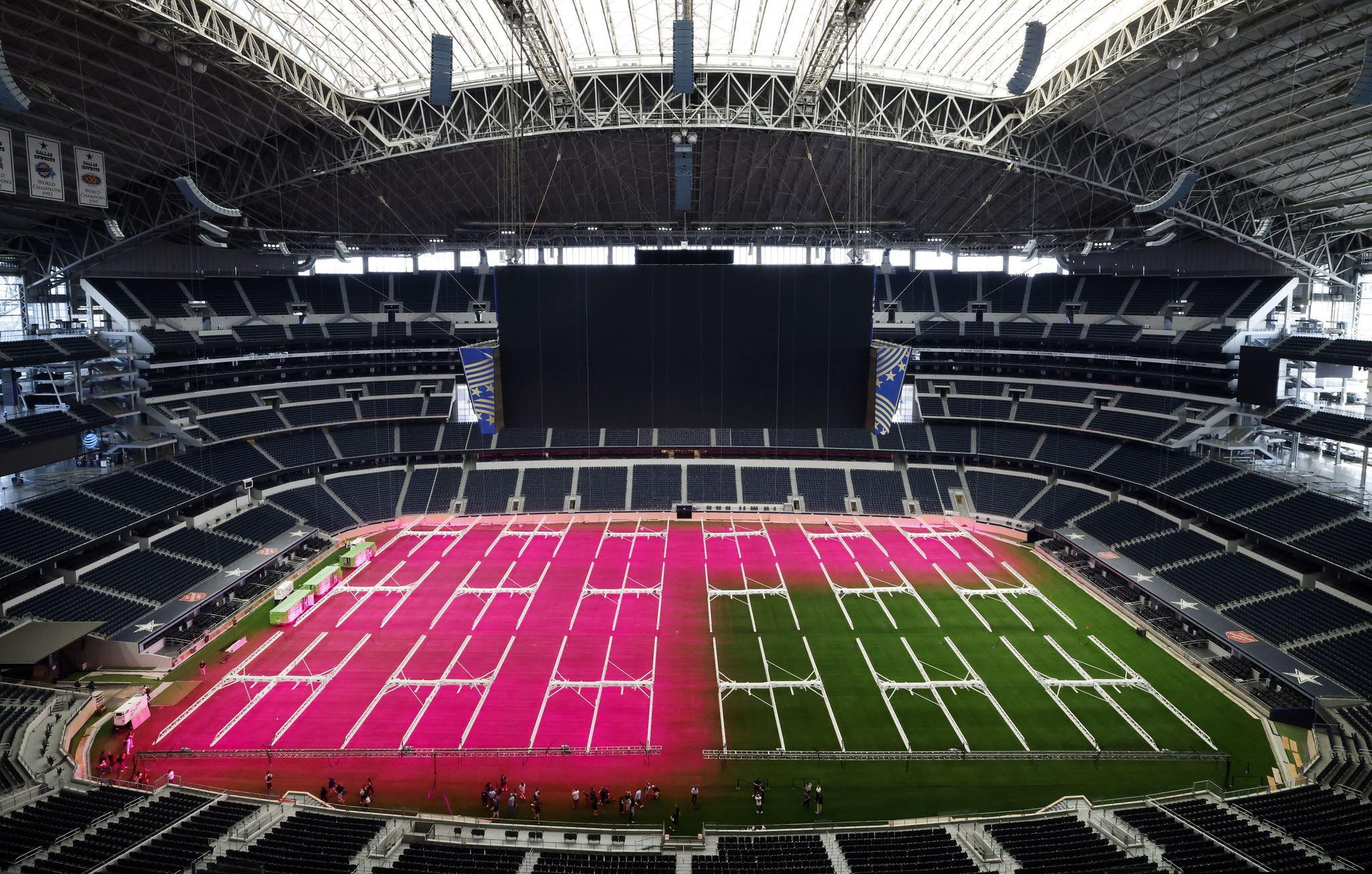

The pink glow of specialized LED grow lights illuminates the mats of sod laid inside of AT&T Stadium, May 14, 2026.
After the final whistle blows July 14, ending the last FIFA World Cup match at Dallas Stadium, crews will begin ripping up the nearly 10,000 square yards of turf to prepare for the Dallas Cowboys’ upcoming season.
According to stadium general manager Tod Martin, AT&T Stadium’s transformation for the World Cup took roughly 45,000 hours and the hauling of around 15,000 tons of materials. Researchers across the United States also spent years perfecting the field in accordance with FIFA’s pitch guidelines.
The hybrid turf, a mix of two grass varieties reinforced with plastic fibers, will be replaced with artificial turf. This news comes despite positive reception from World Cup players, a 2024 NFL Players Association survey reporting 92% of the league’s players wanted to play on grass fields, and research suggesting artificial turf may be more dangerous for athletes.
Article continues below this ad
The research behind the turf grass
Eight of the 16 World Cup venues, including Dallas Stadium, typically use artificial turf. Instead of permanently converting their fields, these stadiums installed temporary hybrid systems.
FIFA allocated $5 million to research, develop and produce the fields for the 2026 World Cup venues, and an Avengers-level team of turfgrass researchers was assembled to develop terrain in accordance with FIFA’s strict standards.
The researchers, led by Trey Rogers at Michigan State University and John Sorochan at the University of Tennessee, ran extensive experiments to determine what types of grass would make for the best playing surfaces, all while accounting for differences in climate, humidity and temperature across stadium locations to ensure consistent turf conditions.
Article continues below this ad
“The main thing was it needed to be produced quickly, so we wanted a bluegrass-dominant system,” Rogers said. Rye grass, he said, was added because the turf was being grown on plastic and needed to grow faster than a 100% Kentucky bluegrass pitch would.
The mixture of these two grasses was ultimately selected for Dallas Stadium’s pitch.
The researchers also performed a series of tests, sometimes developing their own equipment, to see how various turf combinations responded to players’ movements.
One of Sorochan’s team’s inventions is the fLEX, a portable device outfitted with a 3D-printed foot in a soccer cleat that mimics the same motion, impact and acceleration of an average men’s World Cup player and measures the amount of energy absorbed by the turf and returned to the player.
The field used in Dallas was grown in Colorado on a thin layer of sand atop a plastic sheet. This caused the roots of the grass to grow in a dense mat that could be sliced and rolled up for transport, similar to a large, grassy rug.
Article continues below this ad

LED grow lights, designed to stimulate photosynthesis and accelerate turfgrass growth, are pictured being used at AT&T Stadium in May on the freshly laid pitch for the upcoming FIFA World Cup matches at the stadium.
These large rolls of turf were transported approximately 800 miles to North Texas, where they were transplanted and reinforced with plastic fibers, which act as anchors for the natural roots and help stabilize the field.
LED grow-lighting systems, fans, elevated pitches and alternative roof configurations were also used in stadiums to help maintain the fields after installation, ensuring the roots have room to grow and the grass has adequate light and water.
Why the debate?
The debate as to whether artificial or natural turf is better for sports has been going on for decades.
Article continues below this ad
“There’s a lot of differences between natural grass and artificial grass, from the playability standpoint to the environmental standpoint,” said Agustin Boeri, an assistant professor and turf extension specialist at Texas A&M University, who was not involved in FIFA’s turf research.
Natural turf has environmental benefits, but it requires maintenance such as LED grow lights and irrigation systems, Boeri said. Synthetic turf is often promoted for its lower water usage and increased durability, he said, which makes it a good option for situations where there is a lot of heavy use, or in shaded areas like closed stadiums.
“Synthetic turf, in some ways, is easier to maintain,” Boeri said. “That doesn’t mean that it doesn’t require maintenance. It does.” Artificial turf periodically needs to be replaced, and comprehensive measurements need to be taken to ensure the depth is even throughout.
Compared to its natural counterpart, synthetic turf has been linked to more ankle and knee injuries due to it having a less cushioned surface.
Article continues below this ad
Running across artificial turf, Rogers said, causes a lot more stress on players’ bodies. “If you run on grass versus on asphalt, which one’s easier on your body?”

Dallas Cowboys quarterback Dak Prescott (4) races to the goal line for a fourth quarter touchdown against the Washington Redskins defense at AT&T Stadium in Arlington, Texas, Thursday, November 22, 2018. Dak kept the ball after not being able to find a receiver. The Cowboys defeated the Redskins, 31-23. (Tom Fox/The Dallas Morning News)
Tom Fox/Staff PhotographerSome research suggests an increased risk of brain trauma on artificial turf due to the greater impact deceleration, or the sudden loss of momentum experienced by a player after an impact. But the data on artificial turf’s effect on concussions is inconclusive.
The NFL Players Association also advocates for the use of natural grass for both practice and game fields, citing NFL injury data showing a higher contact injury rate on artificial turf and an overwhelming preference among football players for natural grass.
“You look at FIFA, they’ll roll out the green carpet for soccer players, and that’s become the norm,” said NFLPA executive director JC Tretter on the Not Just Football podcast hosted by Pittsburgh Steelers defensive lineman Cam Heyward. “Over in European leagues, that is what you do. You play on grass. They have surface standards that each thing is rolled out. It’s exactly how it’s supposed to be. And those players will not play if it’s not that.”
Article continues below this ad
When asked in March if the Dallas Cowboys would keep the natural turf for their upcoming NFL season, owner Jerry Jones said no.
“We have no belief that it’s any safer to play on grass over turf,” Jones said. “We are ambiguous as to the safety of it.”
Niamh Ordner is a science reporting fellow at The Dallas Morning News. Her fellowship is supported by the University of Texas at Dallas. The News makes all editorial decisions.
Crédito: Link de origem