

China is chasing an asteroid that may not be a piece of the Moon after all
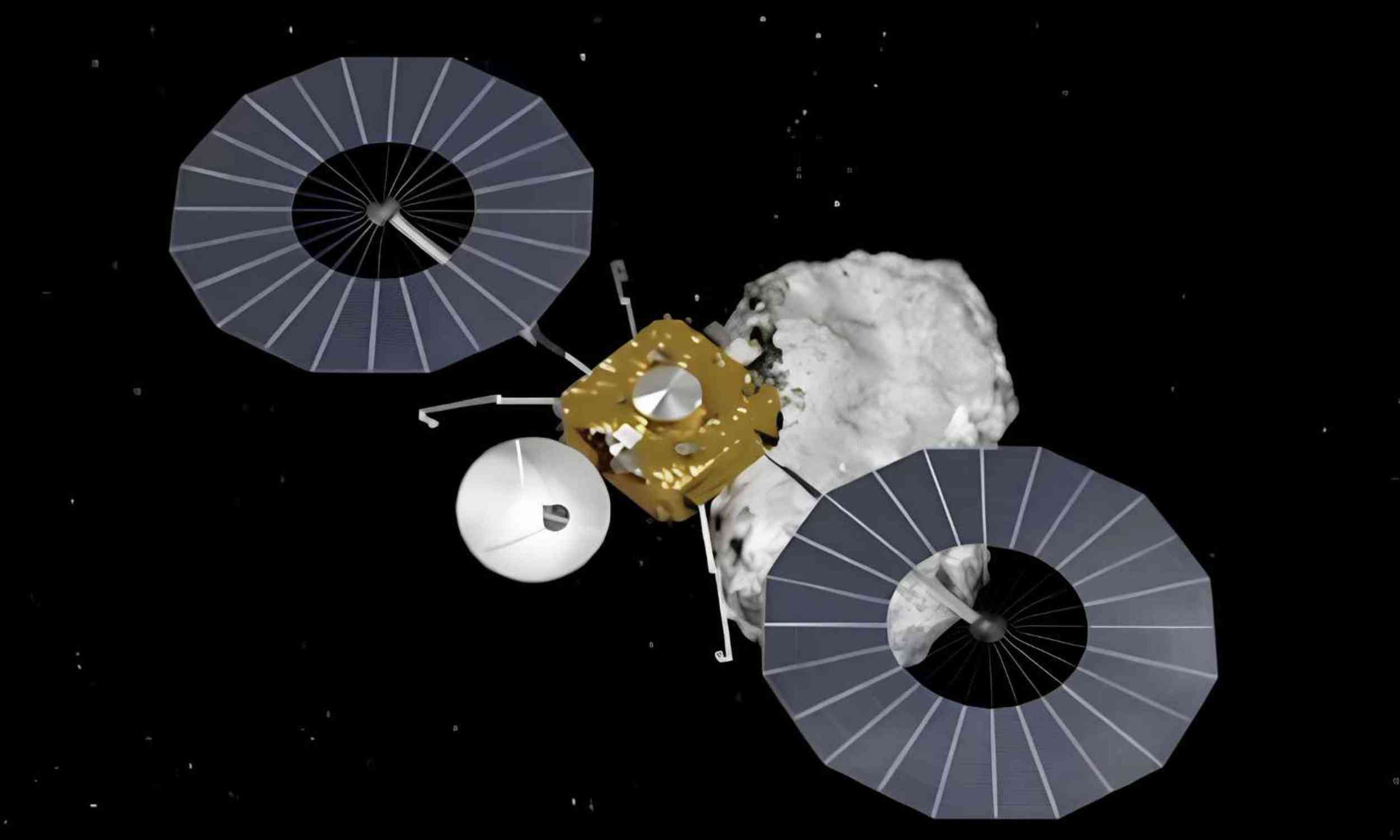
China is preparing to collect a sample from a small near-Earth asteroid that many scientists suspect is a fragment of the Moon.
The leading theory traces the object back to a crater on the lunar far side, where an ancient impact may have blasted the fragment into space. A new study now challenges that idea.
Researchers argue that the asteroid’s unusual red color, long treated as evidence of a lunar origin, can be reproduced in the laboratory without any Moon material at all.
A rock worth chasing
The target is a near-Earth asteroid called Kamoʻoalewa, a quasi-satellite that orbits the Sun while remaining close to Earth.
It measures less than about 330 feet (100 meters) across and completes a rotation roughly every 28 minutes.
China launched the Tianwen-2 sample-return mission in May 2025, and the spacecraft is now approaching the asteroid with plans to collect material and bring it back to Earth by late 2027.
Previous research had linked Kamoʻoalewa to lunar rock, raising the possibility that it originated on the Moon.
Yang Li, a planetary scientist at the Institute of Geochemistry at the Chinese Academy of Sciences, led a team that took a fresh look at the asteroid’s reflected light.
Reading reflected light
Every mineral leaves its mark on the light it reflects. Where a surface dims at certain wavelengths, researchers can determine which minerals are present and roughly how abundant they are.
Li’s team reanalyzed that reflected light and found a characteristic dip in the spectrum. It lines up more closely with LL chondrites, a common, low-iron class of stony meteorites, than with lunar rock.
But the color was strange and extremely red, far redder than fresh stone. Earlier researchers had interpreted that color as a sign of the Moon, since little else matched it.
Burning rock with lasers
Here the team did something that earlier studies had skipped. They took a real LL chondrite meteorite, ground part of it up into fine powder, and hit it with a rapid-fire laser.
The laser stood in for space weathering, the slow battering of an airless surface by the solar wind and tiny meteorite strikes over millions of years.
After that simulated weathering, the powder changed dramatically. Pale grains went dark and their brightness dropped to about a quarter of their starting value.
That mineral dip shrank and the color reddened until it matched Kamoʻoalewa almost exactly.
Until this experiment, there was no lab proof that ordinary stony rock could weather all the way to such an extreme red. A solid slab never achieved this, but loose powder did.
Not so rare
If weathered meteorite dust can look like Kamoʻoalewa, the asteroid may not be the oddball it once seemed.
In response, the team combed large catalogs of measurements for other extremely red, rocky bodies.
They found a few silicate-rich asteroids that were just as red, scattered across both near-Earth space and the main belt.
The previous argument had leaned on a thin catalog. With far more asteroids now measured, the case for a lone lunar fragment weakens, and the case for a weathered rock grows.
Tracing it home
Composition is only half of the puzzle. If the rock isn’t lunar, it had to come from somewhere. An earlier model had named a launch site – the young crater Giordano Bruno on the Moon’s far side.
The team ran its own orbital simulations. One model assumed nothing about composition. It resulted in a roughly a seven-in-ten chance the rock escaped through a gravitational gap in the inner belt that funnels objects toward Earth.
A second version, told to assume LL chondrite, zeroed in even further. Four in five odds the rock came from the Flora family, from an old cluster deep in the inner main belt.
Neither run allowed the Moon as an option, so the team stays careful. They are not declaring the lunar idea dead, only showing a main-belt birthplace fits just as well.
Cousin to Itokawa
One name kept surfacing. Itokawa, the stony asteroid Japan’s Hayabusa probe visited and sampled in 2010. Lab analysis of those returned grains tied Itokawa firmly to LL chondrites.
Kamoʻoalewa’s reflected light looks like a more extreme version of Itokawa’s. It has the same recipe, a redder color, and a shallower dip.
The team interpreted it as the same rock, only weathered harder and far longer. Seven objects from the Flora family share the same basic composition as Kamoʻoalewa.
Rocks that wander close to Earth age faster than those that stay farther out. Kamoʻoalewa, by that logic, is a battered older sibling of rocks still sitting safely in the belt.
The sample decides
Until now, the choice between Moon and meteorite rested on how the asteroid’s light looked.
This study adds lab evidence that weathered stony rock can mimic that appearance, along with orbital tracks that trace back to the asteroid belt.
The question reaches beyond one rock. Small, fast-spinning asteroids like this are the most numerous near-Earth objects, yet we barely know how their surfaces age.
When the capsule lands in 2027, it will carry something no mission has brought back before, material from a body this small and this fast-spinning.
Whatever is inside answers the question directly, if it is lunar fragment, or battered rock from the asteroid belt.
The study is published in Nature Communications.
—–
Like what you read? Subscribe to our newsletter for engaging articles, exclusive content, and the latest updates.
Check us out on EarthSnap, a free app brought to you by Eric Ralls and Earth.com.
—–